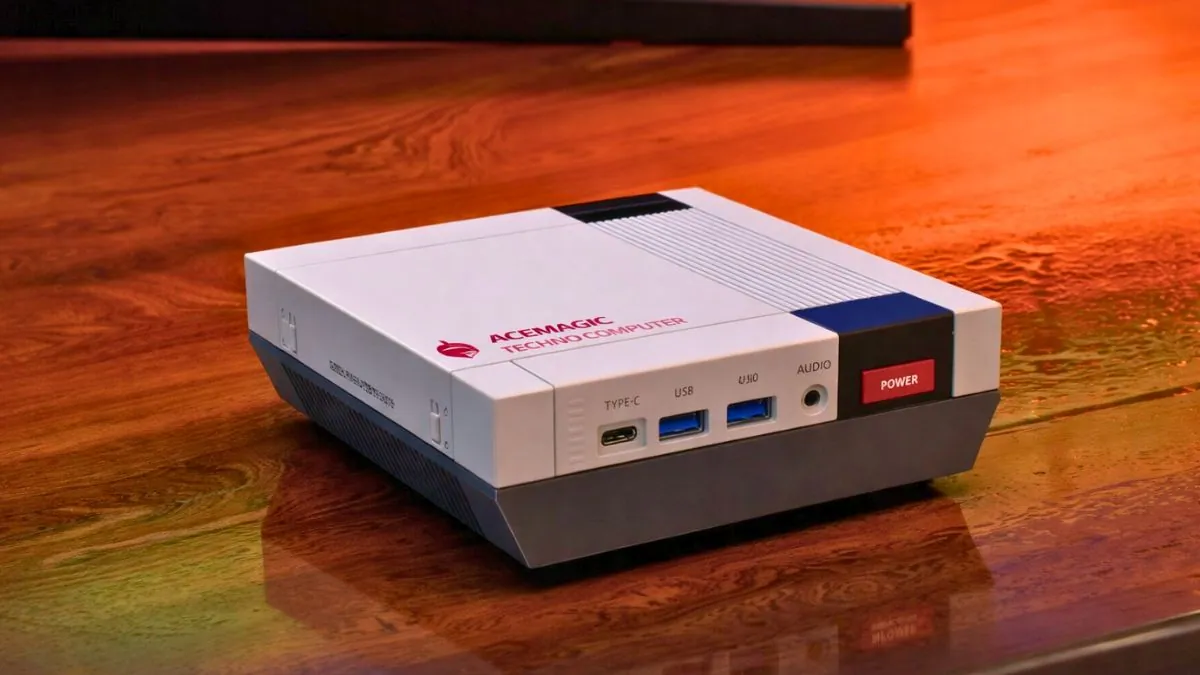
ACEMAGIC has officially launched the Retro X5 mini PC in China, introducing a Ryzen AI 9 HX 370-powered desktop in a Nintendo NES-inspired chassis. The compact system pairs AMD’s latest Strix Point architecture with Radeon 890M graphics and up to 80 TOPS of combined AI compute, positioning it among the most powerful AI-focused mini PCs currently shipping.
Priced at 6,499 yuan ($940) for the 32GB RAM and 1TB SSD configuration, the ACEMAGIC Retro X5 blends retro console aesthetics with modern AI acceleration hardware. While availability is currently limited to China, the system is already drawing attention for bringing AMD’s flagship Ryzen AI 9 HX 370 processor into a compact desktop form factor.
At the core of the Retro X5 is AMD’s Ryzen AI 9 HX 370, a 12-core, 24-thread Zen 5 processor with boost clocks reaching up to 5.1GHz and 24MB of L3 cache. Built on the Strix Point platform, the chip integrates CPU, GPU, and a dedicated neural processing unit (NPU) into a single advanced APU package.
Graphics are handled by the Radeon 890M, based on RDNA 3.5 architecture with 16 compute units running up to 2900MHz. While integrated, the 890M represents one of AMD’s most capable iGPUs to date, targeting light-to-moderate gaming and GPU-accelerated creative workloads rather than discrete-class AAA performance.
On the AI front, the XDNA 2 NPU delivers up to 50 TOPS of dedicated neural compute. Combined with CPU and GPU acceleration, total AI compute reaches up to 80 TOPS a figure that places the Retro X5 among the highest-performing AI mini desktops currently available.
Compared to earlier Ryzen 7040-series systems and many Intel Core Ultra mini PCs, the Retro X5 represents a generational leap in on-device AI acceleration, particularly in dedicated NPU throughput.
Mini PCs were once limited to office, HTPC, or basic productivity roles. The Retro X5 reflects a broader industry shift toward AI-native compact desktops capable of local inference, generative AI processing, and developer workloads.
As operating systems and creative applications integrate more on-device AI features, including background image generation, transcription, summarization, and local model inference, hardware with 40–50+ TOPS NPUs is becoming increasingly relevant. The Retro X5’s 80 TOPS combined AI capability positions it for edge AI experimentation, local generative AI workloads, virtualization labs, software development, and privacy-sensitive enterprise deployments.
Also Read: ACEMAGIC RX16 Laptop: Full Specifications and Benchmarks
Rather than simply branding AI into a traditional desktop, ACEMAGIC is shipping hardware aligned with emerging AI-first software ecosystems.
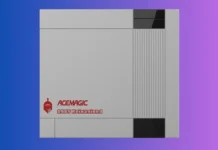
Visually, the Retro X5 mirrors the original Nintendo Entertainment System with a gray-and-black dual-tone chassis and rectangular console styling. The cartridge slot area has been replaced with modern I/O, preserving the retro aesthetic while adapting it for contemporary use.
Front ports include USB Type-C, two USB Type-A ports, a 3.5mm audio jack, and a prominent power button. At the rear, the system provides HDMI 2.1, DisplayPort 2.0, dual 2.5Gb Ethernet, additional USB 3.2 ports, and USB-C connectivity. The device supports up to four simultaneous displays and includes Wi-Fi 7 and Bluetooth 5.4 for next-generation wireless performance.
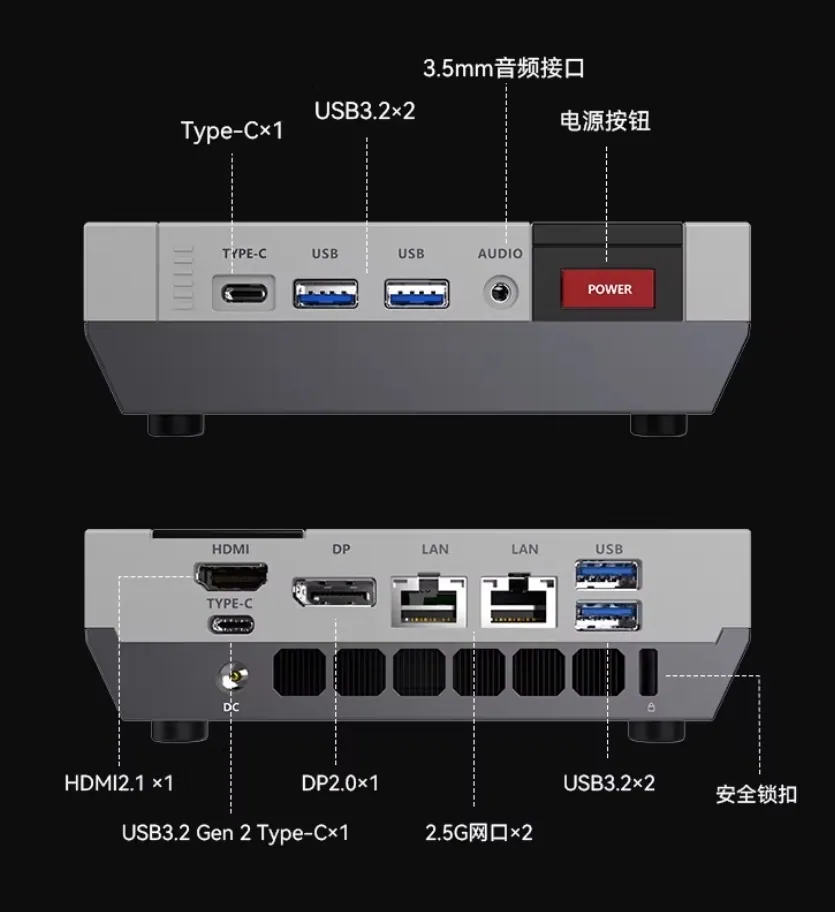
Memory scalability extends up to 128GB DDR5 in dual-channel mode, while storage expands to 4TB via PCIe 4.0 SSD. However, only the 32GB + 1TB configuration is currently listed for sale.
ACEMAGIC advertises an upgraded cooling solution for the Retro X5, but standardized noise and sustained load temperature metrics have not yet been disclosed. Thermals will ultimately determine how effectively the Ryzen AI 9 HX 370 maintains boost clocks under prolonged workloads.
In laptops, the HX 370 operates within constrained thermal envelopes. A mini PC chassis may allow for improved sustained performance, though real-world benchmarks will clarify long-duration behavior under AI and CPU-intensive tasks.
For gaming, the Radeon 890M should handle esports titles and lighter modern games at respectable settings. However, buyers expecting discrete GPU-class AAA performance may find its strengths better aligned with creative acceleration and AI-assisted workflows.
At approximately $940, the Retro X5 sits above entry-level mini PCs but below many premium gaming laptops built around similar silicon. When evaluated on AI compute density, the cost-per-TOPS metric is competitive relative to other Strix Point systems currently available.
The pricing indicates that ACEMAGIC is positioning the Retro X5 toward power users and developers rather than purely nostalgia-driven buyers. Support for up to 128GB of DDR5 memory and dual 2.5Gb Ethernet connectivity further aligns the system with workstation-oriented workloads within a compact desktop form factor.
The NES-inspired design adds emotional appeal, but the hardware beneath it is clearly engineered for modern AI and productivity workloads.
As Windows and productivity software expand local AI features and enterprises explore on-device inference for privacy and latency reasons, mini PCs equipped with dedicated NPUs may become foundational infrastructure rather than niche enthusiast hardware.
For now, the ACEMAGIC Retro X5 remains limited to China, with no confirmed international launch timeline. If global expansion follows, its combination of Ryzen AI 9 HX 370 performance, Radeon 890M graphics, 80 TOPS AI compute, expandable DDR5 memory, modern I/O, and distinctive retro design could help it stand out in an increasingly competitive AI mini PC market.
ACEMAGIC Retro X5- Key Specifications
| Processor | AMD Ryzen AI 9 HX 370 (12 cores / 24 threads, up to 5.1GHz) |
| Architecture | Zen 5 (Strix Point) |
| L3 Cache | 24MB |
| GPU | Radeon 890M (RDNA 3.5, 16 Compute Units, up to 2900MHz) |
| AI Engine | XDNA 2 NPU (up to 50 TOPS) |
| Total AI Compute | Up to 80 TOPS (CPU + GPU + NPU combined) |
| Memory | 32GB DDR5 (expandable up to 128GB, dual-channel) |
| Storage | 1TB PCIe 4.0 SSD (expandable up to 4TB) |
| Networking | Dual 2.5Gb Ethernet |
| Wireless | Wi-Fi 7, Bluetooth 5.4 |
| Display Outputs | HDMI 2.1, DisplayPort 2.0, USB-C (supports up to four displays) |
| Operating System | Windows 11 Pro |
| Price (China) | 6,499 Yuan (~$940) |
Source: realVictor_M(X)