
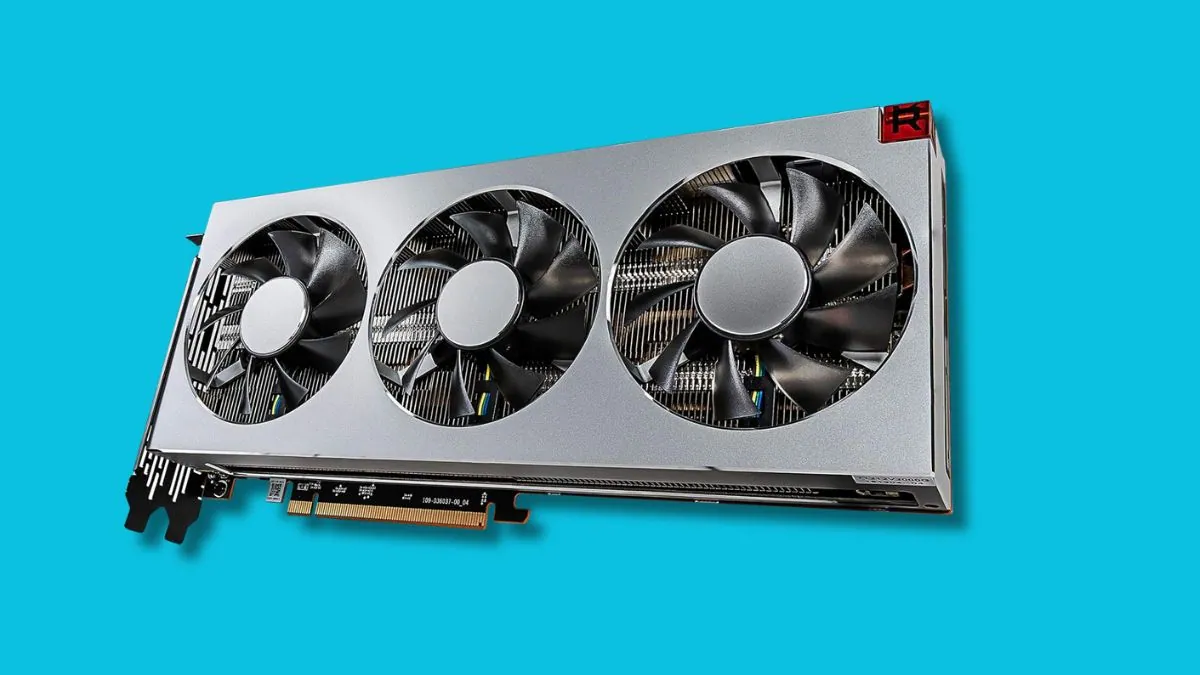
AMD’s Radeon VII reached its seventh anniversary this week, marking seven years since the company introduced its first 7-nanometer GPU for gamers. While the card’s commercial lifespan was brief, its long-term importance far exceeded its market performance and helped shape the strategic direction that now defines AMD’s modern graphics lineup.
The Radeon VII launched on February 7, 2019, following an unexpected debut at CES earlier that year. AMD positioned the card as a technological milestone, pairing a 7-nm Vega 20 GPU with 16 GB of HBM2 memory and up to 1 TB per second of memory bandwidth, specifications that were unprecedented in the consumer gaming segment at the time.
The Radeon VII was never a conventional gaming-first product. The GPU originated from a compute-focused design intended for professional workloads and was repurposed to demonstrate AMD’s early transition to 7-nm manufacturing. That decision delivered extreme memory throughput and strong raw compute capability, but it also introduced trade-offs that would ultimately define the card’s reception.
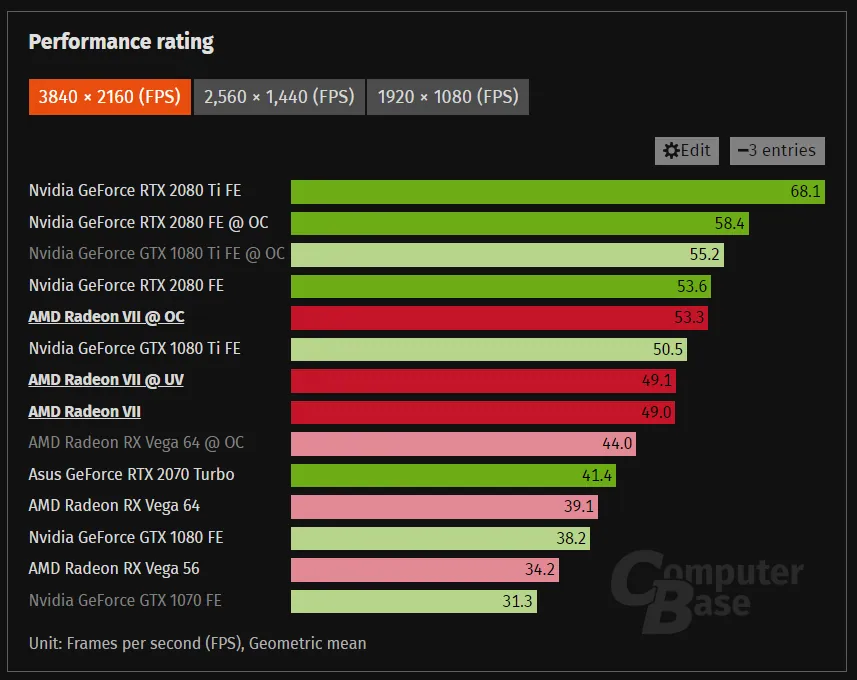
Updated benchmark averages confirm that the Radeon VII still falls short of Nvidia’s GeForce RTX 2080 in traditional rasterized gaming. In recent 4K tests, AMD’s card typically delivers around 49 frames per second, while the RTX 2080 comes in closer to 54 frames per second. That puts the Radeon VII roughly nine percent behind in like-for-like scenarios. Mild overclocking can trim the difference, but it doesn’t meaningfully alter the card’s overall standing.
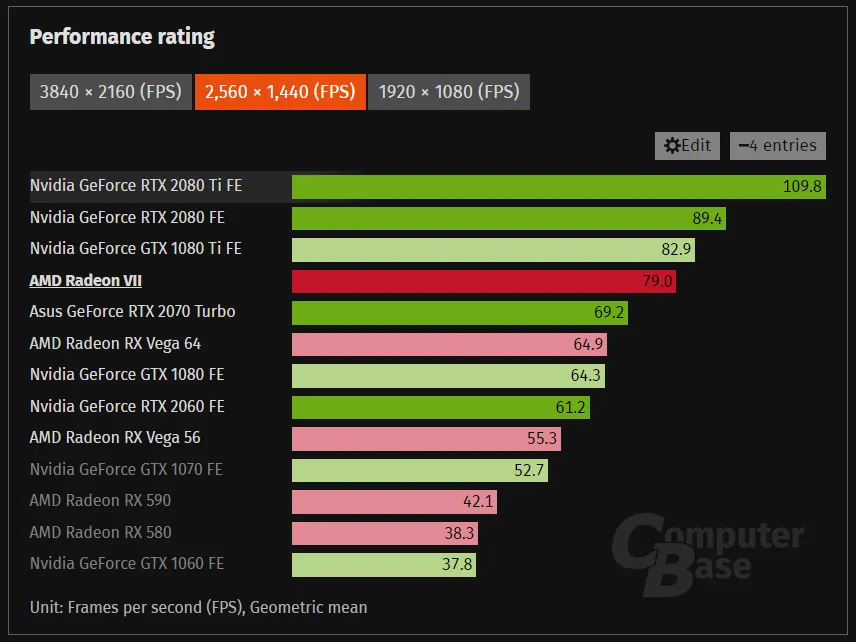
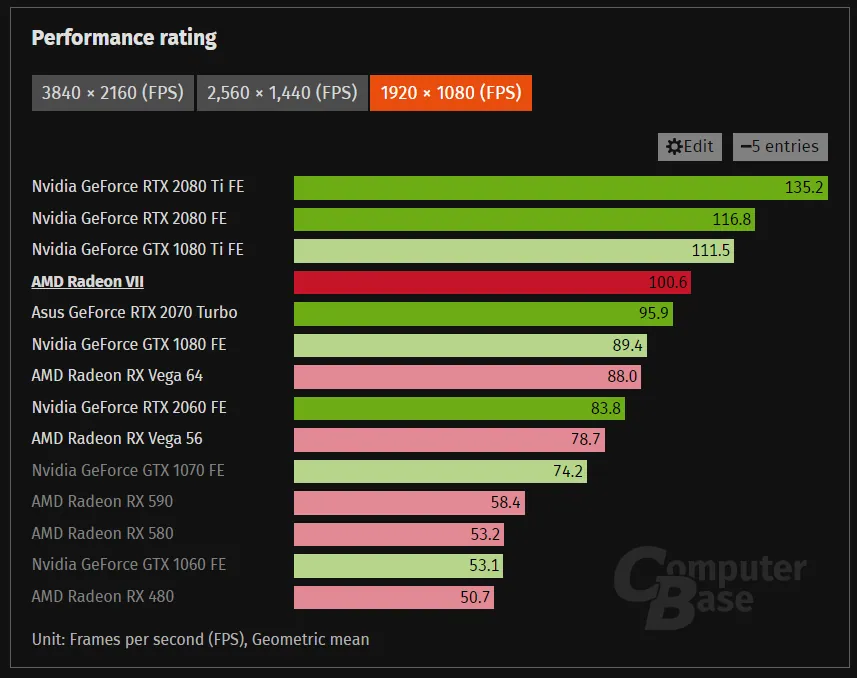
Beyond raw performance, efficiency, and acoustics shaped much of the real-world experience. With a 300-watt power target and a reference-only cooler, the Radeon VII was notably loud under sustained load. Many owners relied on undervolting to reduce noise and power consumption, often achieving substantial gains in performance per watt. While effective, this reliance highlighted how narrowly tuned the card was at stock settings.
The Radeon VII’s aging has been defined less by its compute capability than by its missing platform features. The absence of hardware ray tracing and a competitive upscaling solution became increasingly limiting as modern game engines adopted those technologies as standard. While competing GPUs benefited from years of iterative software improvements, the Radeon VII lacked a comparable upgrade path to extend its relevance.
Also Read: GPU vs CPU for Gaming
AMD discontinued the Radeon VII in August 2019, less than six months after launch, as the company redirected resources toward the RDNA architecture. The decision reflected a strategic course correction rather than a simple product failure. The Radeon VII validated AMD’s 7-nm capabilities while confirming that the Vega architecture could not scale efficiently for the future of gaming.
Seven years later, the Radeon VII occupies a distinct place in GPU history. It stands as AMD’s last and most extreme expression of Vega in the consumer market and a reminder that bandwidth and compute alone cannot guarantee longevity. Its influence lies not in how long it lasted, but in how decisively it cleared the path forward for AMD’s modern graphics strategy.
Source: ComputerBase