

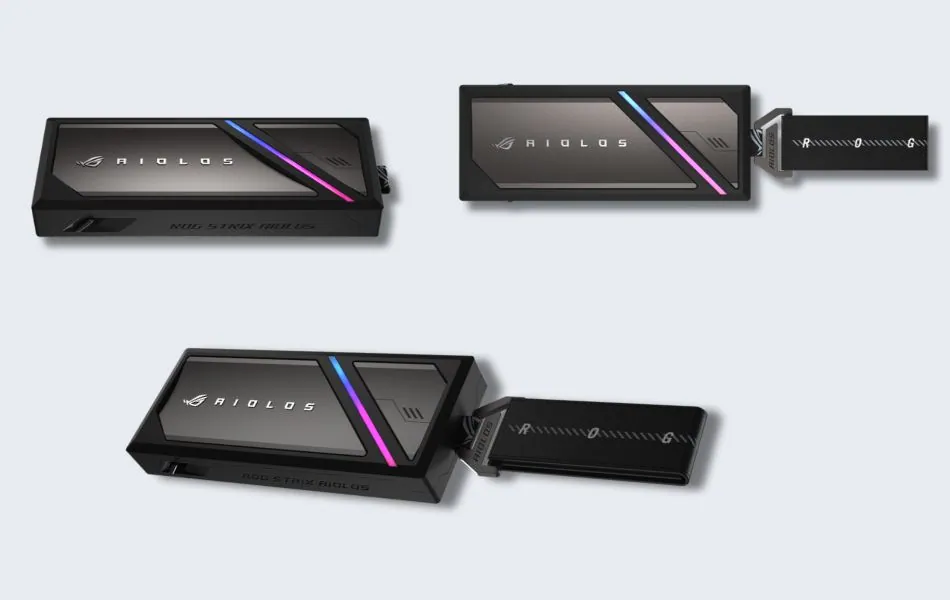
ASUS has unveiled the ROG Strix Aiolos, a next-generation external SSD enclosure that significantly raises the bar for portable storage performance by adopting USB 3.2 Gen 2×2 connectivity with transfer speeds of up to 20Gbps.
Positioned as a clear evolution of ASUS’s earlier ROG Strix Arion, the new enclosure targets gamers, creators, and power users who increasingly rely on high-speed external storage for modern game libraries, high-resolution media workflows, and data-intensive applications.
The ROG Strix Aiolos is designed to support both NVMe PCIe and M.2 SATA SSDs, giving users flexibility to reuse existing drives or upgrade storage without locking into a single standard. This broader compatibility reflects a practical shift in the market, as many users still own high-capacity SATA M.2 drives from older systems that remain viable for secondary or portable storage use.
ROG Strix Aiolos vs Previous ROG SSD Enclosure
| Feature | ROG Strix Aiolos | ROG Strix Arion |
|---|---|---|
| Interface | USB 3.2 Gen 2×2 (Type-C) | USB 3.2 Gen 2 (Type-C) |
| Maximum Bandwidth | Up to 20Gbps | Up to 10Gbps |
| SSD Support | NVMe PCIe + M.2 SATA | NVMe PCIe only |
| Tool-Free Installation | Yes | Yes |
| RGB Lighting | Aura RGB | Aura RGB |
| Target Use | Sustained high-speed portable storage | Compact NVMe enclosure |
Beyond peak transfer rates, ASUS is emphasizing sustained performance rather than short burst benchmarks. The enclosure integrates an internal high-efficiency thermal pad alongside a heat-resistant liquid-silicone-rubber outer coating to manage temperatures during extended file transfers. This design is intended to reduce thermal throttling, a common limitation in compact high-speed enclosures when handling large game installs, system backups, or long video exports.
Software integration is another differentiator. The ROG Strix Aiolos works with the ROG SSD Dashboard, which provides real-time visibility into drive health, temperature, and performance metrics through a dedicated interface. This added layer of monitoring is designed to improve reliability when users install third-party SSDs that can vary widely in endurance and thermal behavior.
Also Read
SSD vs HDD: What’s the Difference?
Ease of use and portability remain central to the product’s design. The enclosure features a tool-free push-open mechanism for quick SSD installation or swapping, reducing friction for users who regularly move data between multiple systems. Customizable Aura RGB lighting is included for personalization, while a reinforced metal hook paired with a fabric tag highlights ASUS’s focus on durability and travel-friendly design.
From a physical and connectivity standpoint, the ROG Strix Aiolos supports 2242, 2260, and 2280 M.2 SSD form factors, connects via USB-C using the USB 3.2 Gen 2×2 standard, measures 115.5 × 46 × 15.12 mm, and weighs 139 grams. These specifications position it as compact enough for everyday portability while still allowing sufficient thermal headroom for sustained workloads.
The product arrives as portable storage continues to play a more critical role in modern computing. Game install sizes now routinely exceed 100GB, while 4K and 8K video production, AI datasets, and local content creation increasingly depend on external drives that deliver both speed and flexibility. At the same time, many laptops and small-form-factor PCs offer limited internal upgrade options, pushing demand toward high-bandwidth external solutions.
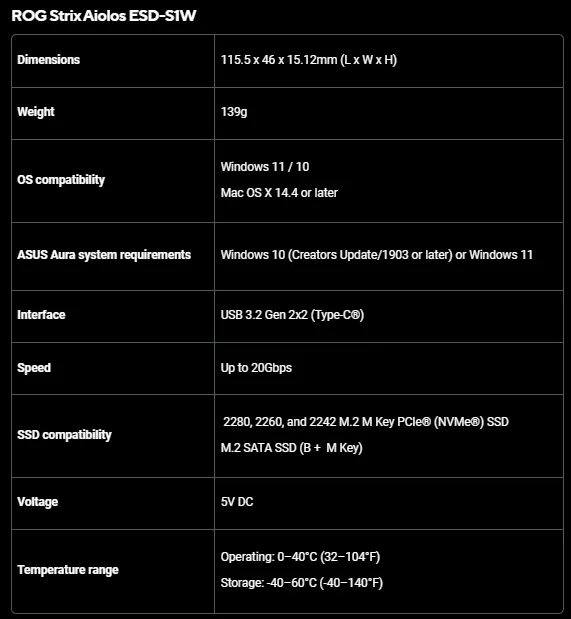
ASUS has not yet disclosed pricing, availability timelines, or independent performance benchmarks for the ROG Strix Aiolos. However, based on its feature set, expanded compatibility, and focus on sustained throughput, the enclosure appears positioned firmly in the premium segment of the external SSD market.
As USB4 adoption remains uneven across devices, high-bandwidth USB 3.2 Gen 2×2 enclosures like the ROG Strix Aiolos are increasingly emerging as a practical middle ground—offering near-USB4-class speeds without requiring next-generation hardware.
Source: Asus