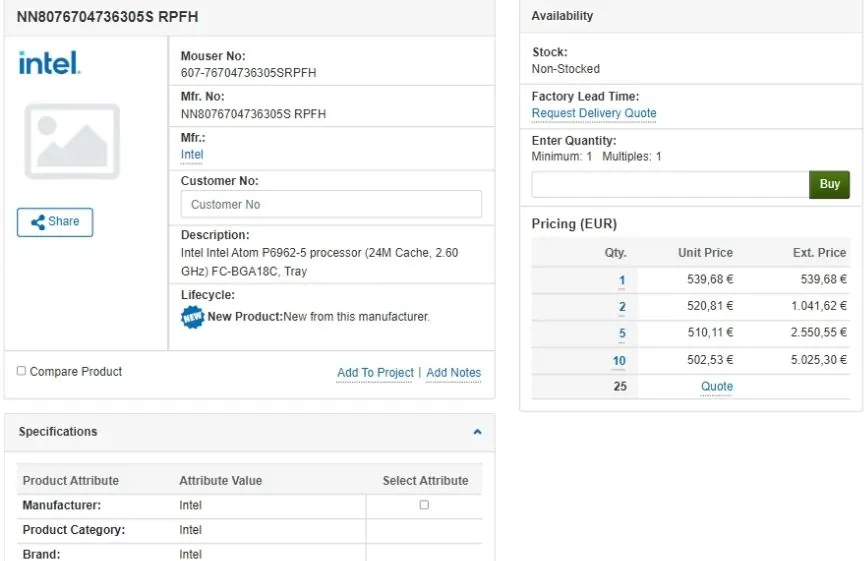
A new product listing on Mouser Electronics has revealed detailed specifications for the Intel Atom P6962-5, providing the clearest indication yet of Intel’s next-generation networking silicon for 5G base stations and edge infrastructure deployments.
The processor appears under part number NN8076704736305S RPFH and is listed as a new product requiring factory lead time, suggesting it’s intended for enterprise and telecom customers rather than the consumer retail market.
“807670” Confusion Clarified
The recent appearance of the number 807670 had caused some confusion online, with speculation that it might represent an unusually high price. The Mouser listing confirms that this number is simply part of Intel’s internal ordering code, not a price figure.
According to Mouser, the Atom P6962-5 is priced in line with enterprise networking hardware rather than server-class CPUs:
- Single-unit price: €539.68 (approximately $570 USD)
- Bulk pricing: For orders of ten or more, the price drops to approximately €502 per unit (approximately $530 USD)
This places the chip significantly below the cost of server-class processors, reinforcing its role as a specialized infrastructure component. Key Specifications as Listed by Mouser
The distributor listing provides several technical details that were not previously clear:
- Model: Intel Atom P6962-5
- Clock Speed: 2.60 GHz
- Cache: 24 MB
- Package: FC-BGA18C
- Integration: Soldered, board-level deployment
- Availability: Not in stock, factory lead time required
The 2.60 GHz frequency is quite high for an Atom-class processor, emphasizing that this chip is designed for consistent throughput and efficiency rather than consumer workloads.
Built for Telecom and Edge Systems, Not Consumer PCs
Despite the Atom branding, Intel’s P-series Atom processors serve a very different purpose than laptop or desktop CPUs. These chips are typically used in:
- 5G radio access network equipment at base stations
- Network switches and routers handling high packet throughput
- Edge computing platforms that process data closer to the source
By using Atom cores instead of a full Xeon design, Intel delivers lower power consumption, easier cooling, and greater reliability, all of which are crucial for outdoor, remote, and always-on infrastructure environments.
Also Read: How to Improve Laptop Battery Life?
Why This Matters for Network Infrastructure
The Atom P6962-5 fits into Intel’s broader strategy of supplying purpose-built silicon to telecom operators as they expand their 5G and edge deployments. While these processors rarely receive customer-facing announcements, they form a critical layer of modern mobile and data networks.
The appearance of this chip on Mouser indicates that Intel’s Parker Ridge-class silicon is nearing widespread deployment, even if it remains largely invisible to end users. Xeon vs. Atom P-Series in Simple Terms
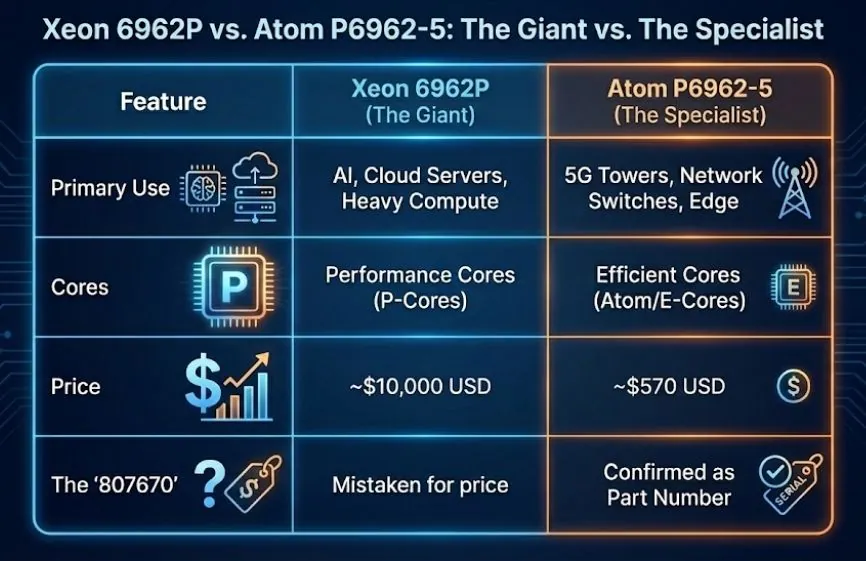
Primary Use Cases
- Xeon Processors: Cloud servers, AI workloads, heavy computing
- Atom P-Series: 5G base stations, network switches, edge systems
Key Focus
- Xeon: Performance-oriented cores
- Atom P-Series: Power-efficient cores optimized for throughput
Typical Price
- Xeon: Server-class processors in this category typically cost several thousand US dollars
- Atom P6962-5: Approximately $570 USD based on distributor pricing
“807670” Reference
- Xeon: Not applicable
- Atom P6962-5: Confirmed as an ordering code, not a price
A Quiet but Important Infrastructure Release
The Atom P6962-5 appears to be a quiet infrastructure launch aimed at system integrators and telecom vendors rather than the consumer market. While it will likely never appear in a gaming PC or laptop, it plays a crucial role in supporting the global 5G rollout and edge computing expansion.
For network engineers and embedded system designers, this chip represents a compact, power-efficient solution designed to handle the increasing demands of modern data traffic.
Source: Mouser Electronics