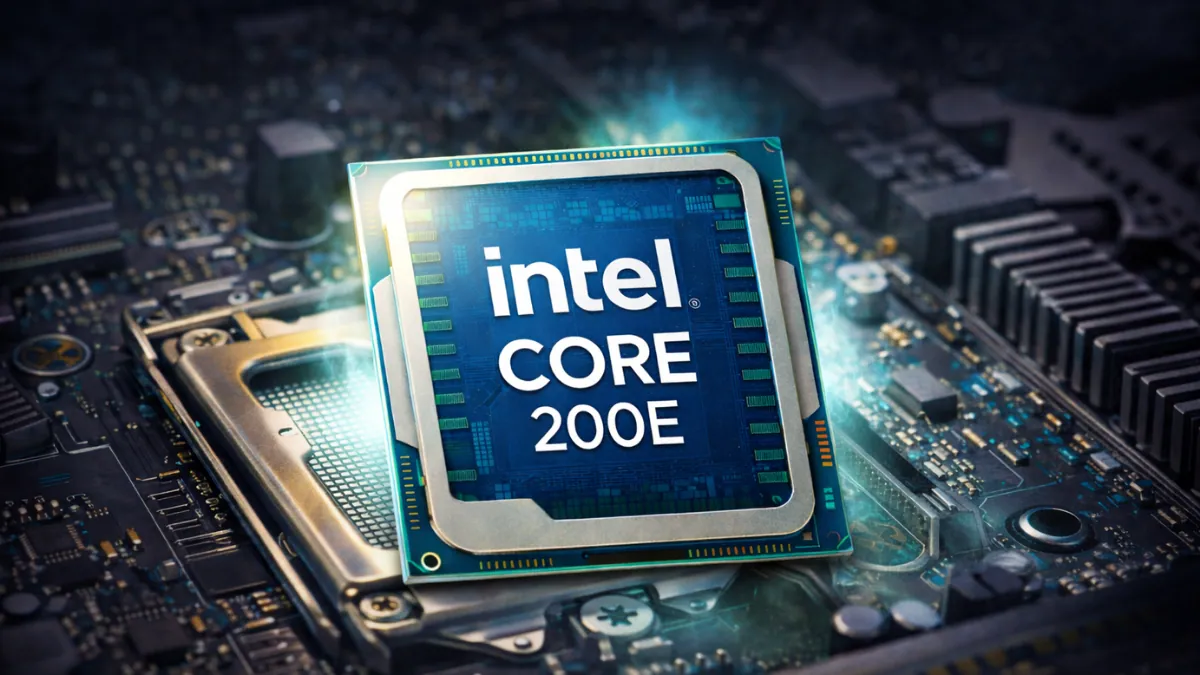
Intel’s upcoming Core 200E “Bartlett Lake-S” desktop processors have appeared in a detailed leak, revealing up to 12 performance cores and boost speeds as high as 5.9 GHz on the LGA 1700 platform. According to information shared by hardware leaker Jaykihn on X, this lineup is not meant to be a typical gaming refresh.
Instead, it is designed mainly for embedded systems and edge computing use cases. The leak also suggests that Intel plans to keep the LGA 1700 socket alive beyond Raptor Lake Refresh, which makes sense for long-term industrial and commercial deployments.
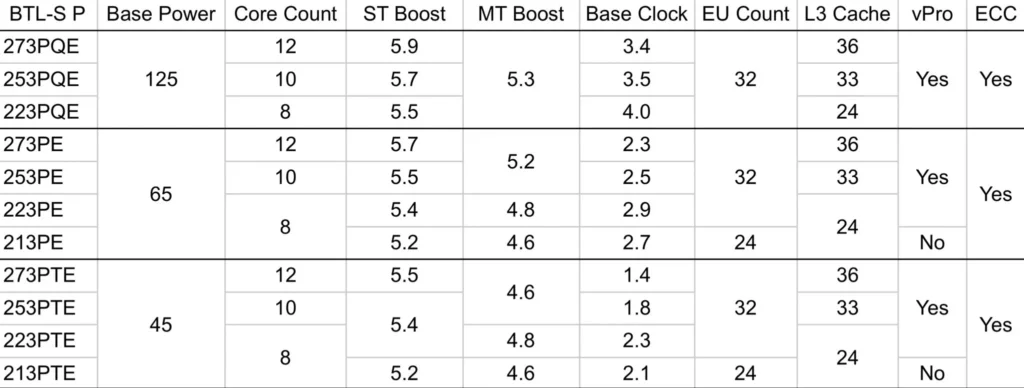
The lineup includes models rated at 125W, 65W, and 45W. The Core 9 273PQE sits at the high end with 12 performance cores, 24 threads, and 36MB of L3 cache, reaching up to 5.9 GHz on a single core. The 65W Core 9 273PE and 45W Core 9 273PTE keep the same 12-core design but lower their maximum boost clocks to 5.7 GHz and 5.5 GHz to fit tighter power limits. This configuration delivers one of the highest all-performance-core counts seen on the LGA 1700 platform.
Moving down the stack, the Core 7 253 series includes 10 performance cores and 20 threads with 33MB of L3 cache. The 253PQE can boost up to 5.7 GHz at 125W, while the 65W and 45W versions run at slightly lower turbo speeds to match their thermal targets.
In the Core 5 range, the 223 and 213 models offer 8 performance cores and 16 threads, paired with 24MB of L3 cache. Boost clocks can reach up to 5.5 GHz depending on the specific model. Across the entire lineup, cache sizes scale logically with core count, similar to what was seen in the Raptor Lake generation.
One major difference compared to Alder Lake and Raptor Lake is that Bartlett Lake-S removes efficiency cores completely. Every chip in the Core 200E series uses only performance cores, meaning there is no hybrid core setup. This simplifies thread scheduling and could make these processors more predictable for industrial and embedded workloads.
This design choice is particularly relevant for real-time operating systems, deterministic industrial workloads, edge inference applications, and legacy enterprise software stacks that may not be optimized for heterogeneous core topologies. A uniform P-core layout simplifies validation, scheduling predictability, and long-term software support.
The suffix naming convention appears to directly reflect power segmentation. PQE models align with 125 W base power, PE models target 65 W, and PTE models are optimized for 45 W embedded deployments.
Integrated graphics configurations vary between 32 and 24 execution units, depending on SKU tier, while several models indicate support for ECC memory and Intel vPro. ECC capability is especially significant for industrial automation systems, networking appliances, edge servers, and mission-critical deployments requiring memory error correction over extended lifecycle periods.
From a platform perspective, Bartlett Lake-S represents a strategic extension of the LGA 1700 ecosystem rather than a transition to a new consumer socket. While Arrow Lake and newer architectures are expected to move to updated platforms in the mainstream desktop space, embedded customers often require seven to ten years of platform continuity.
By introducing new Core 200E desktop processors compatible with LGA 1700, Intel can serve industrial OEMs without forcing a motherboard redesign or chipset migration.
Architecturally, Bartlett Lake-S is widely expected to leverage mature Raptor Lake performance cores manufactured on Intel 7 process technology. There are no indications of new microarchitectural changes, suggesting this series is a targeted derivative optimized for deployment stability rather than feature expansion. The emphasis appears to be on validated silicon, predictable thermals, and long-term availability rather than peak consumer innovation.
In real-world use, the 45W 12-core models like the 273PTE could fit well inside compact industrial PCs, edge AI systems, telecom hardware, and security appliances where low heat output and stable performance matter more than peak power. On the other hand, the 125W 273PQE, with boost speeds close to 6 GHz, may suit embedded workstations or edge servers that need strong single-core performance without the added complexity of hybrid cores.
Even though these chips use the LGA 1700 socket, motherboard support is not guaranteed across all boards. BIOS updates and manufacturer validation will decide which systems can actually run them. Early signs suggest support may focus mainly on Q-series and industrial-grade motherboards rather than enthusiast Z-series models, which could limit availability in the DIY retail market.
Overall, this lineup appears aimed at businesses that require long-term platform stability. By combining high clock speeds with a performance-core-only design and enterprise features such as ECC and vPro support, the Core 200E Bartlett Lake-S series seems built for industrial, networking, and edge deployments rather than mainstream consumer desktops.
If the leaked specifications are accurate, this series could become one of the strongest P-core-only desktop families released on LGA 1700, offering high frequencies and extended platform support for commercial and embedded environments.
Source: jaykihn (X)