
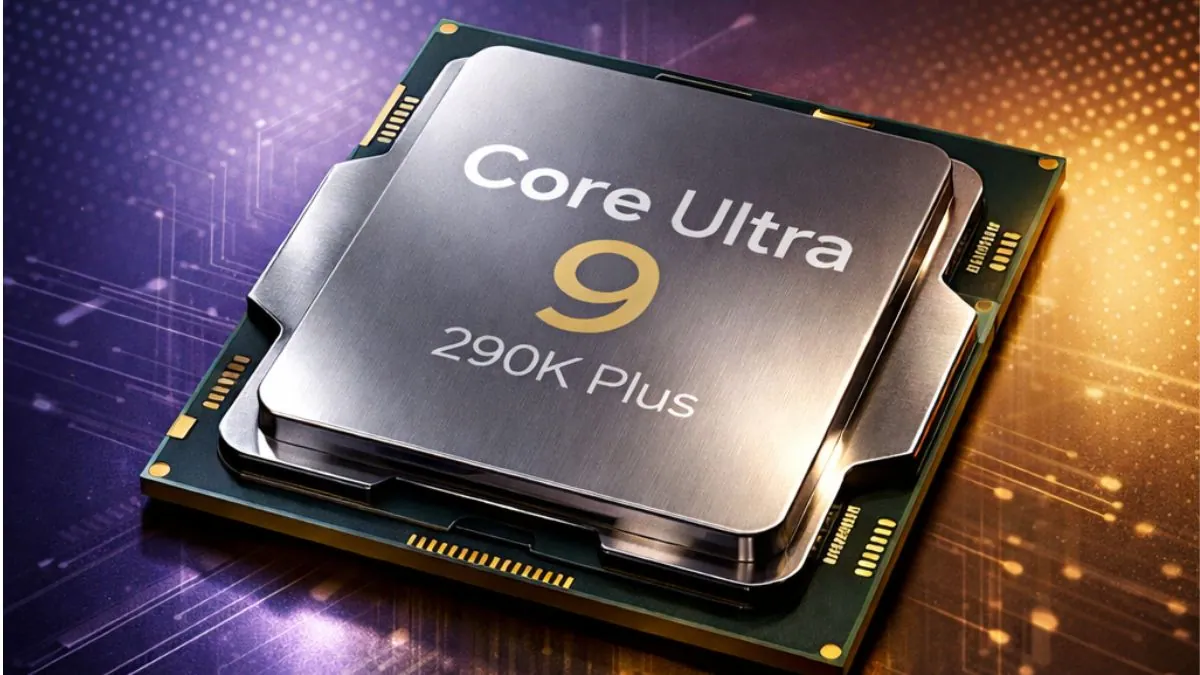
Intel’s upcoming Arrow Lake Refresh desktop lineup is shaping up to deliver a measurable performance uplift, according to a newly surfaced Geekbench 6 benchmark leak.
The flagship Intel Core Ultra 9 290K Plus appears to offer double-digit gains over the current Core Ultra 9 285K, positioning it at the top of Geekbench’s consumer CPU rankings based on early results.
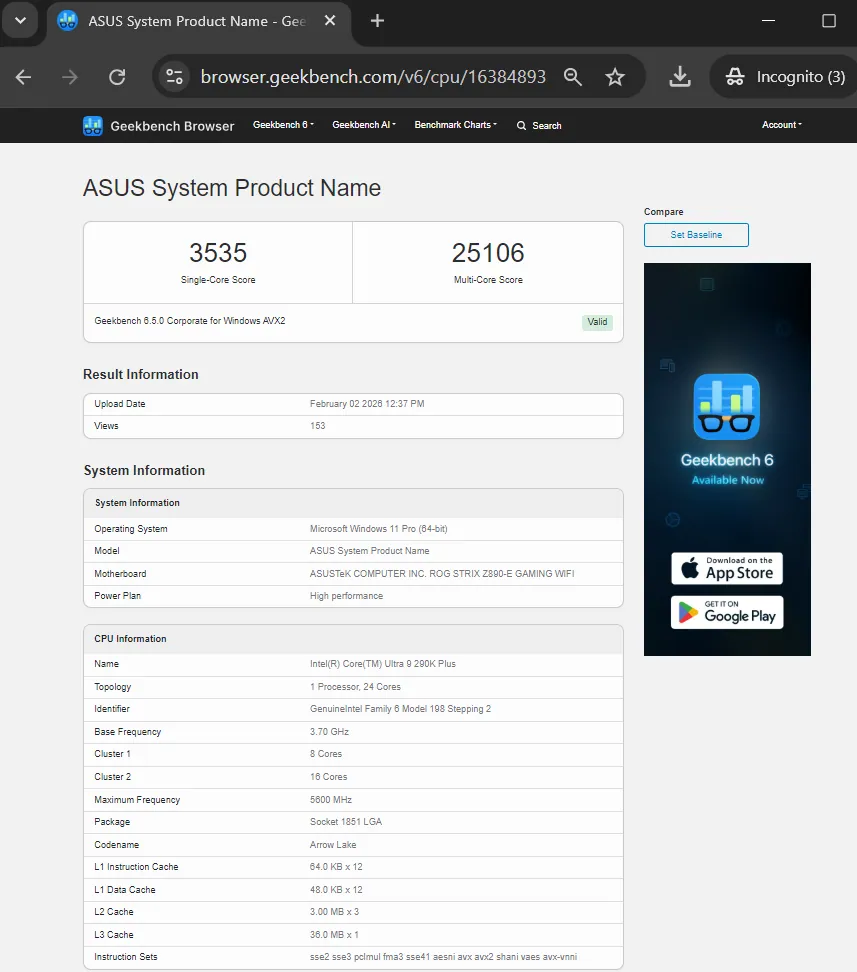
According to the Geekbench 6 database entry, the Core Ultra 9 290K Plus recorded a single-core score of 3,535 points and a multi-core score of 25,106 points. In comparison, the Core Ultra 9 285K typically posts scores of around 3,200 in single-core and 22,560 in multi-core tests. This translates to an improvement of roughly 10.5 percent in single-core performance and approximately 11.3 percent in multi-core workloads, placing the refreshed flagship ahead of all currently listed consumer CPUs in Geekbench’s public database at the time of testing .
The benchmark run was carried out on a high-end desktop platform featuring an ASUS ROG Strix Z890 motherboard paired with 64 GB of DDR5-6800 memory and running Windows 11 Pro.
During testing, the processor reportedly reached boost frequencies close to 5.7 GHz, pointing to improved silicon binning and more refined firmware tuning compared to earlier Arrow Lake processors.
Previous leaks of the same chip on different hardware configurations showed slightly lower scores, suggesting that the latest result benefits from platform optimisation, sustained boost behaviour, and firmware maturity rather than raw architectural changes.
Despite the performance gains, the Core Ultra 9 290K Plus is expected to retain the same 24-core hybrid configuration as its predecessor, consisting of 8 performance cores and 16 efficiency cores. Power limits are also believed to remain unchanged, with a base power rating of 125 W and a maximum turbo power of up to 250 W.
Instead of increasing core counts or pushing higher power budgets, Intel appears to be focusing on higher and more consistent operating frequencies, particularly on the efficiency cores, alongside improvements in scheduling and platform-level tuning.
While Geekbench is a synthetic benchmark and does not always translate directly to real-world performance, the consistency of the gains seen across multiple leaks suggests that the Arrow Lake Refresh could deliver smoother performance in workloads such as content creation, software development, code compilation, and heavy multitasking.
Gaming performance improvements, however, are expected to be more modest, as the underlying architecture, cache configuration, and memory topology remain largely unchanged compared to the Core Ultra 9 285K.
Intel Core Ultra 9 290K Plus vs Core Ultra 9 285K
| Factor | Core Ultra 9 290K Plus | Core Ultra 9 285K |
|---|---|---|
| Architecture | Arrow Lake Refresh | Arrow Lake |
| Core Configuration | 24 Cores (8P + 16E) | 24 Cores (8P + 16E) |
| Max Boost Clock | Up to 5.6–5.7 GHz | Up to ~5.5–5.6 GHz |
| Geekbench 6 Single-Core | 3,535 | ~3,200 |
| Geekbench 6 Multi-Core | 25,106 | ~22,560 |
| Performance Gain | ~10–11% higher | Baseline |
| Power Limits (PL1 / PL2) | 125 W / 250 W | 125 W / 250 W |
| Socket / Platform | LGA 1851 (Z890) | LGA 1851 (Z890) |
Intel has already confirmed that Arrow Lake Refresh processors are on the way, though the company has not announced specific models or release dates. Based on current industry expectations and recent leaks, the refreshed desktop CPUs are widely expected to arrive around March or April 2026.
The Core Ultra 9 290K Plus is also expected to remain compatible with the LGA 1851 socket, meaning users with existing Z890 motherboards may be able to upgrade without changing platforms.
The Core Ultra 9 290K Plus appears to be a refined flagship update designed to extract more performance from the Arrow Lake platform through optimisation rather than major design changes.
If the leaked Geekbench figures are confirmed by independent reviews at launch, the processor could serve as a strong short-term option for productivity-focused desktop users ahead of Intel’s next-generation CPU architectures. As with all pre-release benchmarks, these results are based on limited sample data, and final retail performance may vary.
Sources: Geekbench via Videocardz