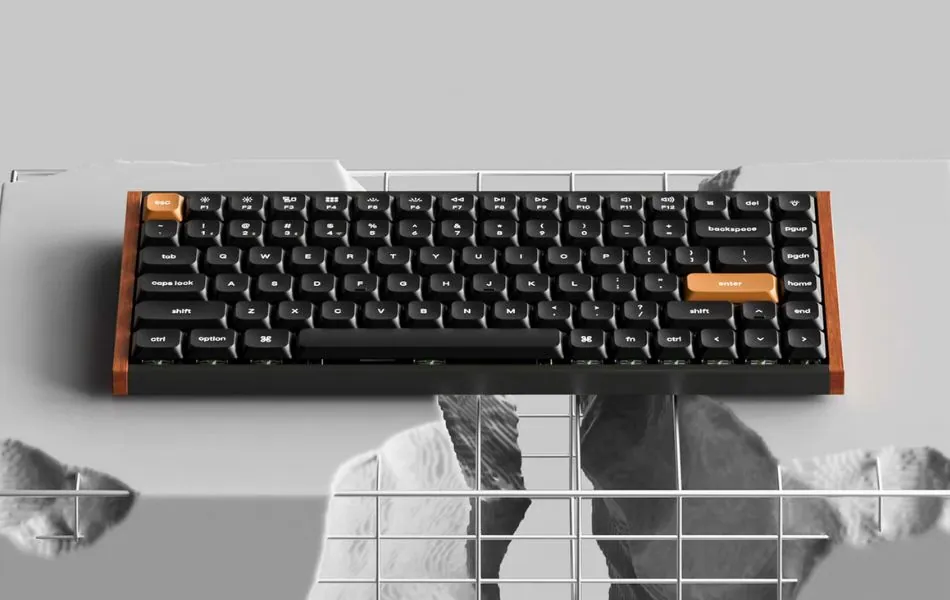
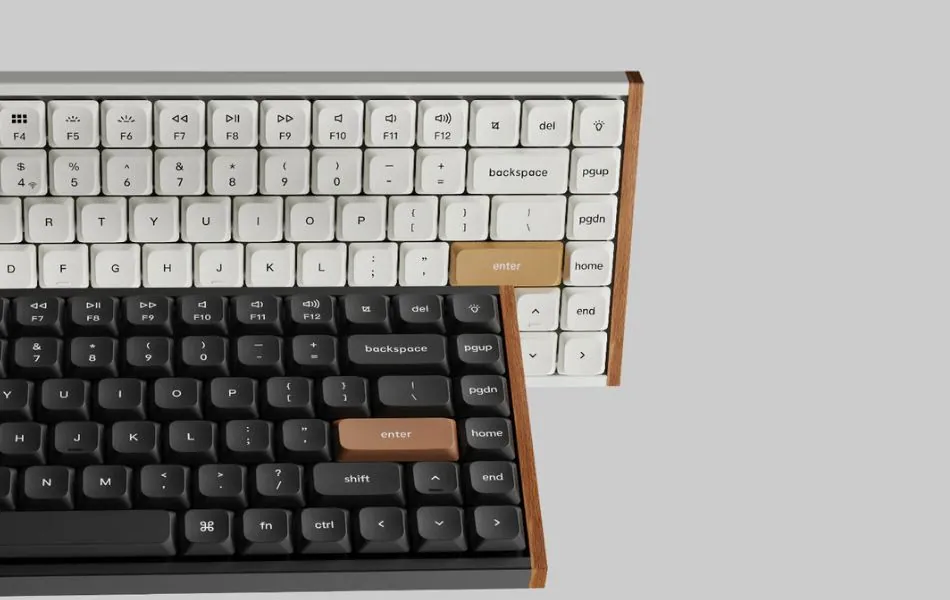
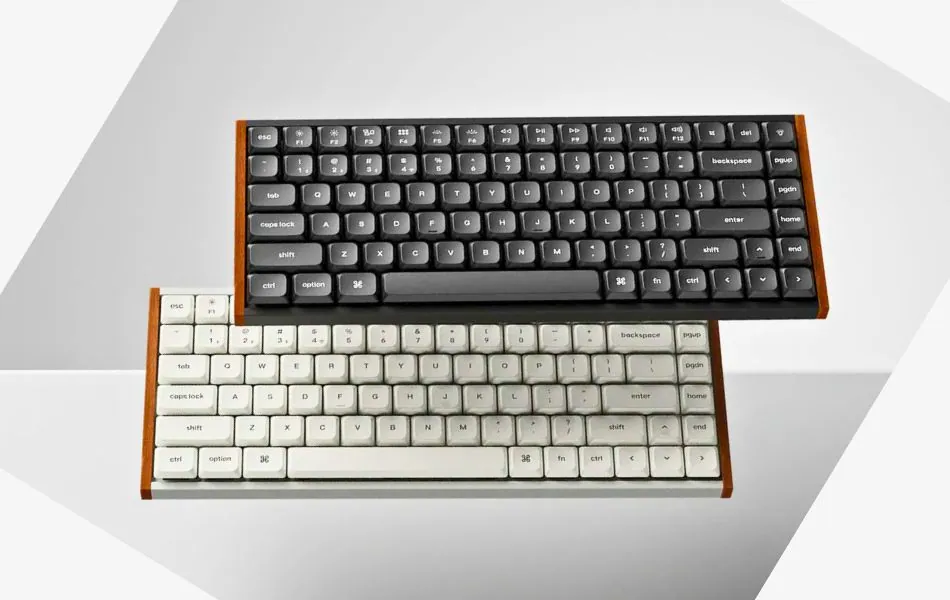
Keychron has officially announced two new additions to its low-profile K-series lineup: the K3 HE and the K3 Ultra 8K. While both keyboards share the same slim 75 percent layout, aluminum-reinforced chassis, and rosewood-accented design, they are built around fundamentally different input technologies and are aimed at distinct user priorities rather than representing a direct upgrade path.
Instead of converging features into a single flagship, Keychron is deliberately splitting its low-profile offerings between analog input precision and maximum digital input speed, positioning the K3 HE and K3 Ultra 8K as parallel products optimized for different workloads.
Hall Effect vs Mechanical: Two Different Input Architectures
The K3 HE is Keychron’s first low-profile Hall-effect keyboard in the K3 lineup. It uses magnetic switches paired with an analog-sensing PCB, enabling features such as adjustable actuation points, rapid trigger behavior, snap tap, dynamic keystroke control, and continuous analog input detection.
The K3 Ultra 8K, by contrast, uses conventional low-profile mechanical switches but focuses on raw responsiveness. It supports polling rates of up to 8,000 Hz over both USB-C wired and 2.4 GHz wireless connections, placing it among the fastest wireless mechanical keyboards currently announced.
Despite launching simultaneously, Keychron does not position either keyboard as universally superior. Instead, the K3 HE is aimed at users who value configurable actuation and analog behavior, while the K3 Ultra 8K targets those prioritizing minimal input latency.
Polling Rate Differences Explained
One of the most visible differences between the two models is polling rate. The K3 Ultra 8K supports 8,000 Hz polling, while the K3 HE is capped at 1,000 Hz over USB-C and 2.4 GHz wireless.
This limitation is tied to the nature of Hall-effect input. Unlike mechanical switches, which report simple on/off states, Hall-effect keyboards continuously measure analog key position. In a low-profile design, increasing scan rates significantly raises power consumption, reduces wireless bandwidth headroom, and can introduce signal instability. By limiting the K3 HE to 1,000 Hz, Keychron is prioritizing consistent analog accuracy and predictable behavior rather than chasing headline polling figures.
The K3 Ultra 8K’s higher polling rate is made possible by its simpler digital scan pipeline, which allows firmware to scale polling frequency without the same power and bandwidth penalties.
Bluetooth mode on both keyboards remains limited to approximately 125–133 Hz, consistent with Bluetooth HID constraints across the industry. Higher polling rates apply only to wired and 2.4 GHz wireless operation.
Connectivity, Software, and Platform Support
Both keyboards support USB-C wired, 2.4 GHz wireless, and Bluetooth 5.3 connectivity. Customization is handled through Keychron Launcher, the company’s web-based configuration software, which provides key remapping, lighting control, and feature tuning across supported platforms.
Keychron has not announced any platform-specific feature limitations, indicating parity across Windows and macOS, as seen with other recent K-series releases.
Switches, Keycaps, and Construction
The K3 Ultra 8K uses a hot-swappable low-profile PCB compatible with 3-pin and 5-pin Gateron Low-Profile 2.0 mechanical switches, with Keychron’s Milk POM linear, tactile, and sharp tactile options offered by default.
The K3 HE uses Keychron’s Ultra-Fast Lime low-profile magnetic switches paired with a dedicated Hall-effect PCB. While the switch design suggests potential compatibility with other low-profile Hall-effect options, Keychron has not officially confirmed third-party support, and full electrical specifications have not yet been published.
Both keyboards feature double-shot PBT LSA low-profile keycaps, north-facing per-key RGB backlighting, and a chassis combining an ABS bottom case with aluminum rails and rosewood edge accents to balance rigidity and portability.
Keychron K3 HE vs K3 Ultra 8K
| Feature | K3 HE | K3 Ultra 8K |
|---|---|---|
| Type of keyboard | Low-profile wireless | Low-profile wireless |
| Switch style | Hall-effect magnetic | Mechanical |
| Feel of keys | Smooth with adjustable trigger | Crisp and clicky (based on switch) |
| Polling speed (how often keys are checked) | Up to 1000 times per second | Up to 8000 times per second |
| Bluetooth speed | Slowest normal Bluetooth rate | Same normal Bluetooth rate |
| Best connection for gaming | 2.4 GHz wireless or USB-C | 2.4 GHz wireless or USB-C |
| Battery life | Not confirmed yet | Up to 550 hours (no lights) |
| Lighting | Per-key RGB | Per-key RGB |
| Software support | Yes (Keychron Launcher) | Yes (Keychron Launcher) |
| Best use | Precise control and advanced actuation | Lowest latency and fastest response |
Pricing and Availability
Keychron has not announced final pricing for either keyboard. The company is currently offering a low-cost early-access reservation, with the full launch scheduled for February 12, at which point complete specifications and pricing are expected to be confirmed.
Also Read: Best Gaming Laptop Under $1000
Two Interpretations of Low-Profile Performance
With the K3 HE and K3 Ultra 8K, Keychron is not simply refreshing an existing product line. Instead, the company is offering two distinct interpretations of low-profile performance: one centered on analog control and actuation flexibility, and the other on maximizing digital input speed within the practical limits of wireless connectivity.
Rather than competing with each other directly, the two keyboards reflect a broader split in enthusiast priorities, allowing users to choose between configurability and latency without compromising on portability or build quality.
Sources: Keychron via Notebookchcek