
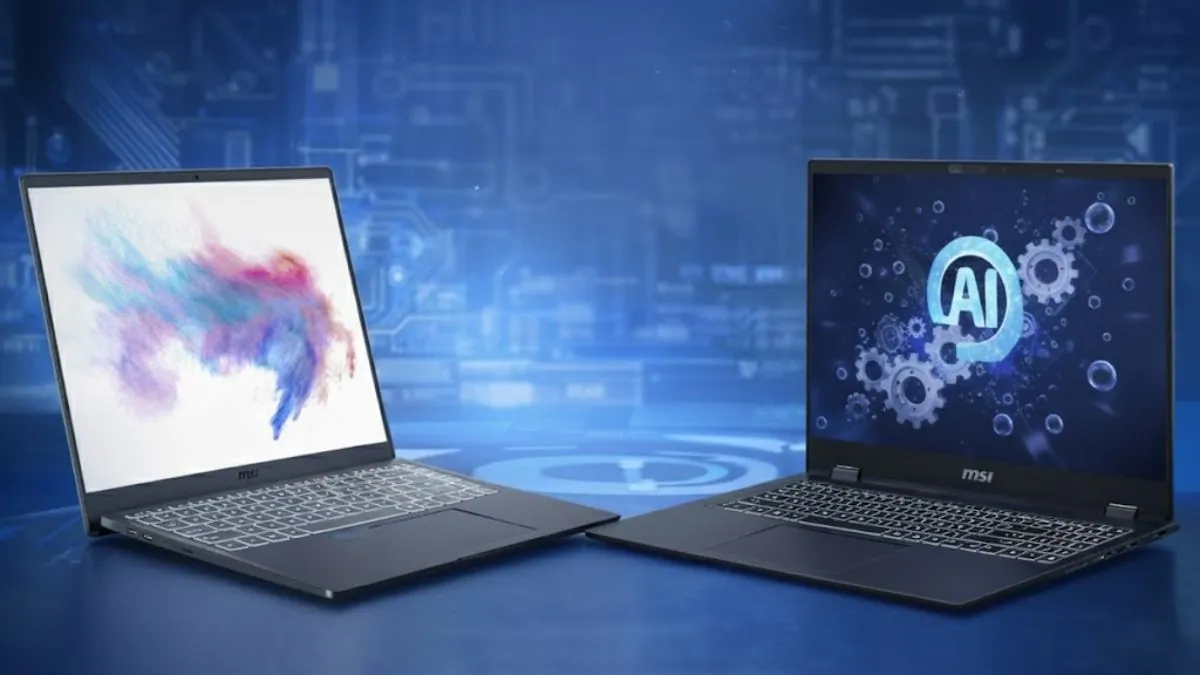
Several MSI laptops powered by Intel’s upcoming Core Ultra 300-series “Panther Lake” processors have appeared in early European retail listings, offering one of the first looks at real-world system configurations ahead of the platform’s expected launch in 2026.
The listings were first spotted on a French retailer’s website and later shared publicly by hardware leaker momomo_us, who has a long track record of identifying unreleased laptop and CPU SKUs. Similar information has since been reported by multiple outlets, including VideoCardz.
Four MSI Prestige Models Appear in Listings
The retailer entries reference four MSI laptops, all of which appear to belong to MSI’s Prestige series, pointing toward thin-and-light designs rather than gaming systems with discrete graphics.
Across the listings, the systems share several common specifications:
- 32GB LPDDR5X memory
- Windows 11 Pro
- NVMe SSD storage ranging from 1TB to 2TB
Display configurations differ by size. The 14-inch models are listed with FHD+ 60Hz panels, while the 16-inch models feature a 2.8K OLED display with a 120Hz refresh rate, suggesting MSI is positioning higher-end Panther Lake systems around premium OLED panels.
Also Read: Best MSI Laptops
Core Ultra X9 388H Model Highlights Xe3 Integrated Graphics:
Among the listed configurations is a higher-end system featuring the Intel Core Ultra X9 388H processor. According to the retail data, this chip is paired with Intel Arc B390 integrated graphics, which is widely believed to be based on Intel’s upcoming Xe3 (Celestial) GPU architecture with 12 GPU cores.
This configuration appears in a 16-inch MSI Prestige laptop equipped with:
- 2.8K 120Hz OLED display
- 32GB LPDDR5X memory
- 2TB NVMe SSD
No discrete GPU is mentioned in any of the listings, reinforcing expectations that Panther Lake X-series processors are designed for premium thin-and-light systems, where stronger integrated graphics play a central role.
Additional Core Ultra 300 CPUs Listed:
Beyond the Core Ultra X9 388H, the retailer data also references several other Core Ultra 300-series SKUs, including:
- Core Ultra 9 386H
- Core Ultra X7 358H
- Core Ultra 7 355
These processors align with Intel’s rumored Panther Lake lineup, which is expected to span Core Ultra X, H, and U variants, covering a range of power envelopes and performance tiers for ultraportables and premium laptops.
Pricing Appears to Be Placeholder Data:
Pricing shown in the listings varies significantly between configurations and does not follow a consistent structure. This strongly suggests the prices are placeholder values, a common practice for early retail entries tied to unreleased hardware.
Neither MSI nor Intel has announced official pricing for Panther Lake-based systems.
Why These Listings Matter:
While early retail listings are often incomplete, they provide important clues about Intel’s Panther Lake strategy. The absence of discrete GPUs, combined with OLED displays and high memory configurations, suggests Intel is positioning Xe3 integrated graphics as a key upgrade for premium thin-and-light laptops.
If accurate, these MSI systems indicate that Panther Lake could represent one of Intel’s strongest pushes yet to reduce reliance on entry-level discrete GPUs in ultraportable designs.
Panther Lake Expected to Launch in 2026:
Intel has not formally confirmed Panther Lake specifications or launch timing. However, the platform is widely expected to debut in 2026 and to be manufactured using Intel’s 18A process technology.
Industry reports suggest Panther Lake will continue Intel’s hybrid CPU core design while placing greater emphasis on integrated graphics performance, particularly in the Core Ultra X variants. Intel is expected to share official details during CES 2026.
Intel Core Ultra 300 Mobile CPUs (Rumored Specifications)
| Processor | Core Configuration | Max Boost | Integrated GPU | Default / Max TDP |
|---|---|---|---|---|
| Core Ultra 9 388H | 16C (4P + 8E + 4LP) | 5.1 GHz | Arc B390 (12 Xe3) | 25W / 65–80W |
| Core Ultra 9 386H | 16C (4P + 8E + 4LP) | 4.9 GHz | Arc (4 Xe3) | 25W / 65–80W |
| Core Ultra 7 368H | 16C (4P + 8E + 4LP) | 5.0 GHz | Arc B390 (12 Xe3) | 25W / 65–80W |
| Core Ultra 7 366H | 16C (4P + 8E + 4LP) | 4.8 GHz | Arc (4 Xe3) | 25W / 65–80W |
| Core Ultra 7 358H | 16C (4P + 8E + 4LP) | 4.8 GHz | Arc B390 (12 Xe3) | 25W / 65–80W |
| Core Ultra 7 356H | 16C (4P + 8E + 4LP) | 4.7 GHz | Arc (4 Xe3) | 25W / 65–80W |
| Core Ultra 5 338H | 12C (4P + 4E + 4LP) | 4.7 GHz | Arc B370 (10 Xe3) | 25W / 65–80W |
| Core Ultra 5 336H | 12C (4P + 4E + 4LP) | 4.6 GHz | Arc (4 Xe3) | 25W / 65–80W |
| Core Ultra 7 365 | 8C (4P + 0E + 4LP) | 4.8 GHz | Arc (4 Xe3) | 25W / 55W |
| Core Ultra 7 355 | 8C (4P + 0E + 4LP) | 4.7 GHz | Arc (4 Xe3) | 25W / 55W |
| Core Ultra 5 335 | 8C (4P + 0E + 4LP) | 4.6 GHz | Arc (4 Xe3) | 25W / 55W |
| Core Ultra 5 325 | 8C (4P + 0E + 4LP) | 4.5 GHz | Arc (4 Xe3) | 25W / 55W |
| Core Ultra 5 332 | 6C (2P + 0E + 4LP) | 4.4 GHz | Arc (2 Xe3) | 25W / 55W |
| Core Ultra 5 322 | 6C (2P + 0E + 4LP) | 4.4 GHz | Arc (2 Xe3) | 25W / 55W |
Note: Specifications are based on industry leaks and remain unconfirmed.
Sources: momomo_us via VideoCardz