
High-performance Linux laptops have traditionally played it safe. Most focus on efficiency, modest GPUs, or developer-centric portability, leaving true workstation-class performance mostly to Windows machines.
With the InfinityBook Max 16 Gen 10, TUXEDO Computers is deliberately challenging this long-standing limitation.
Instead of shying away from driver complexity, the company is pairing Intel’s Core Ultra 9 processor with an NVIDIA RTX 50-series GPU, making this model a no-compromise Linux workstation. Pre-orders are now open, and the first deliveries are expected in early February.
More importantly, this launch signals a significant shift in how Linux laptops are being positioned in 2026 – not as an alternative or secondary option, but as a direct competitor to the high-end performance notebooks that have traditionally been dominated by Windows.
A Linux Laptop Built Around Sustained Performance
The InfinityBook Max 16 Gen 10 is built around the Core Ultra 9 275HX, a high-wattage processor typically found in larger performance laptops like the Rog Strix G16 or Alienware series.
This isn’t a short-burst chip designed for thin ultrabooks, but rather a CPU built for sustained workloads such as compiling large codebases, rendering, simulations, and GPU-accelerated compute tasks.
Memory support goes up to 128GB of DDR5, with PCIe 5.0 storage for the primary SSD slot. With a secondary PCIe 4.0 slot, this platform is clearly designed for sustained, disk-intensive workloads rather than casual development use.
In terms of graphics, users can configure the system with either an RTX 5060 or RTX 5070 GPU. Crucially, both can be tuned via TUXEDO’s Linux-native control software, allowing users to manage power limits and thermal behavior.
On Linux systems, where stability under sustained load is more important than peak benchmarks, this level of control often determines whether performance remains consistent over time.
Key Specs
- Processor: Intel Core Ultra 9 275HX
- Graphics: NVIDIA RTX 5060 or RTX 5070
- Memory: Up to 128GB DDR5
- Display: 16-inch WQXGA LED or OLED
- Storage: PCIe 5.0 SSD support
- Battery: 99Wh
- OS: TUXEDO OS or Ubuntu 24.04 LTS
Two Display Options, Two Very Different Priorities
Instead of imposing a single “best” panel, TUXEDO offers two display options that cater to different professional use cases.
The WQXGA LED panel prioritizes speed, featuring a high refresh rate that’s ideal for motion-heavy workloads and users who value responsiveness. The optional OLED display shifts the focus to image quality, offering higher contrast and full DCI-P3 color coverage that better supports creative and visual workflows.
This flexibility is still uncommon in Linux-first laptops, which often limit display options to simplify support. Here, the configuration options indicate a deliberate effort to meet the needs of both technical and creative professionals.
NVIDIA Graphics on Linux: What to Expect
Running powerful NVIDIA GPUs on Linux is no longer new, but it is still not always smooth. Problems like power limits, fan noise during heavy use, and driver issues often appear only after long hours of work, not during short tests.
TUXEDO reduces these issues by tuning the system at the firmware level and offering its own control software. This lets users adjust performance and cooling directly in Linux. For those using CUDA tasks, GPU rendering, or local AI workloads, this makes performance more stable and reliable in everyday use.
Practical Design Focus
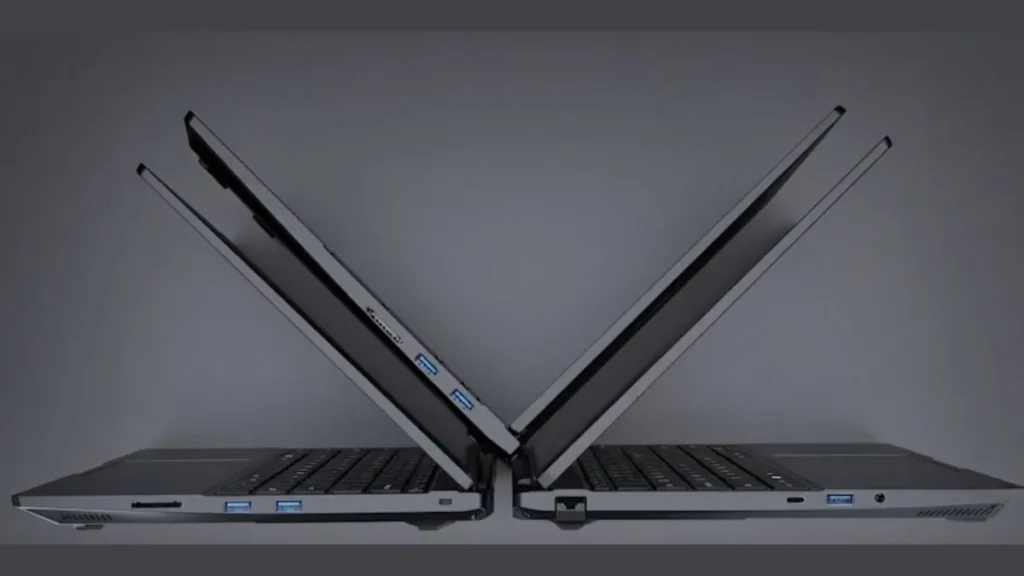
The InfinityBook Max 16 Gen 10 focuses on usability and connectivity rather than visual styling. The 99Wh battery is secured with screws instead of glue, making it easy to replace without any special tools. Users can also access the internal components for memory and storage upgrades, ensuring a longer lifespan.
The port selection follows the same practical approach. It includes Thunderbolt 4, HDMI 2.1, Mini DisplayPort 2.1, USB-C charging, and 2.5Gb Ethernet, all without the need for adapters. These features are more important to Linux users than decorative design elements or RGB lighting.
Also Read: Best Thunderbolt 5 Laptops
Built for Linux from the Start
The system ships with TUXEDO OS by default, with Ubuntu 24.04 LTS also available. Unlike laptops that only support Linux after installation, this model is designed and tuned for Linux at the firmware, driver, and power-management levels.
This reduces setup time and helps avoid common issues related to compatibility and power behavior that users often face when running Linux on hardware originally built for Windows.
How It Fits Into the Linux Workstation Landscape
Compared to thin Linux laptops like the System76 Oryx Pro and Linux-configured Lenovo ThinkPad P-series models, the InfinityBook Max 16 Gen 10 prioritizes sustained performance over portability. Compared to other well-known Linux workstations, its newer HX-class CPUs, current-generation RTX GPUs, and improved Linux-side power tuning set it apart.
It wasn’t designed to be the lightest or quietest Linux laptop. Instead, it’s for users who prioritize consistent performance, upgradeability, and long-term reliability.
Who This Laptop May Not Suit
This laptop is not designed for typical Linux users or those who need long battery life. The HX-class processor and dedicated GPU consume more power and generate more heat, resulting in a larger and heavier system. Its price also places it outside the entry-level and ultraportable categories.
For users who only need lightweight development tools or who primarily work on the go, smaller and lighter Linux laptops might be a better fit.
Pricing and Target Users
Starting at €1,899, the InfinityBook Max 16 Gen 10 is positioned as a high-end Linux workstation rather than a typical laptop. It’s aimed at developers, engineers, and creators who use Linux daily and demand robust CPU and GPU performance without compromising on compatibility or display quality.
For users seeking powerful workstation hardware within the Linux ecosystem, this launch represents one of the most focused and compelling options to date.
Sources: TUXEDO Computers via NotebookCheck