
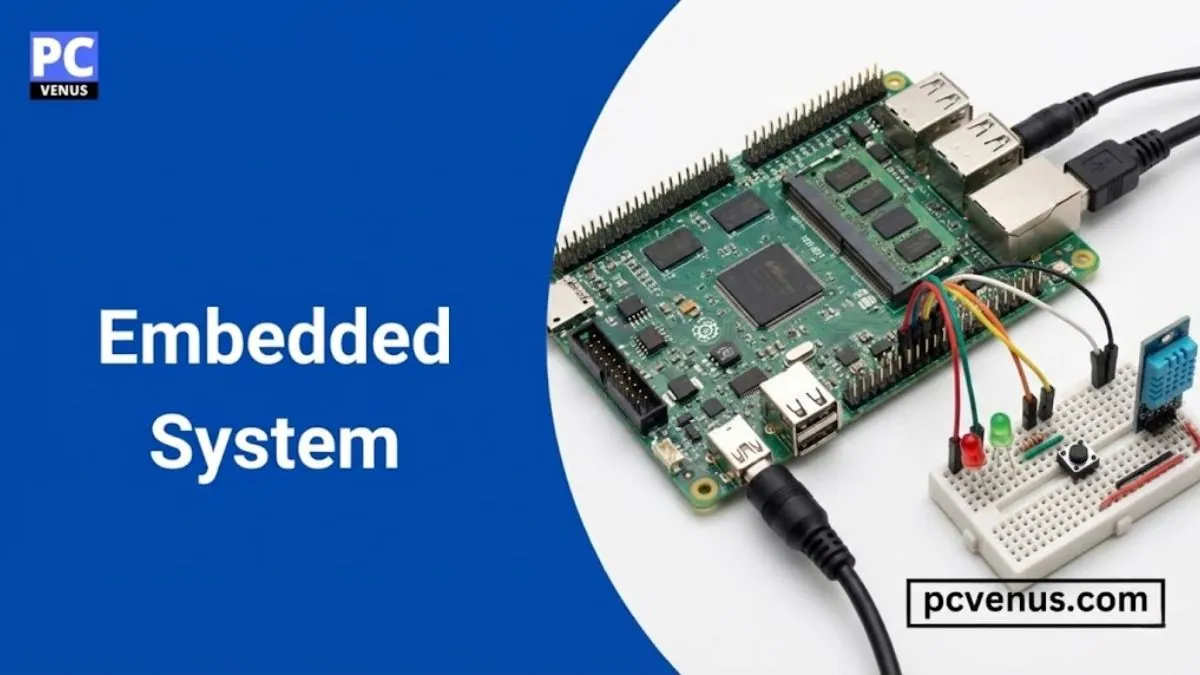
Whenever you press a button on your microwave, adjust your car’s climate control, or wear a fitness tracker, a small computer is working in the background. These computers aren’t designed for browsing the internet or running multiple apps. They’re built to perform one task and do it reliably.
An embedded system is a specialized computer system designed to perform a specific function within a larger device or machine. It combines dedicated hardware and software to automatically control operations, often without direct user interaction.
Embedded systems operate within everyday products and industrial machinery. They control appliances, manage vehicle electronics, support medical equipment, and regulate automated manufacturing systems. From simple digital watches to complex navigation systems, embedded technology helps devices function accurately, efficiently, and independently.
Table of Contents
What is an Embedded System?
An embedded system consists of hardware and software components that work together to perform a predefined set of operations. The term “embedded” reflects how these systems are integrated into the devices they control, becoming an integral part of the overall product.
These systems operate with three key characteristics. First, they perform a specific task rather than general computing functions. Second, they combine a microprocessor or microcontroller with memory, input/output interfaces, and power management circuitry.
Third, they function as subsystems within larger products, enabling those products to fulfill their intended purpose.
The software that runs on embedded systems, often called firmware, is typically stored in non-volatile memory. This software is permanently programmed into the device and performs the same operations repeatedly throughout the product’s lifespan. Real-time operating systems can manage more complex embedded applications, ensuring that tasks are completed within strict timing requirements.
The Core Architecture of an Embedded System
Credit: PCVenus Team
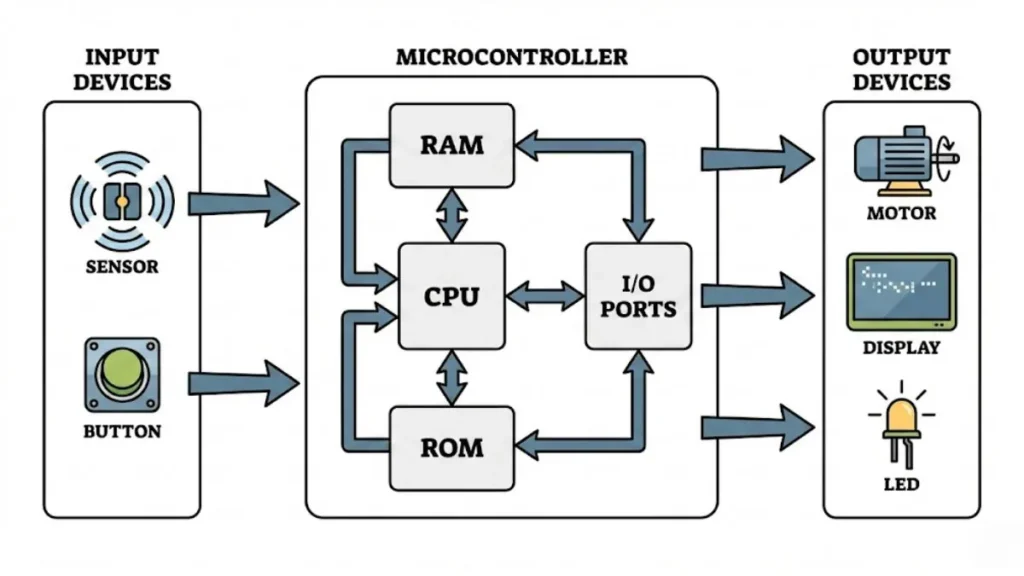
Embedded systems follow a basic architecture based on the flow of information through three distinct layers. Understanding this architecture reveals how these systems transform inputs into meaningful outputs.
The input layer captures data from the physical world via sensors, switches, keyboards, or communication interfaces. In a thermostat, a temperature sensor measures the room temperature, while buttons on a remote control detect user commands. This layer converts physical events into electrical signals that the system can process.
The processing layer contains a microcontroller or microprocessor that executes programmed instructions. This central component reads the input signals, performs calculations or logic operations according to its firmware, and determines the appropriate response. Memory modules store both the program code and temporary data necessary during operation.
The output layer delivers the system’s response through actuators, displays, communication ports, or control signals. A motor might start rotating, an LED might light up, or a signal might be sent to another device. This layer translates digital decisions back into physical actions.
Hardware components provide the physical foundation, while firmware contains the programmed logic. In systems requiring precise timing, a real-time operating system coordinates multiple tasks, ensuring that critical operations are completed within their deadlines. This layered approach allows embedded systems to bridge the gap between digital computation and physical operation.
How an Embedded System Works: Step-by-Step
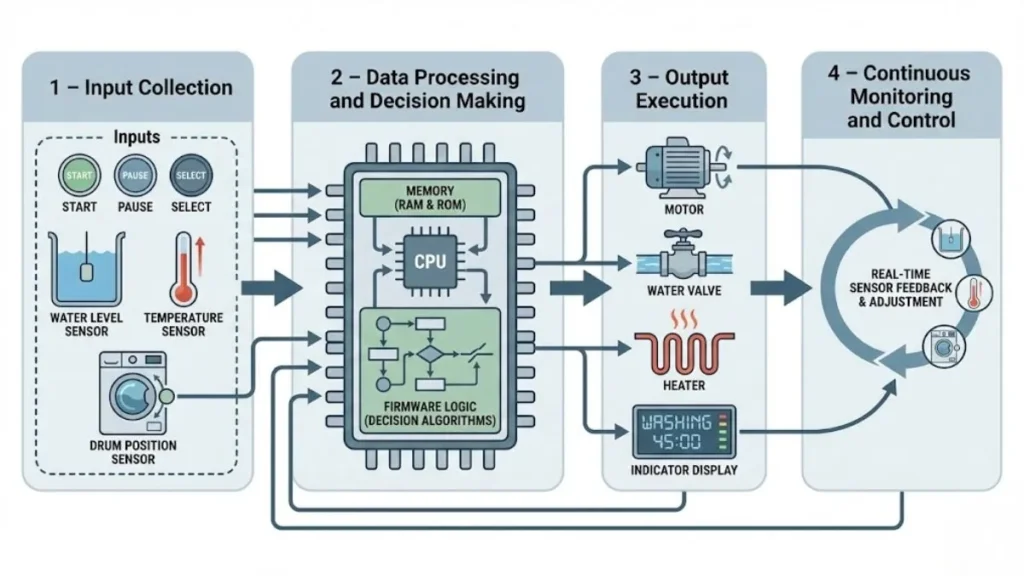
To understand how an embedded system functions in real life, consider a fully automatic washing machine. Inside the machine, an embedded controller manages every stage of the wash cycle, from user input to final output actions.
Credit: PCVenus Team
Step 1: Input Collection
The process begins with input devices collecting information. Buttons allow the user to select a wash program, while sensors measure parameters such as water level, temperature, and drum position. These inputs convert physical actions and environmental conditions into electrical signals that the system can interpret.
Step 2: Data Processing and Decision Making
The microcontroller receives input signals and processes them using its programmed firmware. Based on the selected wash program and real-time sensor data, it determines the correct sequence of operations. This includes deciding when to open water valves, activate the motor, heat the water, or initiate drainage. Accurate timing and logic control are essential at this stage.
Step 3: Output Execution
Once decisions are made, output devices carry out the required actions. Motors rotate the drum, valves regulate water flow, heaters adjust temperature, and indicators display the current cycle status. Each output action directly affects the physical operation of the washing machine.
Step 4: Continuous Monitoring and Control
Throughout the wash cycle, the embedded system continuously monitors sensor data and adjusts operations as needed. This feedback loop ensures consistent performance, safety, and efficiency until the program completes.
This step-by-step process demonstrates how an embedded system senses inputs, processes data, and controls outputs to manage a physical device automatically and reliably.
Main Components of an Embedded System
An embedded system is built from several core components that work together to perform a dedicated task. While the complexity of these components varies by application, their functional roles remain largely the same across most embedded devices.
1. Microcontroller or Microprocessor
The microcontroller or microprocessor acts as the central control unit of an embedded system. It executes programmed instructions, processes input data, and controls output actions.
Microcontrollers are more commonly used in embedded systems because they integrate the CPU, memory, and input/output peripherals into a single chip, making them cost-effective and power-efficient. Microprocessors are used in more complex systems that require higher performance and external components.
Microcontroller vs Microprocessor
| Feature | Microcontroller | Microprocessor |
| Definition | A single chip that includes CPU, memory, and input/output peripherals | A CPU chip that requires external memory and peripherals |
| Purpose | Designed to control specific tasks in embedded systems | Designed for general-purpose computing |
| Components on Chip | CPU, RAM, ROM/Flash, I/O ports, timers | CPU only |
| Memory Requirement | Built-in memory is usually sufficient | Requires external RAM and storage |
| Power Consumption | Very low power usage | Higher power consumption |
| Cost | Low cost and affordable | More expensive |
| System Size | Compact and space-saving | Larger system size |
| Speed | Lower clock speed | Higher clock speed |
| Performance Type | Optimized for control and real-time tasks | Optimized for computation and multitasking |
| Operating System | Can run without an OS or use RTOS | Requires full operating systems like Windows or Linux |
| Real-Time Capability | Well-suited for real-time applications | Not ideal for real-time control |
| Flexibility | Limited flexibility | High flexibility |
| Ease of Design | Easier to design and integrate | More complex system design |
| Typical Applications | Washing machines, microwave ovens, sensors, IoT devices | Laptops, desktops, servers |
| Examples | Arduino, PIC, AVR, STM32 | Intel Core, AMD Ryzen |
2. Memory
Memory stores the firmware and operational data required for system functioning. Embedded systems typically use two types of memory:
- Program memory stores the firmware or application code, usually in non-volatile memory such as Flash or ROM.
- Data memory temporarily stores variables and intermediate data during execution, commonly implemented using RAM.
The amount and type of memory depend on the system’s complexity and performance requirements.
3. Input Devices
Input devices allow the embedded system to receive data from the external environment or users. These components convert physical signals into electrical signals that the system can process.
Common input devices include sensors (temperature, pressure, motion), switches, buttons, keypads, and communication interfaces such as UART, SPI, or I²C. Input accuracy directly affects system reliability and performance.
4. Output Devices
Output devices enable the embedded system to interact with its environment by performing physical actions or displaying information. They translate digital decisions into real-world responses.
Typical output devices include motors, relays, LEDs, displays, buzzers, and communication modules. The type of output device depends on the application, whether it is controlling mechanical movement, visual feedback, or data transmission.
5. Power Supply
The power supply provides stable electrical power to all system components. Embedded systems often operate under strict power constraints, especially in battery-powered or portable devices.
Power supply circuits may include voltage regulators, power management units, and protection components to ensure reliable operation, reduce energy consumption, and extend device lifespan.
6. Firmware (Embedded Software)
Firmware is the software programmed into the embedded system that defines how the hardware operates. It controls data processing, input handling, output responses, and communication between components.
Firmware is typically stored in non-volatile memory and designed to run continuously for long periods. In more complex embedded systems, a real-time operating system may be used to manage multiple tasks and ensure predictable timing behavior.
Embedded System vs General-Purpose Computer
| Feature | Embedded System | General-Purpose Computer |
| Primary Purpose | Designed to perform one specific task | Designed to perform many different tasks |
| Functionality | Focused on a fixed function | Flexible and multifunctional |
| Examples | Washing machine controller, car ECU, microwave oven | Laptop, desktop computer, workstation |
| User Interaction | Limited or no direct user interaction | High level of user interaction |
| Operating System | May run without an OS or use an RTOS | Uses full operating systems like Windows, macOS, or Linux |
| Performance Requirement | Optimized for real-time or task-specific performance | Optimized for multitasking and general use |
| Power Consumption | Very low power usage | High power consumption |
| Hardware Flexibility | Fixed hardware configuration | Hardware can be upgraded or changed |
| Software Flexibility | Software is tightly coupled with hardware | Software can be easily installed or removed |
| Size | Compact and small in size | Larger in size |
| Cost | Lower cost, especially in mass production | Higher cost |
| Boot Time | Very fast boot time | Slower boot time |
| Reliability | Highly reliable for long-term continuous use | Reliability depends on usage and maintenance |
| Real-Time Capability | Often supports real-time operations | Not suitable for real-time tasks |
| Maintenance | Minimal maintenance required | Requires regular updates and maintenance |
While both embedded systems and general-purpose computers process information, they differ fundamentally in design philosophy and capabilities. Recognizing these distinctions clarifies why embedded systems dominate specific applications.
General-purpose computers cater to a wide range of software applications and user needs. Embedded systems sacrifice this flexibility for optimization towards their specific function. This specialization allows embedded devices to operate with lower power consumption, reduced cost, and a smaller physical size.
A laptop offers the flexibility to install new programs, connect various peripherals, and switch between tasks. The embedded controller in a washing machine only performs washing-related operations, but it does so reliably for years with minimal resources. Neither approach is inherently better – each excels in its intended domain.
Types of Embedded Systems
Embedded systems are categorized based on their operational characteristics and application requirements. Each type addresses specific performance, timing, and connectivity needs.
Standalone Embedded Systems
These systems operate independently without requiring network connectivity or an external computer.
They take inputs, process them according to their programming, and generate outputs entirely on their own.
Digital cameras are an example of standalone embedded systems. They capture images, process them, store the results on a memory card, and display photos – all without an internet connection or external device. Calculators, MP3 players, and basic household appliances also fall into this category.
Real-Time Embedded Systems
Real-time systems must complete operations within strict timing deadlines. Missing these deadlines can lead to system failure or dangerous situations, making timing as critical as correctness.
There are two subcategories: hard real-time systems where deadline violations are unacceptable (anti-lock braking systems, medical devices), and soft real-time systems where occasional missed deadlines degrade quality but do not cause failure (video streaming devices). These systems typically utilize real-time operating systems to guarantee timely task completion.
Networked Embedded Systems
These systems are connected to a network, enabling communication with other devices and systems. Network connectivity facilitates remote monitoring, control, and data exchange.
Home automation systems, industrial control networks, and building management systems rely on networked embedded devices. They send sensor data to central servers, receive configuration updates, and coordinate with other network nodes to achieve system-wide objectives.
Mobile Embedded Systems
Mobile embedded systems prioritize portability, emphasizing power efficiency and compact design. Devices in this category must strike a balance between performance and energy consumption.
Smartphones, tablets, wearable fitness trackers, and portable medical monitors represent mobile embedded systems. They incorporate wireless communication, touch interfaces, and power management features while maintaining a small form factor suitable for mobile use.
Security in Embedded Systems
Embedded systems are often designed to work for many years without changes. Because of this, security becomes very important, especially for devices connected to the internet.
Many embedded devices have limited memory and processing power. This makes it difficult to use heavy security methods like those used in computers or smartphones. As a result, poorly secured embedded systems can be vulnerable to attacks.
Common security risks include unauthorized access, data theft, and modification of firmware. Devices such as smart home products, medical equipment, vehicles, and industrial controllers can be affected if security is ignored.
To improve security, developers use methods such as secure boot, encrypted communication, access control, and firmware updates. As more devices become connected through IoT, security is no longer optional. It is a core part of modern embedded system design.
Common Tools Used in Embedded Systems
Embedded systems are built using a combination of software tools and hardware tools. These tools help engineers write code, test functionality, and fix errors during development.
Programming tools, also known as IDEs, are used to write and upload code to embedded devices. Popular tools include Arduino IDE, Keil, STM32CubeIDE, and MPLAB. These platforms make it easier to work with microcontrollers and manage projects.
Debugging tools help developers find and fix problems in embedded systems. Tools such as JTAG debuggers and logic analyzers are used to monitor system behavior and check signals during operation.
Communication tools are used to test data transfer between devices. Protocols like UART, SPI, and I²C are commonly used in embedded systems to exchange information between components.
Using the right tools helps developers build reliable, efficient, and stable embedded systems before they are released into real products.
Real-World Examples of Embedded Systems
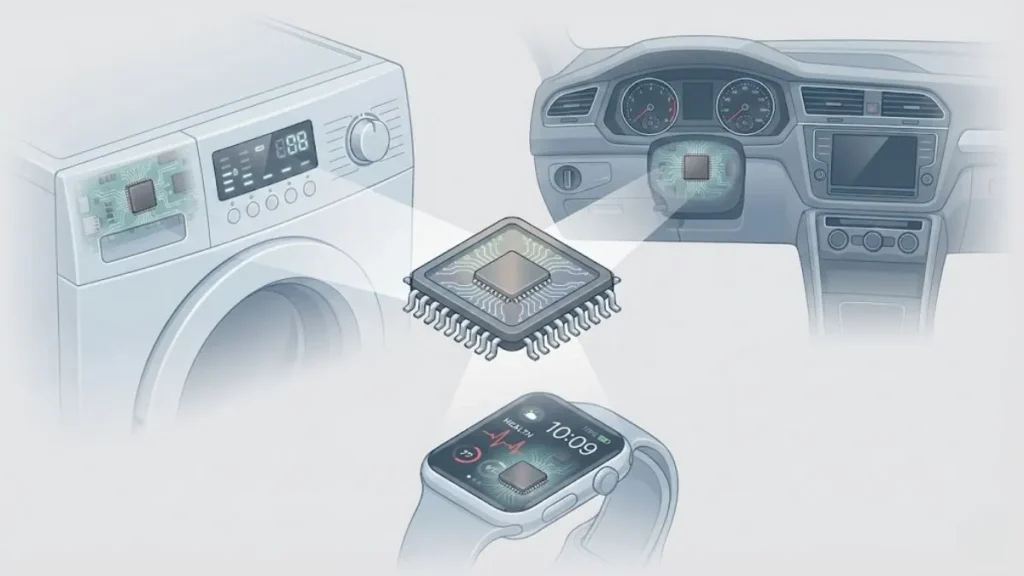
This section focuses only on individual devices that use embedded systems to perform dedicated tasks. These are concrete, everyday examples that help beginners understand how embedded systems operate in real products.
Credit: PCVenus Team
Washing Machines
Fully automatic washing machines use embedded controllers to manage wash cycles, water levels, temperature, drum speed, and safety checks. Sensors continuously provide feedback, allowing the system to adjust operations automatically for different fabric types and load sizes.
Digital Cameras
Digital cameras rely on embedded systems to control image sensors, autofocus mechanisms, image processing, storage, and display functions. These systems ensure fast image capture, accurate exposure, and efficient power usage.
Microwave Ovens
Microwave ovens use embedded systems to manage cooking time, power levels, keypad input, and display output. Safety mechanisms such as door sensors are also controlled by embedded logic.
Automotive Control Units
Modern vehicles contain multiple embedded systems, such as engine control units, airbag controllers, and braking systems. Each unit performs a dedicated task and operates independently while communicating with other systems when needed.
Medical Infusion Pumps
Infusion pumps use embedded controllers to deliver precise amounts of medication. These systems monitor flow rates, detect faults, and trigger alarms to ensure patient safety.
Applications of Embedded Systems
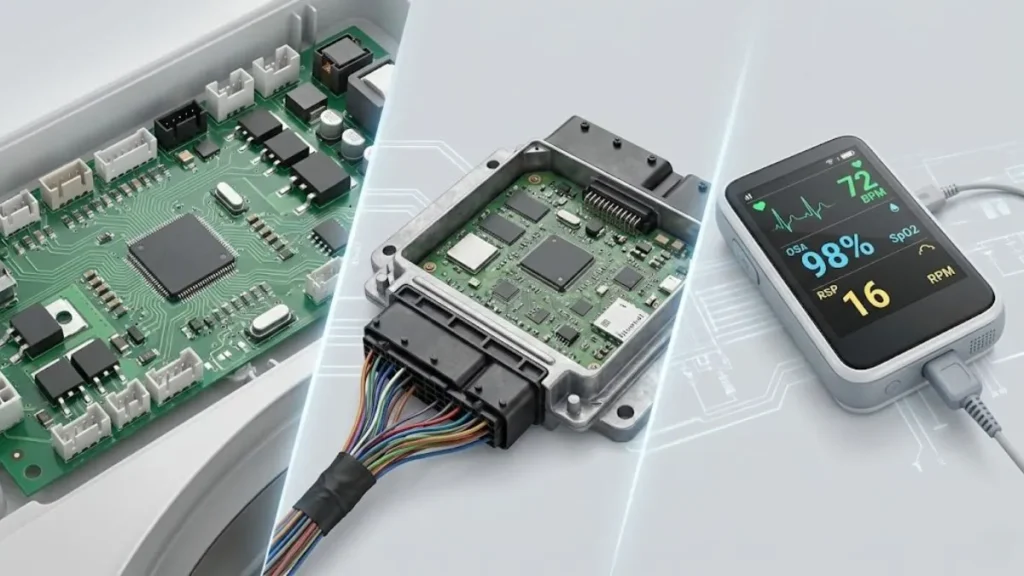
This section explains where embedded systems are used, focusing on industries and sectors rather than individual devices. This categorization improves clarity and SEO relevance.
Credit: PCVenus Team
1. Consumer Electronics
Embedded systems power devices such as smart TVs, gaming consoles, wearables, home appliances, and remote controls. They manage user interfaces, connectivity, multimedia processing, and energy efficiency.
2. Automotive Industry
The automotive sector relies heavily on embedded systems for engine management, braking systems, airbags, navigation, driver-assistance features, and infotainment systems. These systems must meet stringent real-time and safety requirements.
3. Healthcare and Medical Devices
Medical devices such as patient monitors, diagnostic machines, insulin pumps, and imaging systems depend on embedded systems for precise data processing and real-time responses. Reliability and adherence to medical standards are critical in this field.
4. Industrial Automation
Factories and manufacturing plants utilize embedded systems in programmable logic controllers, robotic arms, and monitoring systems. These applications improve productivity, accuracy, and operational safety.
5. Internet of Things (IoT)
IoT applications connect embedded devices to networks, enabling remote monitoring and control. Smart homes, industrial sensors, and environmental monitoring systems are common examples where embedded systems function as intelligent edge devices.
Advantages of Embedded Systems
Embedded systems offer several benefits due to their specialized design and optimized operation.
- High reliability because they are designed for a specific task
- Low power consumption compared to general-purpose computers
- Compact size, allowing integration into small and portable devices
- Cost-effective in large-scale production
- Real-time performance for time-critical applications
- Long operational life with minimal maintenance
- Faster response times due to dedicated hardware and firmware
These advantages make embedded systems ideal for applications where efficiency, consistency, and reliability are required.
Limitations of Embedded Systems
Despite their strengths, embedded systems also have certain limitations that must be considered during design and deployment.
- Limited flexibility, as systems are built for specific functions
- Hardware and software upgrades can be difficult or costly
- Security challenges due to constrained resources and long device lifecycles
- Debugging and troubleshooting are complex because of limited interfaces
- Scalability issues when system requirements change
- Compliance and safety requirements increase development complexity
- Tight memory and processing constraints demand optimized programming
Understanding these limitations helps engineers design more robust and secure embedded solutions.
The Future of Embedded Systems
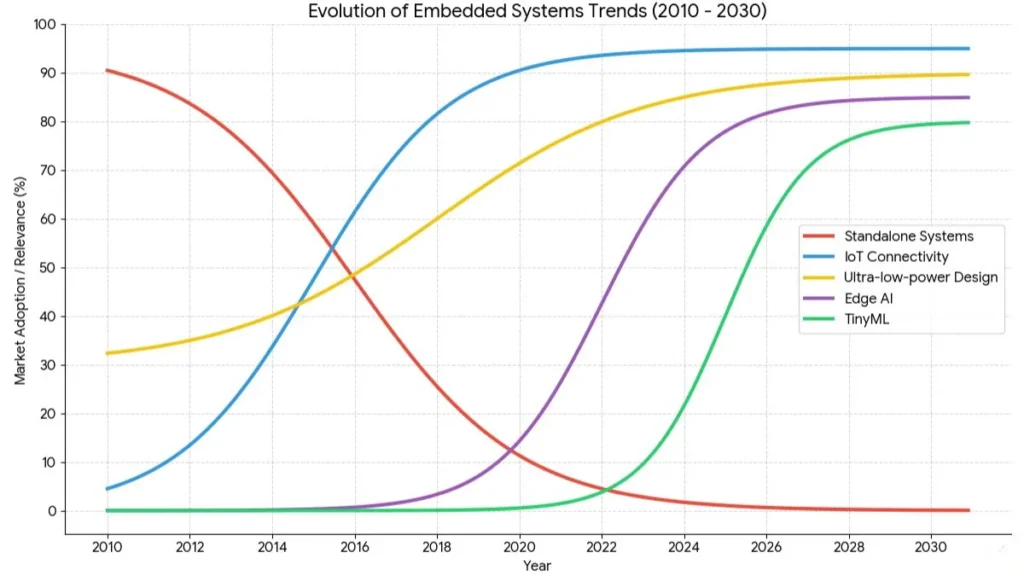
Embedded systems are continuously evolving towards greater intelligence, efficiency, and autonomy. Several technological trends are shaping this evolution.
Edge Artificial Intelligence brings machine learning capabilities directly to embedded devices, enabling them to make intelligent decisions locally without cloud connectivity. Facial recognition cameras, voice assistants that process commands offline, and industrial sensors that detect anomalies are examples of this edge AI integration.
TinyML refers to machine learning models optimized for microcontrollers with severe resource constraints. These ultra-efficient algorithms enable intelligent behavior in battery-powered devices as small as a few millimeters, ranging from environmental sensors to medical implants.
Ultra-low-power design techniques are driving embedded systems towards multi-year battery operation or energy harvesting from ambient sources. Processors operating at microwatts, radios transmitting on nanowatt budgets, and circuits remaining in deep sleep modes enable new deployment scenarios that were previously impossible due to power limitations.
Offline intelligence reduces reliance on network connectivity and cloud services. Embedded systems are increasingly processing complex tasks locally, leading to improved response times, enhanced privacy, and continued functionality during network outages. This distributed intelligence model complements, rather than replaces, cloud computing.
Credit: PCVenus Team
Is Embedded Systems a Good Career Choice?
Embedded systems can be a strong career option for students and professionals who enjoy working with both hardware and software. Instead of building general computer applications, embedded engineers create systems that control real-world devices such as cars, medical equipment, smart appliances, and industrial machines.
This field is especially suitable for people who like problem-solving, logical thinking, and understanding how electronic devices work internally. Since embedded systems are used in almost every modern product, the career demand remains stable across industries.
Skills Required for a Career in Embedded Systems
To start a career in embedded systems, you do not need to know everything at once. Most professionals build skills gradually.
Basic skills include:
- C or C++ programming for embedded applications
- Understanding of microcontrollers and microprocessors
- Basic electronics concepts such as resistors, capacitors, and sensors
- Reading datasheets and hardware manuals
Also Read: Most Popular Programming Languages
As you gain experience, advanced skills become important:
- Real-time operating systems (RTOS)
- Embedded Linux fundamentals
- Communication protocols like UART, SPI, I²C, and CAN
- Debugging tools and logic analyzers
- Basic knowledge of security and power management
These skills are commonly taught in engineering programs and can also be learned through online courses and hands-on projects.
Common Job Roles in Embedded Systems
The embedded systems field offers several job roles depending on experience and specialization.
- Embedded Software Engineer: Focuses on writing firmware and device-level software
- Embedded Systems Engineer: Works on both hardware and software integration
- Firmware Engineer: Develops low-level software for device control
- IoT Engineer: Builds connected embedded devices for smart applications
- Automotive Embedded Engineer: Works on vehicle control and safety systems
Many engineers start in entry-level roles and later specialize in industries like automotive, healthcare, or industrial automation.
Embedded Systems Career Path for Beginners
A typical beginner career path looks like this:
- Learn C/C++ programming and basic electronics
- Work with beginner microcontrollers such as Arduino or STM32
- Build small projects like temperature controllers or motor control systems
- Learn debugging and communication protocols
- Move toward RTOS or Embedded Linux for advanced roles
Hands-on practice plays a big role in this field. Employers often value practical project experience as much as formal education.
Embedded Systems Salary
| Experience Level | United States (USD/year) | Europe (USD/year) | Global Average (USD/year) |
|---|---|---|---|
| Entry-Level Embedded Engineer | $70,000 – $85,000 | $45,000 – $65,000 | $35,000 – $55,000 |
| Mid-Level Embedded Engineer | $90,000 – $120,000 | $65,000 – $90,000 | $55,000 – $80,000 |
| Senior Embedded Engineer / Specialist | $130,000+ | $90,000 – $120,000 | $80,000 – $110,000 |
Industries such as automotive technology, medical devices, aerospace, and semiconductor companies often offer higher compensation.
Industry Demand and Future Growth
Embedded systems professionals are in demand across multiple industries, including automotive, healthcare, consumer electronics, industrial automation, and IoT. The growth of electric vehicles, smart devices, and edge computing continues to increase the need for skilled embedded engineers.
Because embedded systems are tied to physical products rather than trends alone, this career path offers long-term stability compared to some purely software-based roles.
FAQs
What is an embedded system?
An embedded system is a small computer built into a larger device to perform a specific function. It controls how products like washing machines, microwaves, and digital watches operate automatically.
Is Arduino an embedded system?
Arduino itself is a development platform, not a finished embedded system. When an Arduino board is programmed and used inside a device to perform a fixed task, it becomes part of an embedded system.
What is the difference between RTOS and Embedded Linux?
RTOS is used when tasks must be completed within a fixed time. It provides fast and predictable responses, making it suitable for real-time systems like cars and medical devices.
Embedded Linux is used when flexibility and advanced features are needed. It supports complex applications and networking but does not guarantee strict real-time behavior.
What programming languages are used in embedded systems?
C and C++ are the most commonly used languages in embedded systems because they offer fast performance and direct hardware control. Assembly language is used for critical low-level tasks, while Python is used in some higher-level embedded applications.
Is a smartphone an embedded system?
A smartphone contains many embedded systems, such as camera controllers, modems, and power management units. However, as a whole device, it functions more like a general-purpose computer rather than a single dedicated embedded system.
What is the difference between firmware and software?
Firmware is a type of software permanently stored in an embedded device and designed to control hardware functions. Software is a broader term that includes applications running on computers and mobile devices that can be easily updated or replaced.
Do embedded systems need an operating system?
Not all embedded systems need an operating system. Simple systems run directly on hardware, while more complex systems use real-time operating systems to manage multiple tasks efficiently.
Where are embedded systems used the most?
Embedded systems are widely used in automotive systems, consumer electronics, medical devices, industrial automation, and aerospace applications. They are also common in smart home and IoT devices.