


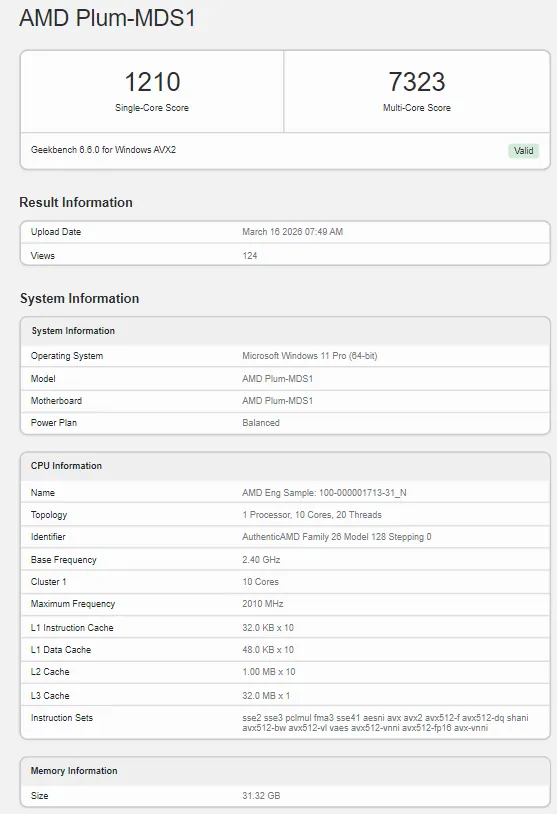
An unreleased AMD processor has appeared in the Geekbench benchmark database, revealing early information about the company’s upcoming Zen 6 mobile platform. The engineering sample carries the identifier 100-000001713-31_N and was tested on a motherboard labeled AMD Plum-MDS1, a platform believed to be associated with AMD’s next-generation Medusa Point laptop processors.
The benchmark entry shows a 10-core, 20-thread configuration, indicating that AMD is experimenting with new CPU layouts for its future mobile architecture. The processor is identified as AuthenticAMD Family 26 Model 128 Stepping 0, a designation commonly used for early silicon during the validation phase of processor development.
According to the Geekbench record, the chip has a base clock of 2.40 GHz, although monitoring data suggests the processor operated closer to 2 GHz during the benchmark run. Reduced operating frequencies are typical for engineering samples, which often run in limited power or validation modes before final firmware and boost algorithms are implemented.
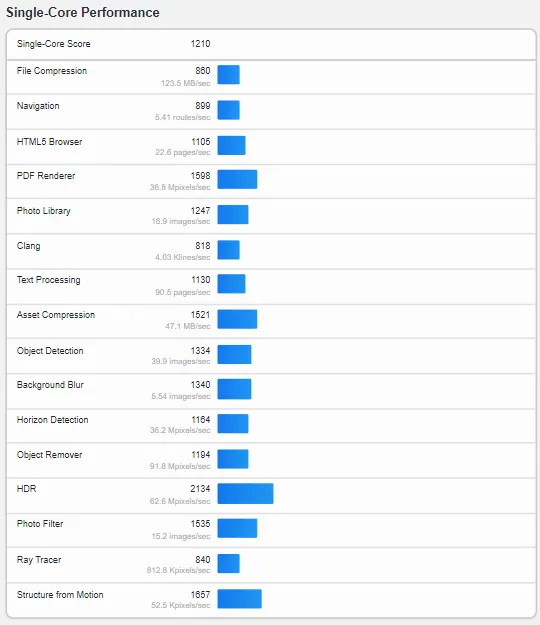
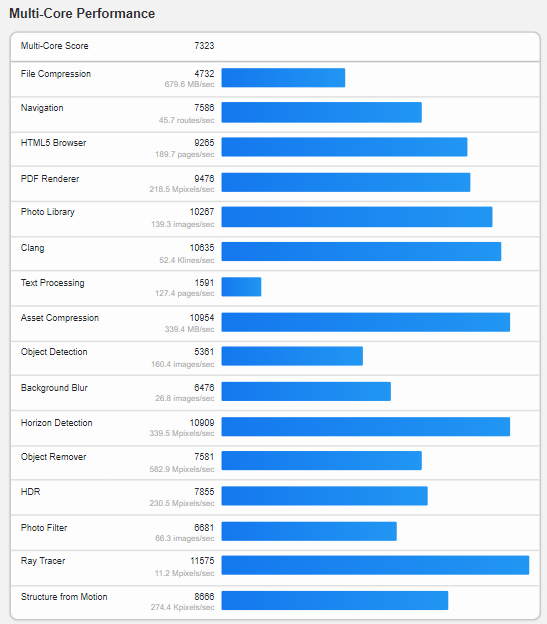
The benchmark system was equipped with 32 GB of memory and running Windows 11 Pro, producing scores of approximately 1210 points in single-core tests and 7323 points in multi-core tests. Because the processor is an early engineering sample running below its expected operating frequency, these results should not be interpreted as final performance.
Each of the ten CPU cores includes 1 MB of L2 cache, while the chip provides a shared 32 MB L3 cache. This represents a clear increase compared with many current AMD mobile processors. For example, the Zen 5-based Ryzen AI 9 365 includes 24 MB of L3 cache, meaning the Medusa Point sample increases total L3 capacity by roughly one-third.
The Geekbench listing does not reveal the internal organization of the ten cores. However, previous leaks related to Medusa Point processors have suggested a hybrid layout combining different core types. Some reports point to a possible 4 + 4 + 2 configuration, consisting of standard Zen performance cores, density-optimized cores, and low-power efficiency cores designed to improve energy efficiency in mobile devices.
The processor was tested on AMD’s Plum platform, which is believed to be an internal evaluation board for the FP10 mobile socket used by Medusa Point processors. This platform is expected to power future Ryzen laptop chips designed for thin-and-light notebooks as well as higher-performance mobile systems.
Medusa Point is widely expected to succeed the Zen 5-based Strix Point architecture, which currently powers the Ryzen AI 300 series of laptop processors. The next generation is expected to introduce Zen 6 CPU cores, updated integrated graphics, and a more capable neural processing unit for on-device AI workloads.
Because the chip detected in Geekbench is an early engineering sample, many specifications may change before commercial release. Clock speeds, core organization, and power targets are typically refined during later development stages as manufacturers prepare processors for mass production.
Even so, the appearance of this processor in a public benchmark database confirms that AMD has begun early validation testing of its Zen 6 mobile architecture. As development progresses, additional engineering samples and benchmark results are likely to surface, providing more details about the capabilities of upcoming Medusa Point laptop processors.
Sources: Geekbench, Benchleaks