

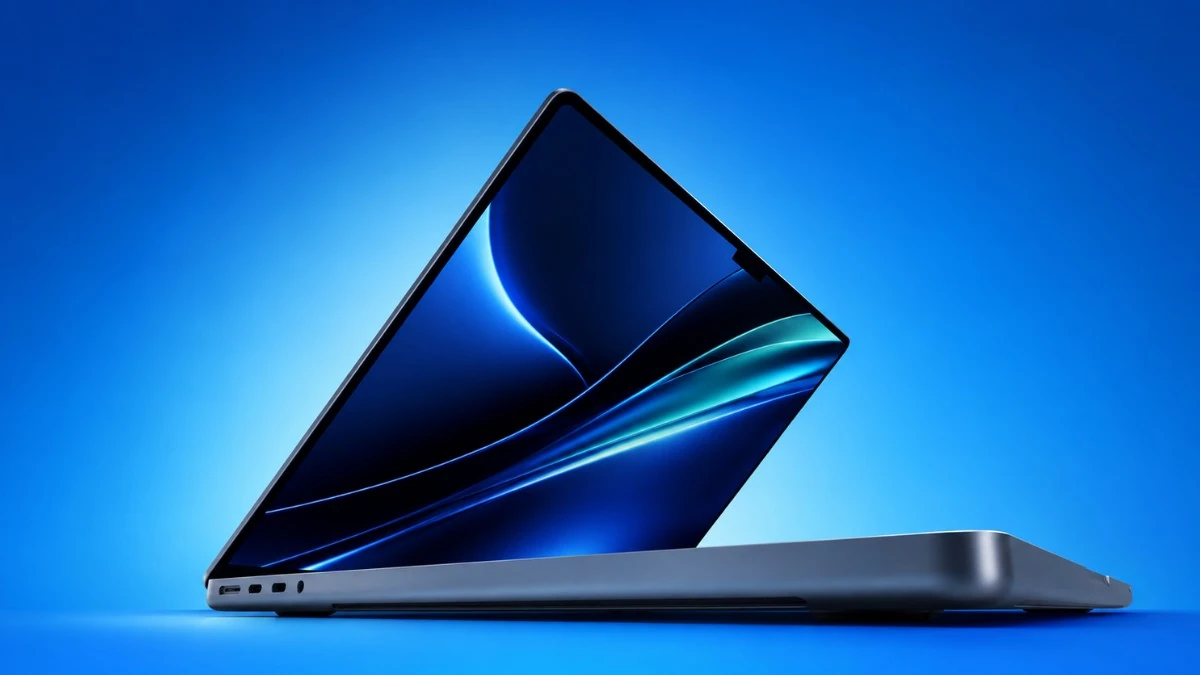
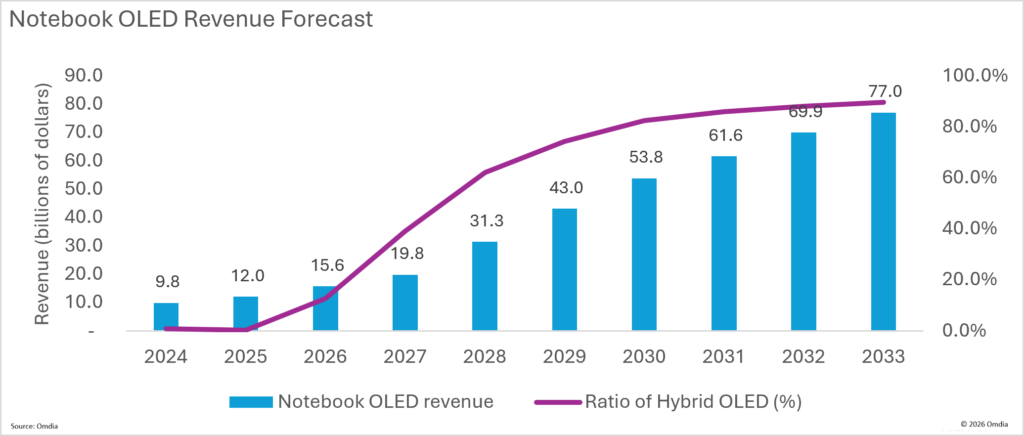
Apple’s first OLED MacBook Pro aka MacBook Ultra could become a major catalyst for hybrid OLED notebook displays, according to a new forecast from market research firm Omdia. The company expects notebook OLED display revenue to approach $4 billion in 2026 as the industry begins shifting toward hybrid OLED panel technology.
Omdia expects Apple’s next-generation 14-inch and 16-inch MacBook Pro/Ultra models to adopt a hybrid OLED architecture that combines oxide TFT backplanes with tandem OLED layers. Apple already uses a similar display structure in its latest iPad Pro models, where the technology delivers higher brightness, improved efficiency, and longer panel lifespan than traditional single-stack OLED panels.
The research firm expects Apple’s adoption of hybrid OLED panels to encourage broader investment across the notebook industry. Display quality, power efficiency, and battery life remain key areas of competition in premium laptops, making hybrid OLED an increasingly attractive option for manufacturers.
Samsung Display has invested heavily in its 8.6-generation OLED production line in South Korea and recently reached a milestone required for mass production. Multiple supply-chain reports have identified Samsung Display as the likely panel supplier for Apple’s first OLED MacBook Pro generation.
OLED suppliers are also testing alternative manufacturing methods for larger panels. Alongside the established Fine Metal Mask (FMM) process, technologies such as inkjet printing (IJP) and Fine Photolithography Mask (FPM) are being evaluated to improve manufacturing efficiency and reduce production costs for notebook-sized displays.
Omdia’s Hybrid OLED Laptop Market Forecast
Omdia projects hybrid OLED panels will account for 12.6% of OLED notebook shipments in 2026. That figure is forecast to rise to 89.5% by 2033, making hybrid OLED the dominant technology within the OLED notebook segment.
Reports from analyst Ming-Chi Kuo and Bloomberg’s Mark Gurman point to additional changes beyond the display upgrade. The redesigned MacBook Pro generation is expected to introduce thinner chassis designs, touchscreen support, and a new display cutout that could replace the notch used on current models.
Those reports also mention Apple’s M6-series processors, which are expected to power the first OLED MacBook Pro generation.
Apple has not officially confirmed any OLED MacBook plans. Current expectations place the launch of the first OLED MacBook Ultra/Pro models in late 2026 or early 2027, although supply-chain conditions could still influence the final timeline.