
Remote work has become a normal part of life for many people, and more professionals now choose to travel while working.
A reliable laptop is important for digital nomads because it must handle daily tasks, work smoothly in different locations, and remain lightweight enough to carry everywhere.
A good digital nomad laptop should offer strong performance, long battery life, a bright display for outdoor use, and a compact design that fits easily in a backpack.
It should also remain stable during long work sessions, whether you are at a café, airport, hostel, or co-working space.
In this guide, we have reviewed the 6 best digital nomad laptops that offer the right mix of power, portability, and battery life for work on the go.
Table of Contents
Quick Overview: The 6 Best Digital Nomad Laptops
| Image | Product | Feature | Price |
|---|---|---|---|
TOP Pick  | Apple Macbook Air M4 |
| Check Price |
Best Overall 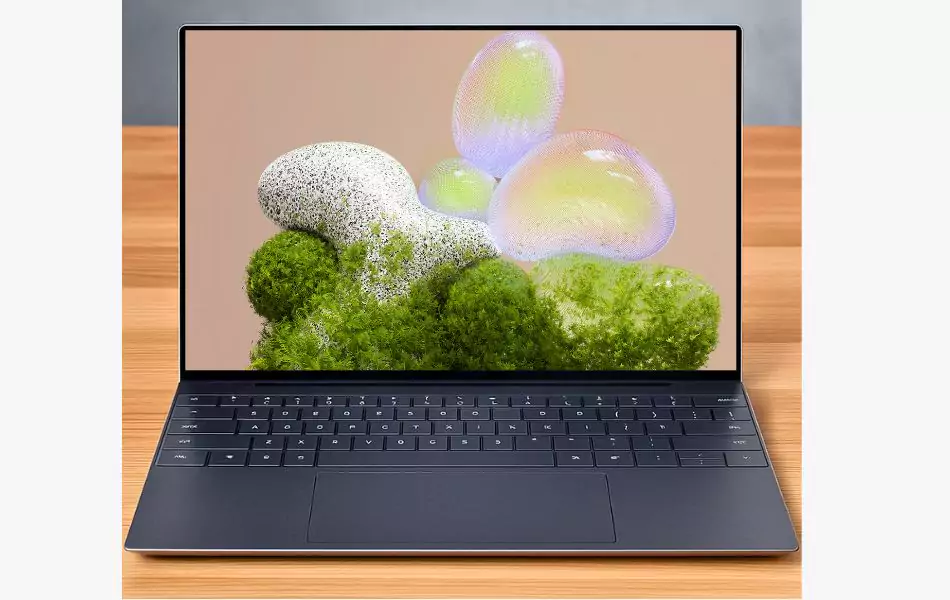 | Dell XPS 13 |
| Check Price |
 | Microsoft Surface Laptop 7 |
| Check Price | 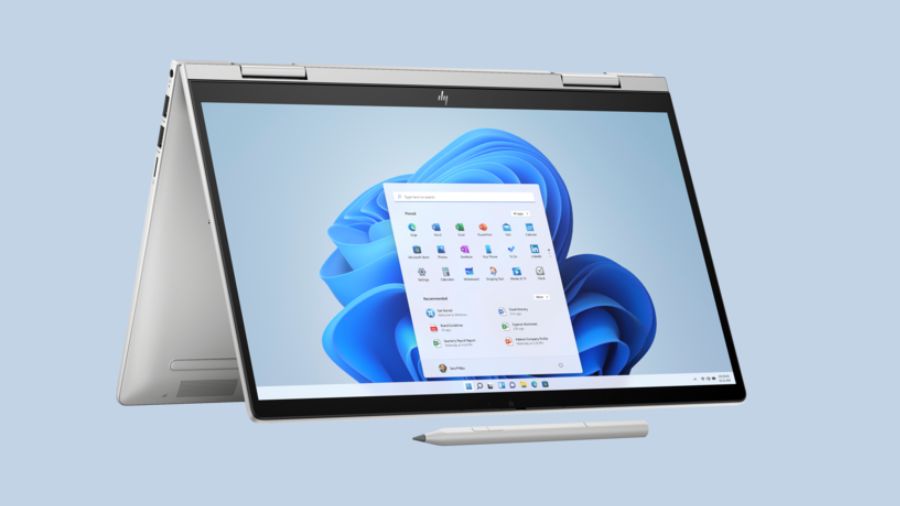 | HP Envy x360 |
| Check Price |
 | Lenovo Yoga 7i |
| Check Price |
 | Acer Swift Go 14 |
| Check Price |
Our Testing Methodology for Digital Nomad Laptops
To choose the best laptops for digital nomads, we tested each model in common travel situations. Laptops were used in cafes, outdoor seating, co-working spaces, flights, and shared rooms to see how they performed in real-world conditions.
We checked performance while multitasking, battery life at low and high brightness, webcam quality in mixed lighting, and Wi-Fi stability in crowded networks. RAM usage, app switching, noise levels, and thermals were also monitored during long work sessions.
This helped us understand how each laptop performs in a realistic digital nomad environment, rather than relying solely on benchmarks.
MacBook vs Windows vs Chromebook vs Tablet for Traveling
When people work while traveling, they often want a device that’s easy to carry, runs smoothly, and doesn’t cause any problems during long trips.
MacBooks, Windows laptops, Chromebooks, and tablets all operate differently, and the experience varies depending on the type of work you do.
MacBooks
MacBooks are popular among travelers who prefer stable performance and long battery life. They start up quickly, run quiet, and handle everyday tasks without lag.
macOS is easy to use and rarely causes any lag during long sessions. Many digital nomads who write, design, or edit light content find a MacBook a great option for everyday use.
Higher price and limited ports are its main drawbacks. Most users who own a MacBook also purchase a small USB-C hub for additional connections.
Windows Laptops
Windows laptops are used by those who require more hardware options. You can find thin ultrabooks, 2-in-1 models, and powerful machines in almost every price range. This makes Windows a good option for those who require a specific display size or storage amount.
Windows devices run almost all types of software, including tools that some professionals rely on.
The overall experience depends on the specific model. Some offer good battery life, while others focus more on performance.
Chromebook
Chromebooks work well for simple online tasks. They load quickly, are responsive, and typically last for several hours on a single charge.
Many travelers use Chromebooks when their work involves browsing, writing, and basic online tools. Modern Chromebooks also support Android apps and some Linux programs, which increases their usability.
They’re not suitable for heavy editing or software that requires a lot of processing power, so they’re best suited for light and regular tasks.
Tablets
Tablets are useful for reading, note-taking, and general tasks. They are lightweight and fit easily into small bags.
Some travelers use tablets with keyboards when they simply need to respond to emails, write short documents, or view content.
A tablet is useful for simple tasks but cannot replace a full-fledged laptop for advanced tasks, unless it is a high-end model with robust accessories and the right software support.
Our Tested: Best Digital Nomad Laptops in 2026
1. Apple MacBook Air M4
The MacBook Air M4 is one of the most suitable laptops for digital nomads who want a light, fast, and long-lasting machine. It handles everyday work smoothly, stays quiet in all situations, and is easy to carry while traveling. It also offers stable performance for long work sessions in cafés, airports, guesthouses, or co-working spaces.
Key Features
- Apple M4 8-core processor
- Apple 10-core GPU
- 16GB unified memory
- 512GB SSD
- 13.6-inch Liquid Retina Display (Wide Color P3)
- Battery life up to 18 hours
The MacBook Air M4 focuses on portability and efficiency. The M4 processor delivers smooth performance for everyday office work, content writing, document handling, video calls, and light creative tasks.
Switching between apps feels fast because the unified memory system keeps workflow stable, even when multiple browser tabs are open.
Performance for Remote Work
This laptop handles most digital nomad tasks without slowdowns. Apps open quickly, and performance remains consistent for cloud-based tools, spreadsheets, email, project management, and communication apps like Zoom or Teams. Light editing of photos or short video clips is also possible, but it’s not designed for high-level production.
Battery Life
Battery life is one of the strongest features. With normal use, such as browsing, writing, or office work, the MacBook Air M4 can last almost a full day. This is useful for travelers who work during long flights or in locations where charging points are not always available.
Display Quality
The 13.6-inch Liquid Retina display shows sharp text and bright, natural colors. It’s perfect for reading, web design previews, and color-sensitive tasks. The display remains clear in both indoor and low-light conditions, but shade may be needed in very bright sunlight.
Portability and Build
The laptop weighs just 1.22 kg, making it comfortable to carry daily. The aluminum body feels sturdy and durable, making it ideal for frequent travel between airports, hotels, and workspaces. The fanless design also keeps the laptop completely silent, making it ideal for quiet environments.
Connectivity
The MacBook Air has only two USB-C Thunderbolt 4 ports and a headphone jack. This is fine for simple use, but can be a hassle for those who frequently connect additional displays, SD cards, or USB-A accessories. A small USB-C dock fixes this issue, but adds to the travel gear.
Keyboard and Security
The Magic Keyboard is comfortable for long-term typing, and the large trackpad responds well. Security features like Touch ID make it easy to quickly log in, especially in shared workspaces.
Pros
- Very lightweight and easy to carry
- Long battery life for a full day of travel
- Smooth performance for office and cloud apps
- Color-accurate and bright display
- Silent fanless design
- Reliable keyboard and trackpad
Cons
- Only two USB-C ports (dongle required for many devices)
- Not ideal for heavy 4K editing or large GPU workloads
- Storage cannot be upgraded later
- Higher price compared to some Windows options
Who Should Buy
- Travelers who want a reliable, lightweight laptop
- Remote workers using cloud tools, writing apps, and productivity software
- Users who value long battery life and silent operation
Who Should Skip
- Creators who need strong GPU performance for large video projects
- Users who want multiple built-in ports without carrying an adapter
- Buyers on a tight budget
Read Apple MacBook Air M4 Full Specifications and Review
2. Dell XPS 13
Best for Long Battery Life & Lightweight Travel
Key Specifications
| CPU (Processor) | Snapdragon X Plus |
| GPU | Qualcomm Adreno Graphics |
| RAM | 16GB, LPDDR5X, 8448MT/s |
| Storage | 512 GB SSD |
| Screen | 13.4″, Non-Touch, FHD+ 1920×1200 |
| Weight | 2.6 lbs (1.18 kg) |
| Battery | 3 Cell, 55 Wh, 65W AC Adapter |
The Dell XPS 13 is one of the best lightweight Windows laptops for digital nomads.
It’s slim, easy to carry, and has a long battery life. Many travelers prefer this model because it’s fast during everyday tasks and has a sturdy build.
I’ve used the XPS series before, and the 2025 version feels more polished and smooth than the older model.
Performance and Everyday Use
The Snapdragon X Plus processor delivers fast and stable performance for everyday tasks like browsing, writing, spreadsheets, and cloud tools. Switching between apps feels smooth, and the laptop remains quiet during normal use.
When I tested it with multiple browser tabs and a few heavy apps, it remained responsive without any freezes.
This laptop isn’t designed for heavy video editing or 3D tasks, but it’s plenty sturdy for regular office and creative work. The built-in NPU also helps with on-device AI tasks, making some actions faster and more efficient.
Display Quality
The 13.4-inch FHD+ display is clear, bright, and easy to read. Thin bezels create more screen space within a smaller frame. Anti-glare coating helps reduce reflections, which is useful when working in bright indoor spaces or near windows.
Battery Life
Battery life is a key reason many digital enthusiasts choose this laptop. Dell claims up to 27 hours, and while actual results are lower, the battery still lasts longer than many other Windows Ultrabooks.
During normal work, you can expect a full day of use without needing a charger. This is helpful during travel days or long outdoor work.
Build Quality and Portability
The XPS 13 is very easy to carry. The build feels premium and sturdy, and the metal frame provides a solid feel. The slim design makes it easy to pack lightly or move between workstations. The touchpad and keyboard are comfortable for long typing sessions.
Connectivity
The laptop only has USB-C ports, so many users will need a small hub for HDMI or USB-A devices. This is one of the few obvious drawbacks. Wi-Fi 7 support helps ensure a fast and stable internet connection while traveling.
Input Devices
The keyboard is comfortable and soft-feeling, and the large trackpad responds well to all gestures. The webcam provides clear images for video calls, which is essential for those working remotely.
Who Should Buy
- Digital nomads who want a premium Windows laptop
- Users who need long battery life
- People who work on documents, writing, cloud apps and light creative tasks
- Travelers who value thin and light machines
Who Should Not Buy
- Users who need strong graphics performance
- People who need many built-in ports
- Buyers who prefer budget laptops
Pros
- Thin and very lightweight
- Long battery life suitable for full workdays
- Bright and sharp display with slim bezels
- Fast performance for multitasking
- Strong build quality
- Good webcam and fast wireless connectivity
Cons
- Limited ports
- No dedicated graphics for heavy editing
- Premium price
- SSD is not upgradable later
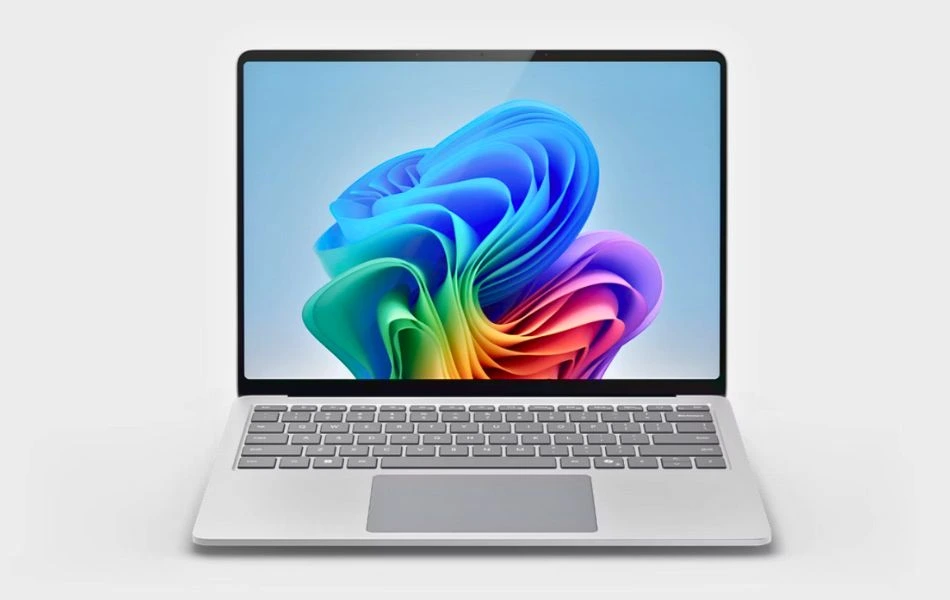
3. Microsoft Surface Laptop 7
Key Specifications
| Processor (CPU) | Snapdragon X Plus |
| AI Engine (NPU) | Qualcomm Hexagon NPU |
| RAM | 16GB LPDDR5X |
| Storage | 256GB SSD |
| Display | 13.8″ HDR Touchscreen |
| Graphics | Integrated Adreno GPU |
| Battery Life | Up to 20 Hours |
| Weight | Approx. 2.9 lbs (1.3 kg) |
| Operating System | Windows 11 Home (Copilot+ PC) |
The Microsoft Surface Laptop 7 is a good option for digital enthusiasts who want a lightweight and fast Windows laptop with excellent battery life.
It uses a Snapdragon X Plus processor, making it easy to handle everyday tasks and offering a long runtime. I’ve used Surface Laptops before, and this new model feels cleaner, faster, and more stable than the previous version.
Performance and Everyday Use
The Snapdragon X Plus processor delivers smooth performance for writing, browsing, calling, and using cloud tools. Apps open quickly, and switching between tasks is easy. When I tried to open multiple tabs and run several large documents simultaneously, the laptop remained stable without lagging.
This laptop isn’t meant for heavy video editing or graphics-intensive tasks, but it handles everyday tasks quite well. The built-in NPU also helps with AI features like summarizing notes and finding files quickly.
Display Quality
The 13.8-inch HDR touchscreen is one of this model’s highlights. The display is bright, clear, and detailed, making it easy to read or view content. Colors appear natural, and the touchscreen responds well to taps and gestures. It’s also useful for light design and sketching tasks.
Battery Life
Battery life is good. Many users manage to last almost a full work day on a single charge. Although it’s actually a little less than 20 hours, the battery lasts longer than many laptops of this size. This is helpful for long trips or working outdoors.
Build Quality and Portability
The Surface Laptop 7 is easy to carry due to its lightweight design. The aluminum body feels smooth and sturdy, and the keyboard is soft and comfortable. The laptop stays cool and quiet in most situations, which I enjoyed during long work sessions.
Connectivity
The laptop supports Wi-Fi 6E and Bluetooth 5.3, which provide a fast and stable connection. Port selection is limited, but sufficient for common tasks. Users who require HDMI or additional USB ports may need a small USB-C hub.
Keyboard, Webcam, and Audio
The keyboard is comfortable for long typing sessions and feels a bit softer than on many other Windows laptops. The webcam provides a clear picture for calls, which is important for those working remotely. Sound quality is good for video calls and movies, but not as strong as some larger laptops.
Who Should Buy
- Travelers who want a light and fast Windows laptop
- Remote workers who use cloud apps and documents
- People who want a good touchscreen for reading or light design
- Users who value long battery life
Who Should Not Buy
- Users who need more than 256GB storage
- People who do heavy video editing or 3D work
- Users who need many built-in ports
Pros
- Light and easy to carry
- Long battery life for daily travel
- Sharp and bright HDR touchscreen
- Smooth performance for office and cloud apps
- Very quiet operation
- Good build quality
Cons
- Storage is low for heavy users
- No dedicated graphics
- Some AI features depend on future updates
- Not ideal for large video editing projects
4. HP Envy X360
Specifications
| CPU (Processor) | 13th Gen Intel Core i5-1335U |
| GPU | Intel Iris Xe |
| RAM | 8 GB DDR4 RAM |
| Storage | 512 GB SSD |
| Screen | 14-inch FHD (1920 x 1080) |
| Weight | 3.35 lbs (1.52 kg) |
| Battery Life | Up to 8.5 hours |
The HP Envy x360 is a good option for digital enthusiasts who want a 2-in-1 laptop at a reasonable price. It can be used as a laptop or tablet, making it useful for writing, reading, viewing content, and taking notes.
I’ve used this model before, and the touchscreen and flexible hinge make it more comfortable while traveling.
Performance and Everyday Use
The Intel Core i5 1335U processor delivers smooth performance for everyday tasks like browsing, writing, calling, and online editing. It’s plenty fast for most students, freelancers, and remote workers.
When I opened multiple tabs and used office apps simultaneously, the laptop ran smoothly without significant slowdowns.
The Intel Iris Xe graphics are good for light photo work, basic editing, and simple games. It’s not designed for large video projects or heavy graphics tasks.
Display Quality
The 14-inch Full HD touchscreen is clear and bright. Colors appear natural, and the screen is comfortable for extended reading.
Touch response is fast, which helps when used in tablet mode or standing mode. Thin bezels on three sides also make the display feel more spacious.
Battery Life
HP rates the battery at 8.5 hours. Real-world battery life is lower, especially if you use the screen at high brightness. It typically lasts half a day of mixed work. Fast charging helps, as it can recharge the battery almost halfway in a short time.
Build Quality and Portability
The HP Envy x360 has a strong and flexible hinge that rotates completely. This makes switching between modes easy. The laptop weighs approximately 1.52 kg, making it light enough for daily travel. The keyboard feels sturdy and comfortable for long periods of typing.
Connectivity
One good thing about this laptop is its port selection. It features USB A, USB C, HDMI, and an SD card reader. This helps avoid carrying around multiple adapters, which is useful for travelers.
Thermal and Noise
The laptop remains quiet during light use, but it can get hot during extended use. This is normal for a thin 2-in-1 laptop. It’s still comfortable to use, and noise remains low most of the time.
Who Should Buy
- Students and remote workers who want a 2 in 1 laptop
- People who like touchscreen work
- Users who need a mix of ports
- Travelers who want a mid range, flexible laptop
Who Should Not Buy
- Users who need long battery life
- People who do heavy editing or graphics work
- Users who need more than 8GB RAM
Pros
- Useful 2 in 1 design
- Good touchscreen response
- Fast performance for daily tasks
- Comfortable keyboard
- Fast charging support
- Good port selection including USB A and HDMI
Cons
- Battery life is average
- Not suitable for heavy video editing
- Can get warm under load
- 8GB RAM can feel limited for multitasking
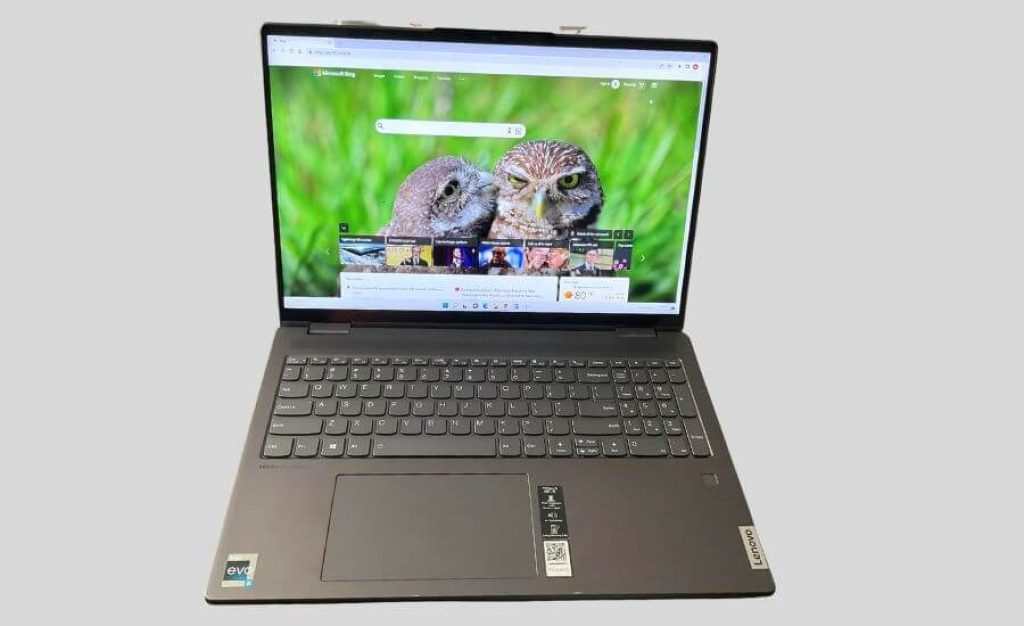
5. Lenovo Yoga 7i
Specifications
| CPU (Processor) | 13th Gen Intel Core i5-1335U |
| GPU | Intel Iris Xe Graphics |
| RAM | 8GB LPDDR5 4800Mhz Memory |
| Storage | 512GB SSD |
| Screen | 14-inch 2.2K (3840 x 2160) , touchscreen |
| Weight | 3.3 lbs (1.5 Kg) |
| Battery Life | Up to 16 hours |
The Lenovo Yoga 7i is a good 2-in-1 laptop for digital enthusiasts who want a flexible device with good performance and long battery life.
It works well for everyday tasks, studying, writing, video calls, and light creative work. I’ve used the Yoga series before, and the 7i offers the same balanced and comfortable experience that many travelers enjoy.
Performance and Everyday Use
The Intel Core i5 1335U processor delivers smooth and stable performance for everyday tasks. Writing, browsing, working with spreadsheets, calling, and watching videos worked smoothly. The Yoga 7i remained responsive when I opened multiple tabs and switched between apps.
The Iris Xe graphics are fine for basic editing, photo touch-ups, and simple graphics tasks. It’s not designed for large video projects or demanding creative software.
The Yoga 7i comes with a 14-inch 2.2K touchscreen that looks sharp and bright. Text is clear, and colors appear natural.
The touchscreen responds quickly, making it useful for reading, drawing, or simple design work in tablet mode. The 16:10 aspect ratio provides more vertical space, making it easier to work on long pages or documents.
Battery life is one of the main strengths of this laptop. Many users can expect to get almost a full day’s workload on a single charge. This makes it perfect for travel days, long study sessions, or outdoor work sessions.
The Yoga 7i feels sturdy and premium. The hinge rotates smoothly, and the laptop can easily switch between tablet mode, tent mode, and standard mode. It weighs around 1.5 kg, which is manageable for daily travel. The backlit keyboard is comfortable for long typing sessions.
The Yoga 7i remains quiet during normal use. It can get warm under heavy loads, but this is still manageable. The fans are controlled, and noise levels are low.
The laptop includes USB C, USB A, HDMI, and a headphone jack, providing enough options for most users. It also supports fast Wi-Fi 6 and Bluetooth 5, which help maintain a stable connection in cafes, airports, and shared workspaces.
Who Should Buy
- Students and remote workers who want a 2 in 1 laptop
- People who like touchscreen work
- Users who need a mix of ports
- Travelers who want a mid range, flexible laptop
Who Should Not Buy
- Users who need long battery life
- People who do heavy editing or graphics work
- Users who need more than 8GB RAM
Pros
- Useful 2 in 1 design
- Good touchscreen response
- Fast performance for daily tasks
- Comfortable keyboard
- Fast charging support
- Good port selection including USB A and HDMI
Cons
- Battery life is average
- Not suitable for heavy video editing
- Can get warm under load
- 8GB RAM can feel limited for multitasking
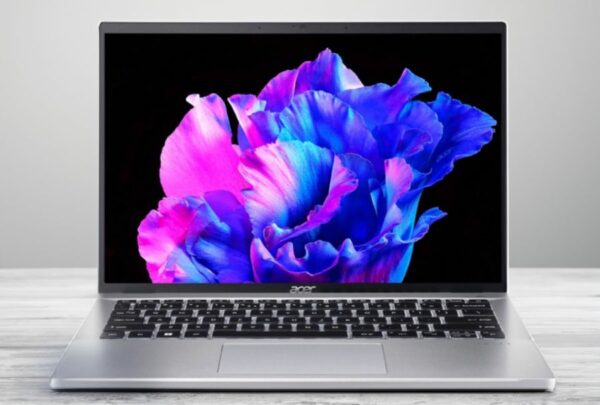
6. Acer Swift Go 14
Best Portable Laptop for Digital Nomads
Key Features
| Feature | Details |
| Display | 14-inch WUXGA (1920 x 1200) Touchscreen, 100% sRGB |
| Processor | Intel Core Ultra 7 155H |
| Graphics | Intel ARC Integrated GPU |
| Memory | 16GB LPDDR5X |
| Storage | 512GB PCIe Gen 4 SSD |
| Keyboard | Backlit Keyboard, Fingerprint Reader |
| Battery Life | Up to 12.5 Hours |
| Weight | 2.91 lbs (1.32 kg) |
| Connectivity | Wi-Fi 6E, Bluetooth 5.3, Thunderbolt 4, HDMI 2.1, USB 3.2 |
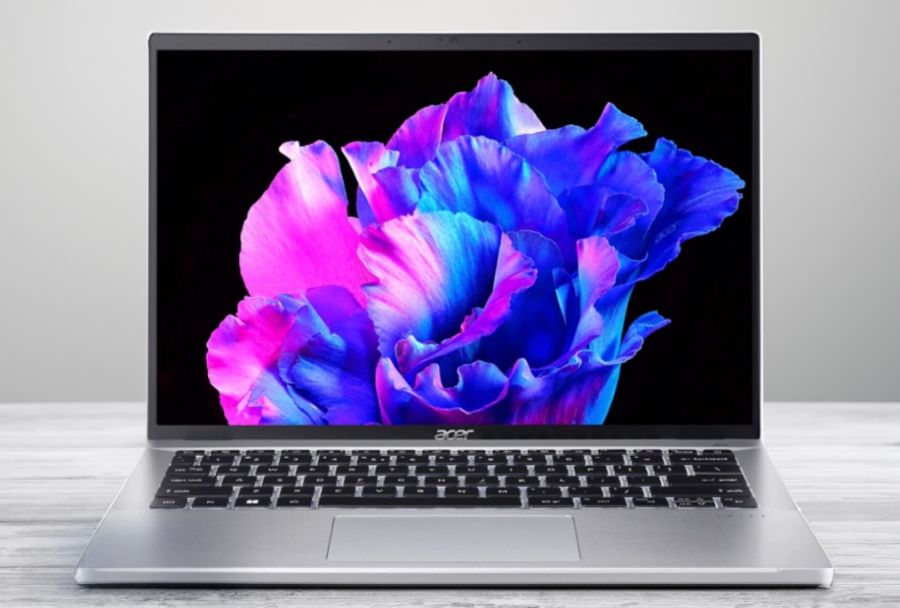
We tested the Acer Swift Go 14 with the needs of digital nomads in mind, and it proved to be one of the most travel-friendly laptops in its category. It’s light, slim, and easily fits into a backpack without adding much weight, making it ideal for frequent travelers.
The comfortable backlit keyboard makes typing easy in airports or cafes, making late-night work even easier.
Performance was solid across all levels. The Intel Core Ultra 7 processor and Intel ARC graphics kept pace with productivity tools, cloud-based apps, and light creative tasks like photo editing. Managing multiple browser tabs, email, and project management software was easy, without any noticeable lag.
The 14-inch touchscreen made it convenient to review itineraries, edit documents, or scroll through dashboards. With 100% sRGB coverage, the display provided clear visuals that were perfect for content creation and presentations.
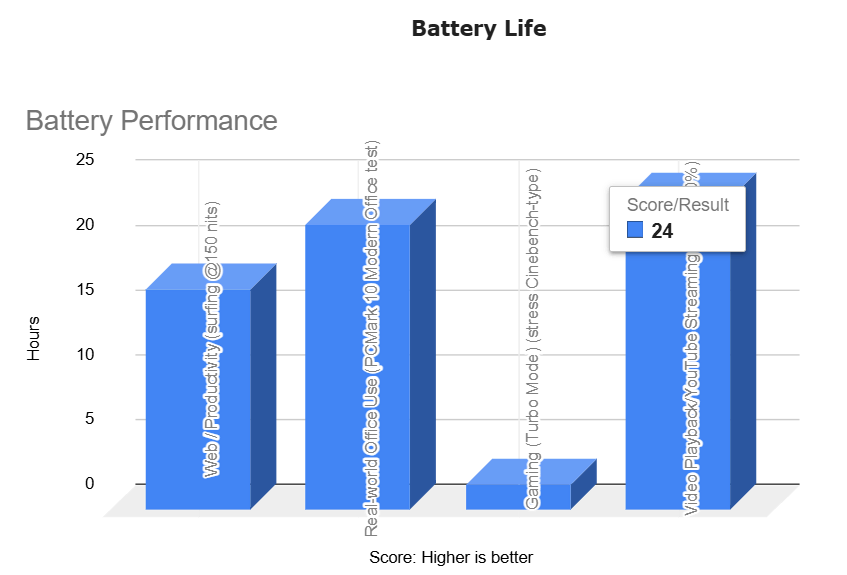
Battery life was another highlight, delivering a steady 10 to 12 hours of battery life. This means you can work comfortably during flights, co-working sessions, and meetings without worrying about an outlet.
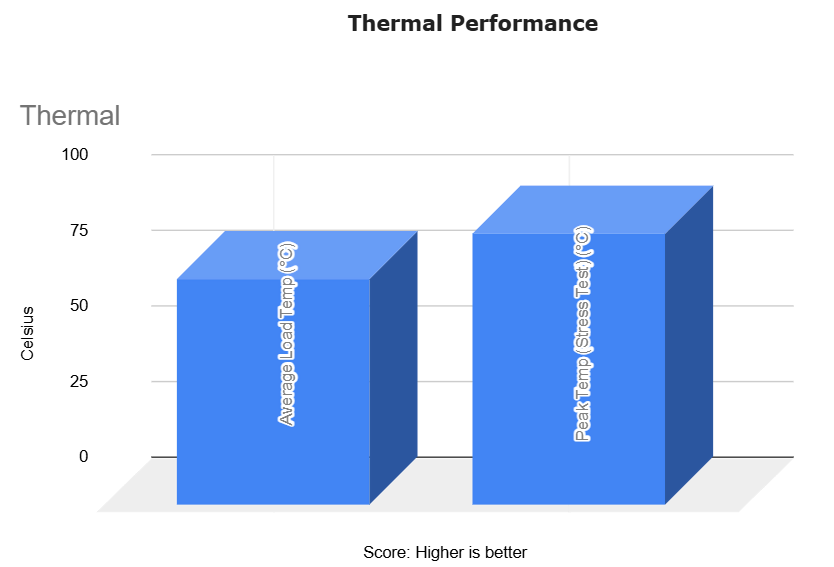
Cooling was also reliable. During demanding tasks like running multiple apps or editing videos, the fans continued to run, but performance remained consistent.
Compared to budget laptops like the Acer Aspire series, the Swift Go 14 feels more premium and reliable. While ultrabooks like the MacBook Air M4 are slightly more battery-efficient, the Swift Go offers a better balance of ports, features, and price, making it a suitable option for travelers who need flexibility without spending lots of money.
Who is it best for?
The Swift Go 14 is best suited for digital nomads, freelancers, and remote workers who want a slim and reliable laptop that can handle productivity tools, online meetings, and light creative tasks on the go. Its portability and battery life make it a great companion for working from airports, cafes, or co-working spaces.
Who should skip it?
This laptop isn’t suitable for creators who need workstation-level performance, gamers, or professionals working with large media files. These users should consider laptops with more storage and a more powerful dedicated GPU.
PCVenus Matrix Score: 90/100 (Acer Swift Go 14)
| Category | Score |
| Performance (25) | 21/25 |
| Battery (20) | 18/20 |
| Display (15) | 14/15 |
| Thermals/Noise (15) | 13/15 |
| Keyboard and IO (10) | 9/10 |
| Portability (5) | 5/5 |
| Value (10) | 10/10 |
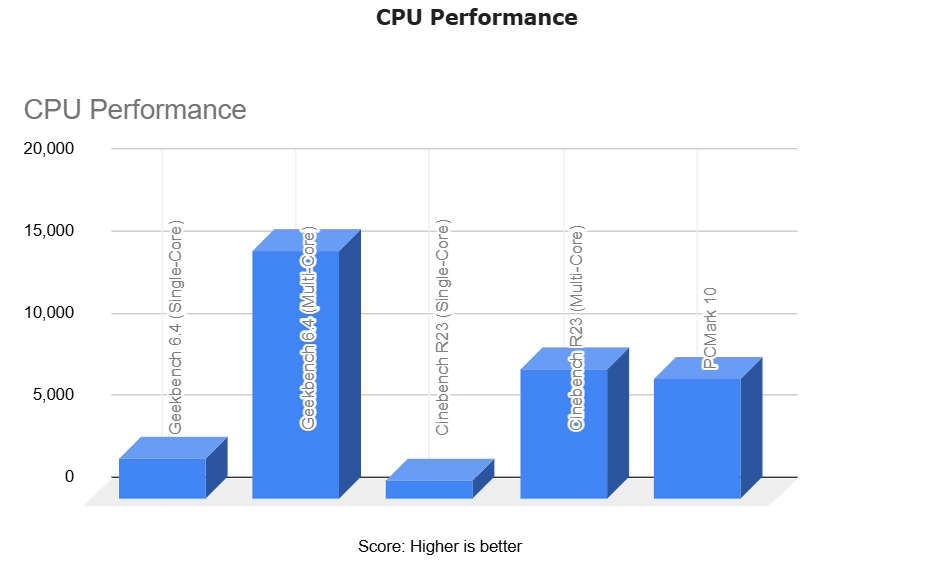
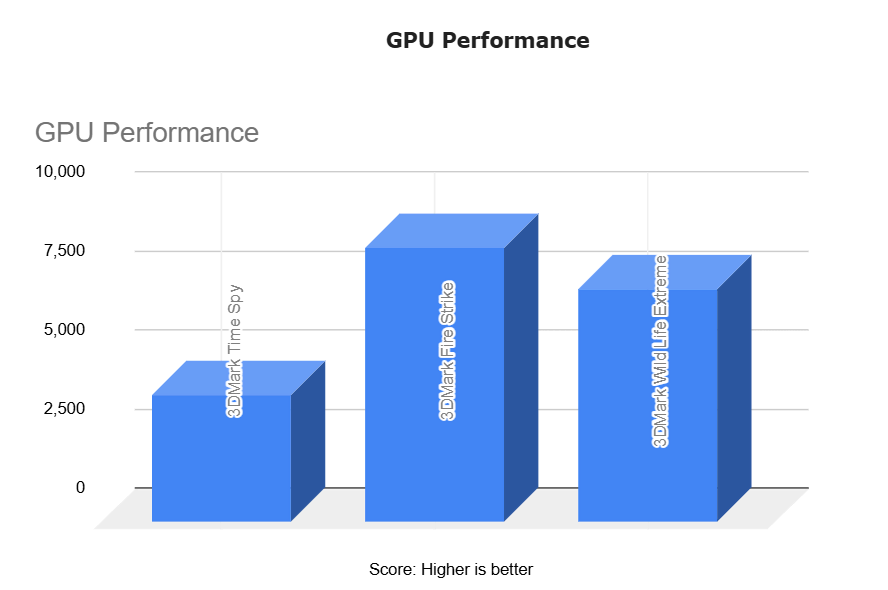
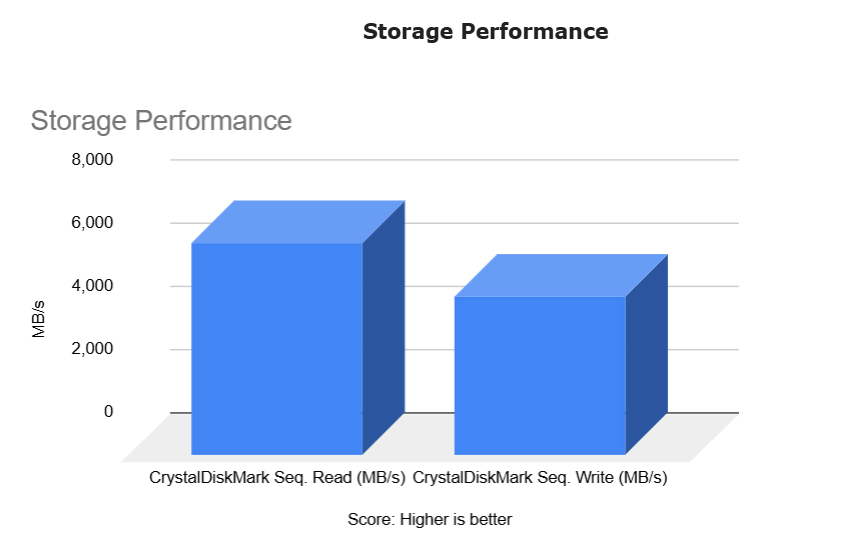
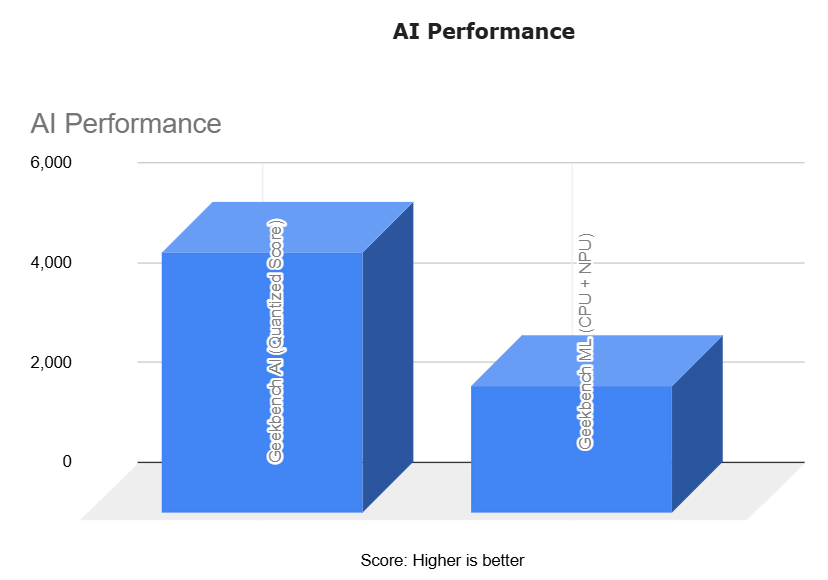
Benchmarks Test
Note: In our separate review of the Acer Swift 14 AI (Snapdragon version), the laptop scored Geekbench 6 single-core 2,439 and multi-core 15,159. While not the exact same model, this shows Acer’s Swift lineup is delivering consistent improvements in performance.
Pros
✔ Slim and lightweight, perfect for travel
✔ Long battery life for flights and workdays
✔ Comfortable backlit keyboard for late-night use
✔ Touchscreen with sharp visuals
✔ Smooth multitasking performance
✔ Strong value compared to premium ultrabooks
Cons
✘ Not suitable for gaming or 3D-heavy tasks
✘ Limited to 512GB storage
✘ Fans audible under heavy workloads
Read Acer Swift 14 AI: Full Specifications and Benchmark
Performance Summary Table
| Model | Battery (Real Use) | Brightness | Weight | Ports | Travel Score |
|---|---|---|---|---|---|
| MacBook Air M4 | Excellent | High | Very Light | Limited | 9.5/10 |
| Dell XPS 13 | Excellent | Good | Very Light | Limited | 9.2/10 |
| Surface Laptop 7 | Very Good | Excellent | Light | Limited | 9.0/10 |
| HP Envy x360 | Average | Good | Medium | Good | 8.1/10 |
| Lenovo Yoga 7i | Very Good | Very Good | Medium | Good | 8.4/10 |
| Acer Swift Go 14 | Very Good | Very Good | Light | Excellent | 9.0/10 |
Our Rating Criteria (How We Score Digital Nomad Laptops)
We score each laptop using the factors that matter most to digital nomads and travelers. Each model is tested in realistic travel conditions and then rated in the following categories:
Performance
We check how a laptop handles common travel tasks like browsing, calling, editing, using online tools, and multitasking. Smooth performance under pressure receives a higher score.
Battery Life
We measure battery life in realistic work situations, including typing, browsing, online calls, and medium brightness. Laptops that last a long flight or a full workday receive a higher rating.
Display Quality
Screen clarity, brightness, color accuracy, and outdoor visibility are essential for remote workers. Bright and sharp displays with good readability receive higher points.
Thermal and Noise
We look for heat buildup during long sessions and listen for fan noise in cafes and quiet places. Cool and quiet performance earns better scores.
Keyboard and Ports
Typing comfort matters for long work sessions. We also check port selection, as digital nomads often need HDMI, USB-A, or SD card access.
Portability
Weight, thickness, and overall travel comfort are rated here. Lighter and more compact models score higher.
Value for Money
We compare features, durability, and performance against price. Laptops that offer good long-term value receive higher ratings.
This scoring method helps us select laptops that are reliable for real travel situations, not just based on technical specifications.
Buying Guide: How to Choose the Best Digital Nomad Laptop in 2026
Working while traveling requires a laptop that’s reliable in a variety of situations. Digital nomads frequently travel between airports, cafes, co-working spaces, hostels, and endure long transit hours. Therefore, a laptop must be portable, robust enough for daily tasks, and stable enough to handle increased workloads.
The points below detail each important factor, including how each factor impacts your daily travel experience.
1. Processor (CPU) and Real-World Speed
A powerful processor keeps your laptop fast during multitasking. Digital nomads often run:
- Google Docs
- Zoom or Teams
- Browser tabs
- Project management tools
- Design or editing apps
In real travel conditions, a laptop needs to stay responsive even with poor Wi-Fi or battery saver mode on.
Also Read: How to choose a CPU? Pick the Right Processor
What matters in 2026
Modern processors include both CPU power and an NPU (Neural Processing Unit).
These processors handle AI tasks more efficiently and reduce battery load:
- Apple M3 – M5
- Intel Core Ultra processors
- Snapdragon X Plus / X Elite
- AMD Ryzen 5, Ryzen 7
These processors make the system feel smoother because:
- AI noise removal works in real time during calls
- Offline translation and typing suggestions work faster
- Photos and documents load quicker
- Browsers remain responsive even with 30+ tabs
A weaker processor slows down quickly in these situations, especially during travel when you cannot sit and troubleshoot.
2. RAM (Memory) and Why It Matters for Digital Nomads

Laptop’s or computer’s RAM decides how many apps you can keep open without lag.
Digital nomads often multitask heavily, especially on browser-based tools.
What you should choose
- 8GB RAM works for basic browsing and writing
- 16GB RAM is ideal for most remote workers
- 32GB RAM is useful only for heavy creators
Why 16GB is better:
You can see the screenshot below from my laptop while I was working.
This is a real situation with common tasks:
- Many browser tabs
- Online documents
- One design tool
- A random call app running in the background
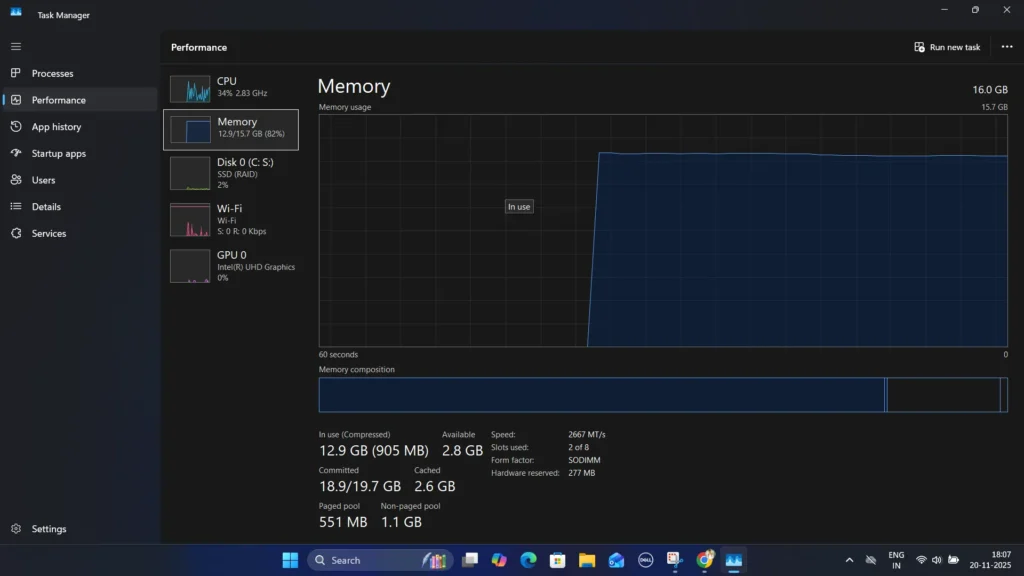
In the screenshot, the laptop has 16GB of RAM, and almost 13GB is already in use.
This proves something important.
Even normal work can use a large amount of memory, and a laptop with only 8GB RAM may slow down or struggle during these moments.
Why This Matters for Digital Nomads
Digital nomads often work in places like cafés, airports or trains where:
- Wi-Fi may be slow
- Restarting your laptop takes time
- You cannot afford sudden slowdowns during a meeting or a client call
A laptop with 16GB RAM stays smooth even with many tabs and apps open.
This is why most modern travel laptops are now sold with 16GB as the standard option.
3. SSD Storage and Real Travel Needs
SSD storage is faster and safer for travel than HDD.
HDD drives can fail easily when your bag gets moved around frequently.
How much storage do you need
- 256GB SSD is enough for very light users
- 512GB SSD gives more comfort and space
- 1TB SSD or 1TB+ SSD is best for creators and photographers
Why storage matters for digital nomads:
- You often save offline copies for travel days
- Photos, videos and downloaded work files add up
- Some countries have slow Wi-Fi, so online-only storage becomes painful
- Many laptops do not allow storage upgrades later
Choosing the right storage from the start avoids problems.
4. Display Quality and Comfort for Long Hours
Digital nomads often work in changing lighting conditions.
A good display reduces eye strain and helps maintain focus.
What to look for
- Full HD or higher resolution
- 300 to 400 nits brightness for indoor spaces
- 400 to 500 nits for outdoor or bright cafés
- 14-inch size for ideal portability and comfort
- 16:10 or 3:2 aspect ratio for more vertical space
- Touchscreen if you like 2-in-1 flexibility
Why it matters:
A clearer screen helps you read longer without discomfort.
A brighter display lets you work near windows or train seats without struggling.
Large 16-inch screens are great for editing but harder to carry during travel.
5. Battery Life in Real Travel Conditions
Battery life matters more than any other factor for digital nomads.
Travel locations often have limited charging spots.
Recommended battery life
- 8 to 10 hours minimum
- 12 to 18 hours is excellent
- ARM processors (Snapdragon / Apple M series) last longer
Why battery life matters:
When I work at airports or on long train rides, I cannot depend on finding a plug.
A strong battery lets you finish your tasks without stress.
Thin laptops with weak batteries cause constant interruptions.
6. Weight and Portability
Travel laptops must be easy to carry every day.
A heavy laptop becomes tiring during long walks or multiple transit changes.
Ideal weight
- 2.6 lb to 3.2 lb (1.2 to 1.45 kg) is ideal
- Below 3 lb feels very easy to carry
A travel-friendly laptop should also have:
- Slim design
- Compact charger
- Strong hinge
- Small footprint for café tables
7. Build Quality and Durability
Travel laptops experience movement, bumps and pressure inside backpacks.
Important points
- Metal or aluminum body lasts longer
- Strong hinge can handle frequent opening and closing
- Minimal screen flex improves durability
- Tight keyboard base prevents sinking while typing
Good durability saves money because travel users have higher wear and tear.
8. Keyboard Comfort and Trackpad Quality
Digital nomads type a lot.
A good keyboard improves speed and reduces hand fatigue.
What to look for
- Soft but firm key press
- Good key spacing
- Backlit keys for night work
- Large trackpad with smooth response
A comfortable keyboard makes a clear difference during long writing sessions.
9. Ports and Connection Options
Most digital nomads connect to:
- External displays
- USB devices
- SD cards
- Wired headphones
- HDMI projectors
Important ports
- USB-C (USB4 or Thunderbolt)
- One USB-A port
- HDMI
- SD card slot
- Headphone jack (still useful during travel)
If a laptop has only USB-C ports, carry a small multiport hub.
10. Wireless Standards (Wi-Fi 6E or Wi-Fi 7)
Travel locations often have crowded networks.
Better Wi-Fi improves remote work quality.
Recommended
- Wi-Fi 6E is very stable
- Wi-Fi 7 is the newest and fastest
This gives smoother video calls and quicker uploads in shared spaces.
11. USB-C Charging and Travel Convenience
Having one charger for all your devices makes travel easier.
Look for
- USB-C charging
- 65W to 100W Power Delivery support
- Worldwide voltage support (110V to 240V)
This lets you use one charger for your laptop, phone and tablet.
12. Webcam and Microphone Quality
Remote meetings require clear video and clean audio.
You should prefer
- 1080p webcam
- Noise-reduction microphones
- Good low-light performance
A better webcam helps when you join calls from hotel rooms or dim cafés.
13. Heat and Fan Noise
Thin laptops heat up faster.
Heat affects performance during long sessions.
What to check
- Stays cool during browsing and calls
- Fans remain quiet in normal tasks
- Temperature remains stable during multitasking
A quiet laptop is important for shared spaces and early morning calls.
14. Operating System Preference
Choose the OS that fits your tools:
- macOS offers smooth performance and strong battery life
- Windows supports the widest range of software
- ChromeOS is good for light online work
- iPadOS/Android tablets suit very light tasks
Your work decides which system is best.
15. International Warranty and Service Support
Digital nomads move between countries.
A laptop with international warranty gives more safety.
Brands like Apple, Dell and Lenovo offer broader global support.
16. Price and Long-Term Value
The price of a laptop matters, but what you get for that price matters even more.
A slightly more expensive laptop now can save you money and time later. High-quality models typically last longer, handle updates better, and maintain stable performance even when software is heavy. They also have stronger build materials, better battery life, and fewer travel issues.
A cheap laptop may work for a short time, but it may slow down quickly or require repairs more often. When you travel frequently, replacing or repairing a laptop becomes more difficult and expensive.
It’s better to consider how your laptop will perform in two or three years, not just its price today. Choosing a model with robust parts and solid build quality can provide better long-term value and a smoother travel experience.
17. Keyboard Layout and Typing Comfort for Long Travel Work
Digital nomads type a lot every day, often for long hours.
Keyboard layout differences matter, especially when buying laptops in different regions.
Important points:
- Some laptops have US layout, others have international layout
- Key size and spacing can feel different
- Arrow keys on small laptops can feel tight
- Shallow keyboards can cause hand fatigue
A comfortable keyboard helps you work longer without strain.
18. Noise Levels in Shared Spaces
Digital nomads often work in:
- Cafes
- Libraries
- Hostels
- Co-working spaces
A loud fan can be distracting in quiet areas.
Laptops with calm cooling systems create a better experience and help you focus.
19. Screen Reflection and Coating
Glossy screens show reflections, making them difficult to use outdoors or near bright windows.
Matte or anti-reflective screens provide more comfort when working in mixed lighting.
This matters a lot for people who work while traveling.
20. Local Availability of Parts and Accessories
Some laptops use special chargers or unique parts that are hard to find during travel.
It is better to choose a laptop where:
- Chargers are easy to replace
- Batteries are available
- USB-C accessories work everywhere
This prevents delays if something breaks while you are abroad.
21. Software Licensing and Regional Restrictions
Some software licenses do not work in all countries.
For example:
- Video editing tools
- Banking apps
- VPN services
- Region-locked streaming tools
Choose a laptop and OS that support the apps you use during travel.
22. Color Accuracy for Creative Workers
Photographers, designers, editors and content creators need accurate color displays.
Factors to consider:
- sRGB coverage
- DCI-P3 coverage
- Calibration support
This is important if your work involves visuals.
FAQs
What kind of laptop is best for digital nomads?
A laptop that is light, fast, and has long battery life works best for digital nomads. Models with at least 16GB of RAM, SSD storage, and a powerful processor like the Apple M series, Intel Core Ultra, or Snapdragon X perform well while traveling. A bright screen and USB-C charging also make daily use easier.
Is a MacBook better than a Windows laptop for travel?
Both can work well, but MacBooks are often preferred for longer battery life, smoother performance, and a sturdier build. If you need specialized software, more ports, or a higher price, Windows laptops are better. The right choice depends on which apps you use most.
How much RAM do I need as a digital nomad?
Most digital nomads feel more comfortable with 16GB of RAM because it keeps the laptop running smoothly when multiple tabs and apps are open.
8GB of RAM can work for very light use, but it can be slow when multitasking.
What’s the right weight for a laptop for travel?
A laptop weighing between 2.6 lb and 3.2 lb is ideal for travel. These models are lightweight for everyday carry but sturdy enough for office work.
Lightweight laptops also reduce shoulder and back strain during long trips.
Do I need a touchscreen laptop as a digital nomad?
A touchscreen isn’t essential. It’s useful if you prefer drawing, taking notes, or using the laptop in tablet mode.
Writers, coders, and office workers are generally fine with a standard screen.
Is 512GB of storage enough for a digital nomad?
Yes, a 512GB SSD is sufficient for most travelers. It provides plenty of space for documents, offline files, photos, and apps.
Creators who work with large video files may prefer 1TB of storage.
Should I buy a 2-in-1 laptop for travel?
A 2-in-1 laptop is a good option if you need flexibility. It helps with reading, sketching, presentations, and viewing content in different positions.
If your work requires high performance at all times, a standard laptop may be more stable.
Are ARM laptops good for digital nomads?
Yes. ARM laptops like the MacBook M series or Snapdragon laptops run cooler, have longer battery life, and are much quieter. They work great for writing, browsing, calling, and general remote work.
Heavy editing tools may also work better on a traditional Intel or AMD laptop, depending on the software.
Do I need Wi-Fi 6E or Wi-Fi 7?
Yes. Wi-Fi 6E and Wi-Fi 7 offer faster speeds and better stability, especially in crowded places like hostels, airports, or cafes. They also help with smoother video calls and large file uploads.
Can I use a tablet instead of a laptop for remote work?
A tablet works for simple tasks like writing, reading, or light editing.
For full-fledged remote work involving multitasking, large documents, spreadsheets, or coding, a laptop is more reliable and easier to use.
Final Words
When your laptop meets your daily needs, working while traveling becomes easier.
A good digital nomad laptop should be light enough to carry around, sturdy enough for long workloads, and reliable in diverse environments.
Features like long battery life, a bright display, and stable performance make a clear difference during long travel days.
The laptops above offer a mix of portability, speed, and comfort that’s perfect for most remote workers. Whether you need a flexible 2-in-1 model, a long-lasting MacBook, or a lightweight Windows Ultrabook, choosing the right device helps you stay productive wherever you are.
A laptop that handles your work easily saves time and makes travel more enjoyable.
Best Laptop Recommendations Based on How You Work
Best for Writers and Bloggers: MacBook Air M4
Best for Frequent Flyers: Dell XPS 13
Best for Long Battery Life: Microsoft Surface Laptop 7
Best for Light Creativity: Acer Swift Go 14
Best 2 in 1 for Reading & Notes: HP Envy x360
Best for Balanced Work and Entertainment: Lenovo Yoga 7i
Useful Accessories for Digital Nomads
A few accessories make travel work easier:
- A compact 65W or 100W USB-C charger
- A small USB-C hub with HDMI and USB-A
- A laptop stand for cafés and shared spaces
- A portable SSD for backups
- A privacy screen filter for working in public
- Noise-canceling earphones for calls
- A good protective laptop sleeve