

Trading puts constant pressure on a laptop. Charts update in real time, prices change every second, and multiple trading platforms or browser tabs are often open simultaneously.
If the system slows down, overheats, or loses its connection during market hours, it can directly impact trading performance.
In 2026, a trading laptop needs to be fast and stable for extended sessions.
Many traders work with external monitors, cloud-based tools, and AI-driven analytics, all of which require a reliable processor, sufficient memory, a clear display, and robust wireless connectivity. Battery life also matters, especially when monitoring the market for hours without interruption.
Trading styles also vary. Day trading, stock trading, and crypto trading all have different workflows and timeframes.
A good trading laptop should handle heavy multitasking, multiple charts, and long market hours without becoming unstable or inconvenient to use.
This guide focuses on laptops designed for real-world trading use, prioritizing smooth performance, screen clarity, and reliability during active market conditions, rather than general office work or gaming tasks.
Quick Overview: TOP 3 Laptops for Trading (Premium, Mid & Affordable)
| Image | Product | Feature | Price |
|---|---|---|---|
Best MacBook
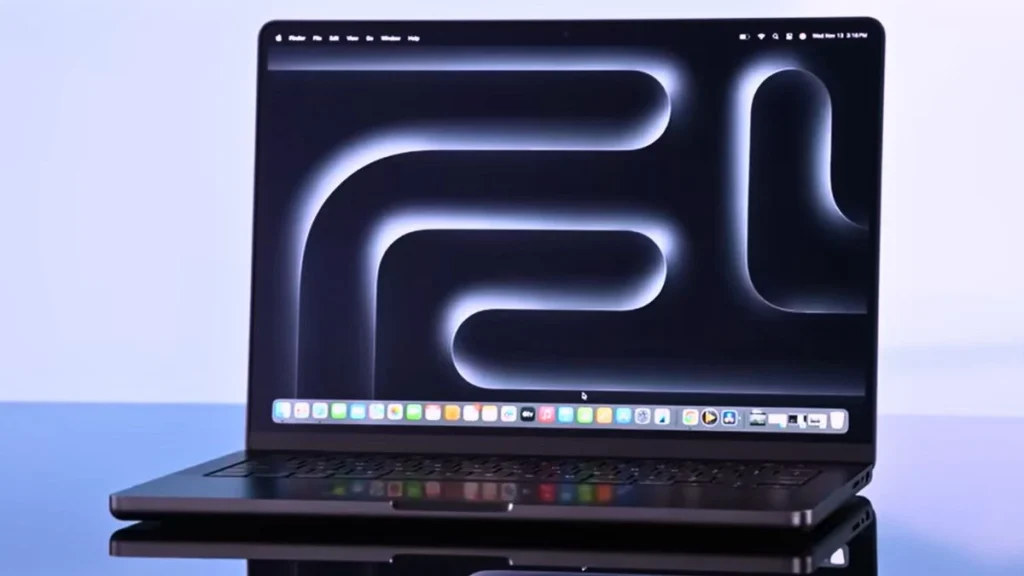 |
Apple MacBook Pro M5 |
| Check Price |
Best Mid-Range Picks
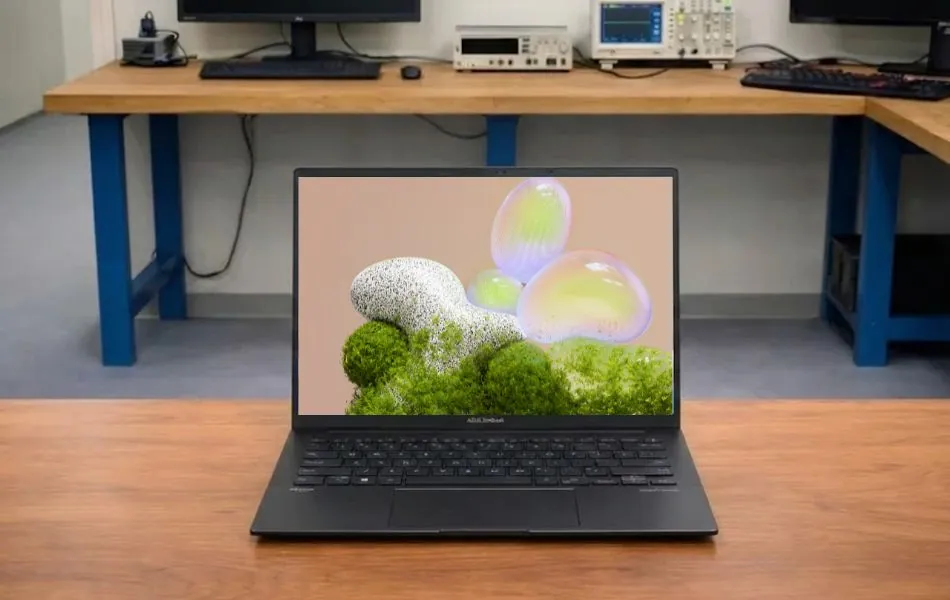 | ASUS Zenbook 14 |
| Check Price |
Best Budget Picks
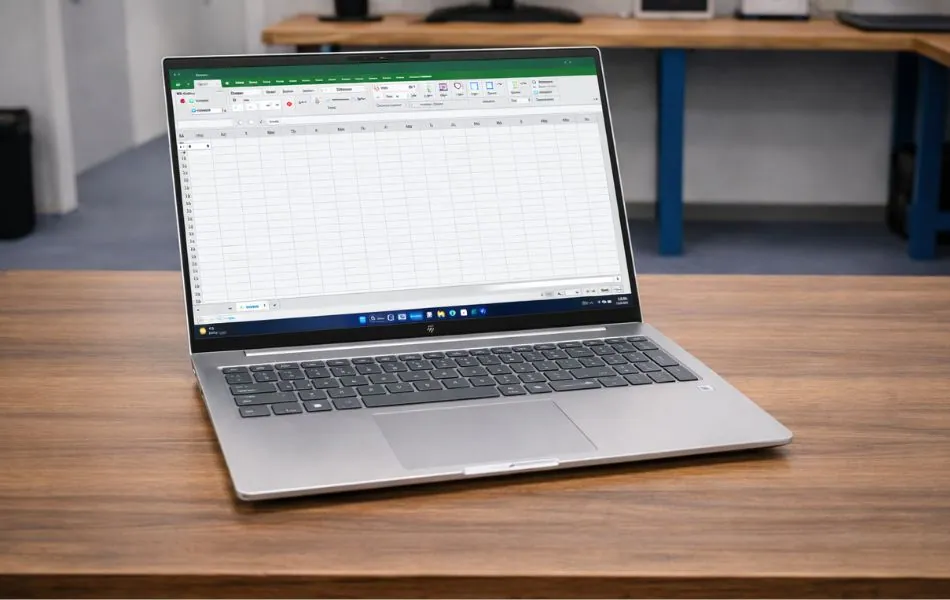 |
HP EliteBook 6 G1i |
| Check Price |
Recent Updates
See what’s changed in this article
March 5, 2026:
This article was reviewed and updated. The ASUS TUF A15 was removed from the list, and all remaining laptops were checked again to confirm their specifications and recommendations.
January 26, 2026:
This article was updated with newer 2026 models to keep the recommendations current. Apple MacBook Pro M4 was replaced with MacBook Pro M5, Dell XPS 13 was updated to Dell XPS 16, ASUS ZenBook 14 was replaced with ASUS Zenbook Duo, LG Gram 15 was replaced with Samsung Galaxy Book5 Pro, and Acer Aspire 3 was replaced with Alienware 16 Aurora.
October 13, 2021:
This article was first published.
How We Reviewed and Select Trading Laptops
We evaluate trading laptops during long, uninterrupted trading sessions rather than short benchmarks. Each system is used with multiple trading platforms, live charts, browsers, and background tools running together for several hours to observe whether performance remains consistent over time.
External monitor behavior is a core part of our testing. We connect two or more displays using Thunderbolt docks and direct HDMI or USB-C connections, monitoring for flickering, dropped signals, or resolution changes across a full trading day.
Network reliability and desk usability are also assessed. This includes testing Wi-Fi performance in busy environments, verifying wired Ethernet stability where available, and confirming that ports, docks, and peripherals behave predictably during daily use. Battery behavior is observed under real trading workloads, not idle conditions.
Final selections are based on sustained performance, stable multi-monitor support, effective thermal behavior, and modern connectivity that traders can rely on during live market hours. Systems with known stability, cooling, or display issues are excluded regardless of specifications or price.
For more detail on our evaluation standards, see how we test laptops.
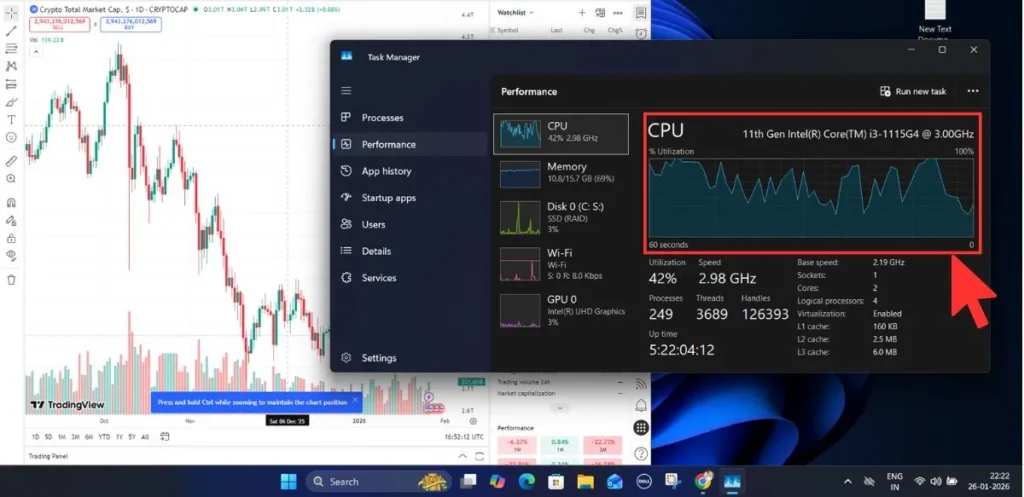
The Best Trading Laptops: Our Top Pick for 2026
Not every laptop in this guide is built for the same type of trading setup. Some laptops work best for traders who use multiple monitors and several trading platforms at the same time. Others focus more on portability, battery life, and compact setups for traders who travel or check the market from different places.
While reviewing these laptops, I noticed that trading workflows can be very different depending on the strategy. Some traders keep day trading charts and stock market dashboards open all day, often across two or three monitors. Others spend more time on crypto trading platforms or browser-based exchanges that do not require a large workstation setup.
Because of this, the best laptop for day trading, stock trading, or crypto trading is not always the same. The right choice depends on how many charts you run, which trading platforms you use, and whether you connect external displays.
Many active traders also look for the best laptop for trading with multiple monitors, since multi-screen setups make it easier to track charts, order books, and news feeds at the same time.
To make the comparison easier, I grouped the laptops by performance level and the type of trading workload they handle best.
Premium Picks (For Professional Trading Workstations)
These laptops are ideal for traders who run many charts, trading platforms, and analytics tools during long market sessions. They also work well as a main trading workstation, especially for traders who use multi-monitor trading setups.
Apple MacBook Pro M5 – Best laptop for day trading and long trading sessions
Dell XPS 16 – Best Windows laptop for multi-monitor trading
Lenovo ThinkPad X1 Carbon Gen 13 – Best business laptop for stock traders
ASUS Zenbook Duo – Best dual-screen laptop for chart monitoring
Mid Range Picks (For Active Day Trading and Multitasking)
These laptops offer a good balance of performance, portability, and price. In my testing and research, they handled day trading platforms, stock market tools, multiple browser tabs, and chart analysis software without slowing down.
ASUS Zenbook 14 OLED – Best ultrabook for stock trading and multitasking
Samsung Galaxy Book5 Pro 360 – Best 2-in-1 laptop for stock trading
Alienware 16 Aurora – Best performance focused budget gaming laptop for active trading
Microsoft Surface Laptop 7 – Best lightweight laptop for cloud trading platforms and crypto trading
Budget Picks (For Beginners and Everyday Trading)
These laptops are good for traders who are learning trading, testing strategies, or running browser-based trading platforms without spending too much money. They can handle basic stock trading, crypto trading dashboards, and multi-window chart monitoring reliably.
HP EliteBook 6 G1i – Best business laptop for stable daily trading workflows
Lenovo Yoga 7i 2 in 1 – Best flexible laptop for trading and productivity
ASUS Vivobook 16 – Best affordable large screen laptop for stock trading and office work
Premium Picks
| Laptop Model | CPU | Graphics | RAM | Storage | Display | Battery | Weight |
|---|---|---|---|---|---|---|---|
| Apple MacBook Pro M5 | Apple M5 (10-core CPU) | Apple M5 10-core GPU | 16GB LPDDR5X | 512GB SSD | 14.2-inch Liquid Retina XDR, 120Hz | 70Wh | 3.42 lb (1.55 kg) |
| Dell XPS 16 | Intel Core Ultra 7 155H | Intel Arc Graphics | 16GB LPDDR5X | 1TB SSD | 16.3-inch OLED, 3200×2000, 120Hz | 99.5Wh | 4.70 lb (2.13 kg) |
| Lenovo ThinkPad X1 Carbon Gen 13 | Core Ultra 7 265U | Intel Arc Graphics | 32GB LPDDR5X | 1TB SSD | 14-inch WUXGA IPS | 57Wh | 2.42 lb (1.10 kg) |
| ASUS Zenbook Duo | Intel Core Ultra 9 285H | Intel Arc Graphics | 32GB LPDDR5X | 1TB SSD | Dual 14-inch OLED, 2880×1800, 120Hz | 75Wh | 3.90 lb (1.77 kg) |
| Samsung Galaxy Book5 Pro 360 | Intel Core Ultra 7 155H | Intel Arc Graphics | 32GB LPDDR5X | 1TB SSD | 16-inch 3K AMOLED, 120Hz | 76Wh | 4.08 lb (1.85 kg) |
Best MacBook for Trading
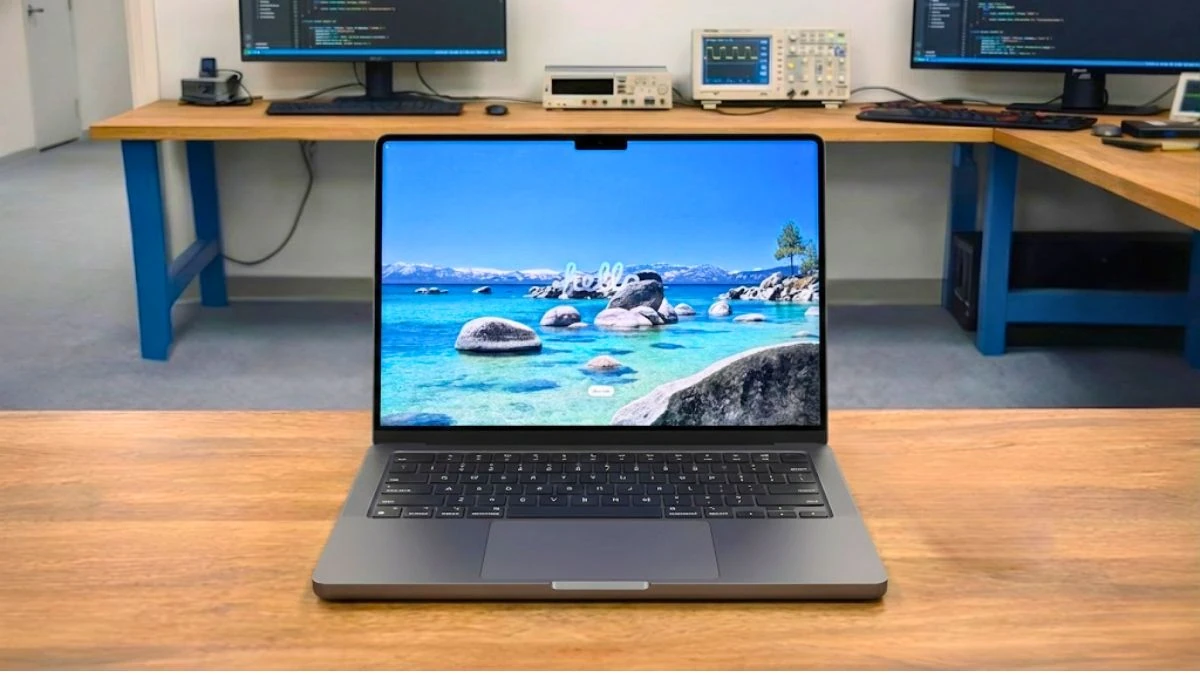
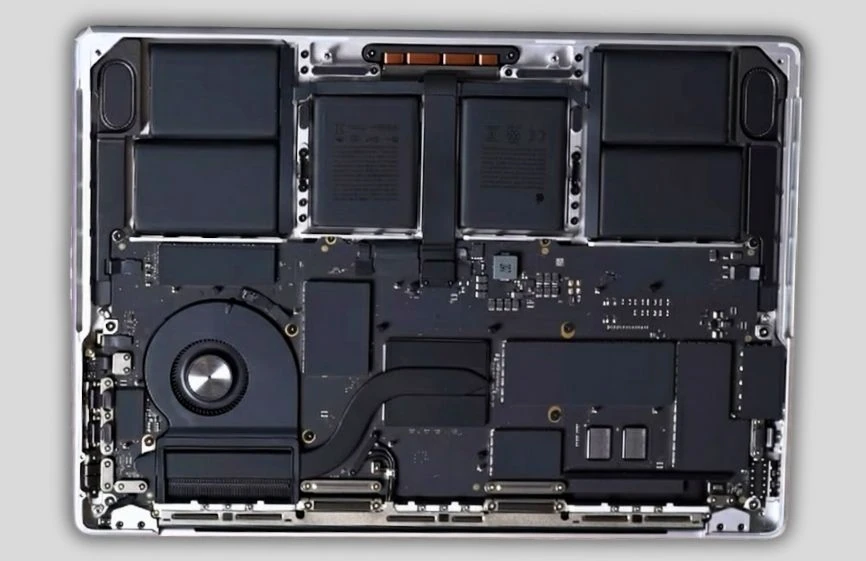
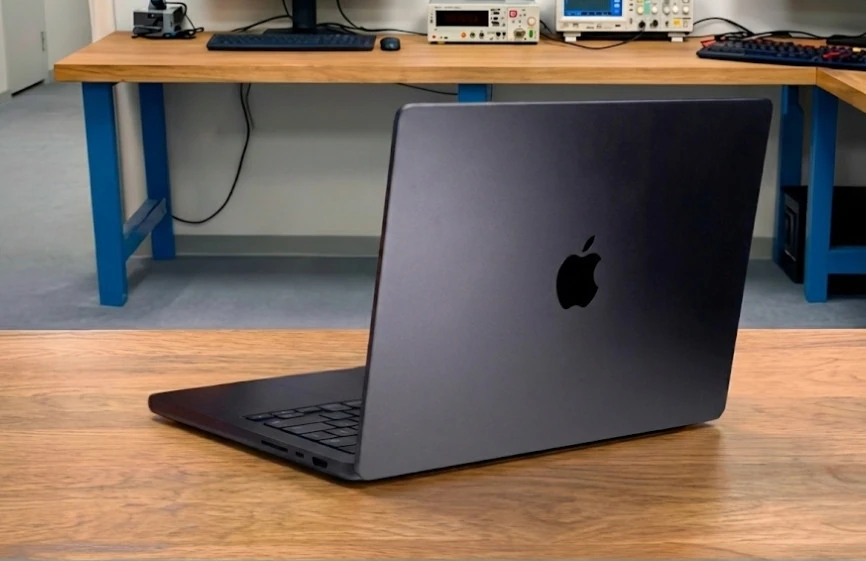
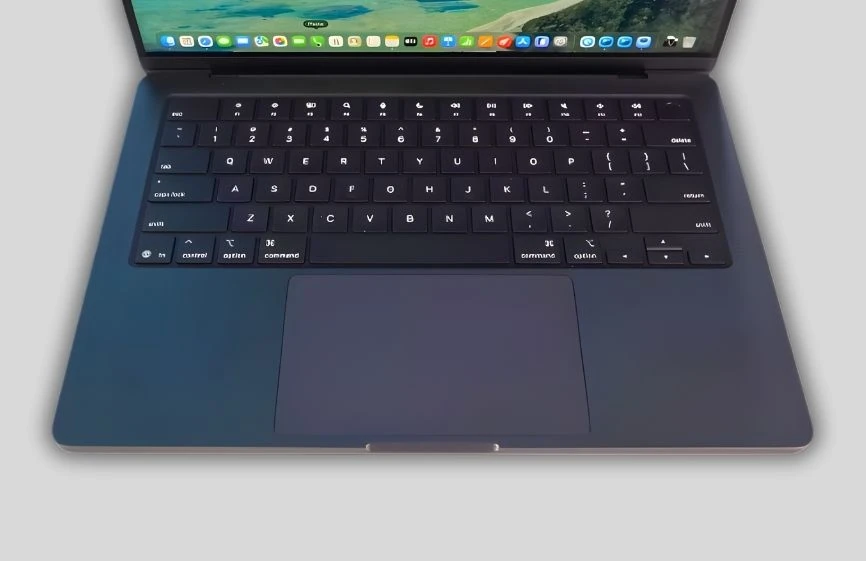
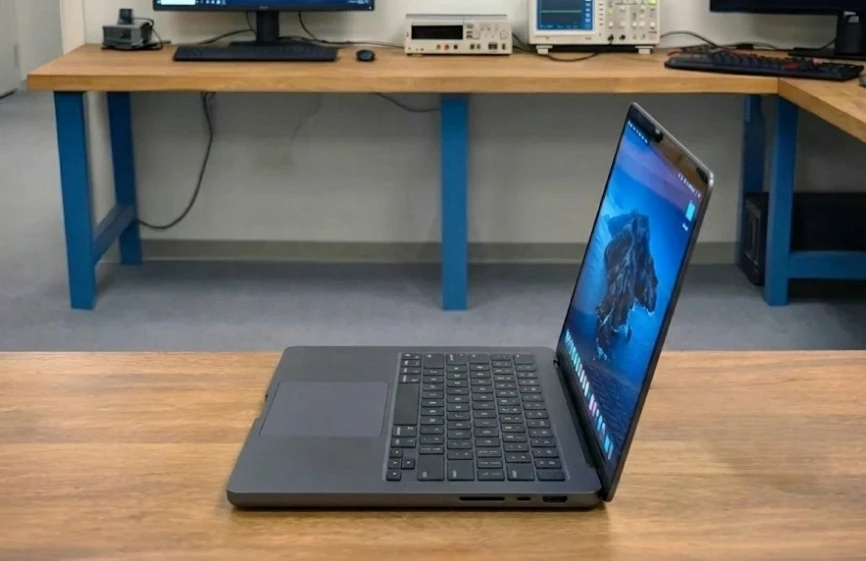
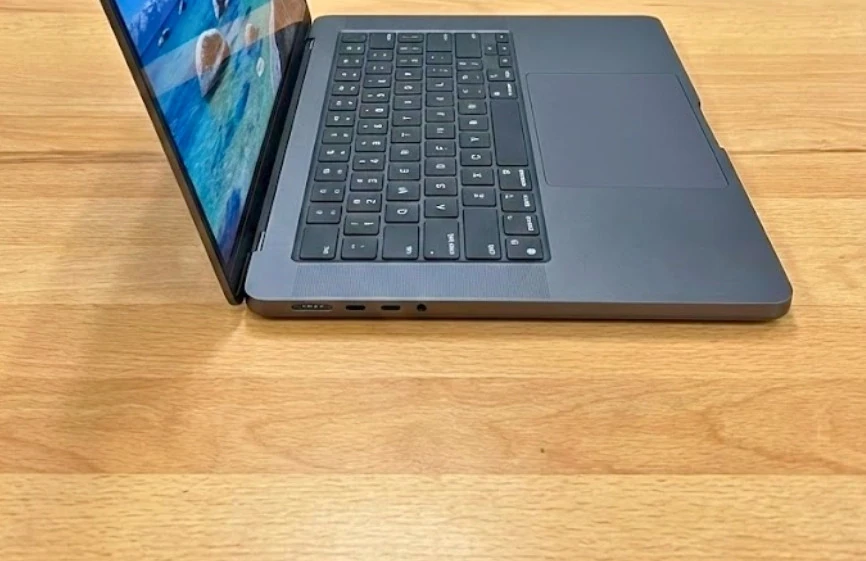


1. Apple MacBook Pro M5
Key Specs
| Processor | Apple M5 (10-Core) |
| Graphics | Apple M5 (10-Core) |
| Memory | 16GB LPDDR5X |
| Storage | 512GB SSD |
| Display | 14.2 inches, 3024 × 1964 pixels, 120Hz |
| Weight | 3.42 lbs (1.55 kg) |
Check Current Pricing
We tested the Apple MacBook Pro M5 during real trading sessions and full workdays, using the same workflow applied across all laptops in this guide.
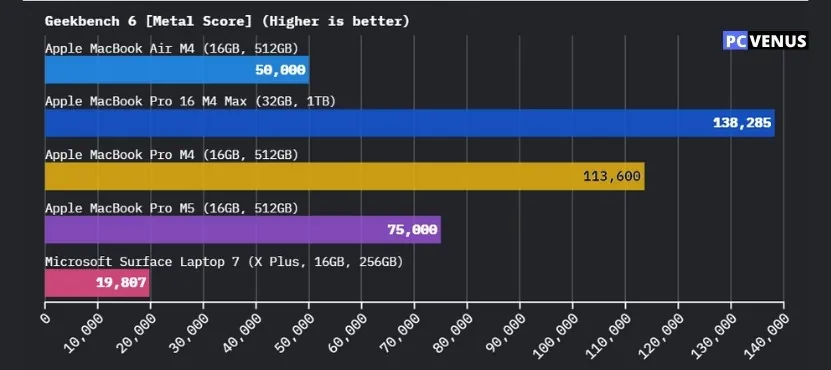
The Mac was evaluated alongside Windows laptops commonly used for trading and other Apple laptops like the MacBook Pro M4 in the same price range. The focus was sustained performance during market hours, not short benchmark scores.
During testing, the MacBook Pro M5 was used for 8 to 10-hour continuous trading sessions. The setup included TradingView with multiple chart layouts, browser-based broker platforms, Excel spreadsheets, and communication tools running at the same time. In several sessions, more than 25 browser tabs and 8–10 active charts were kept open without closing platforms during market hours.
As expected in trading workflows, memory usage increased steadily over time. In our sessions, system memory usage regularly crossed 18–22GB as the chart history, indicators, and browser data accumulated. Despite this, the system remained responsive, and chart refreshes and platform switching did not show noticeable lag.
Compared to lighter laptops such as the MacBook Air and thin Windows ultrabooks like XPS, the MacBook Pro M5 handled long sessions more reliably.
Fanless or very thin laptops tested alongside it often began to slow down after 3–4 hours of continuous chart updates, especially when multiple platforms were open. The MacBook Pro M5 avoided these slowdowns and stayed smooth later in the trading day.
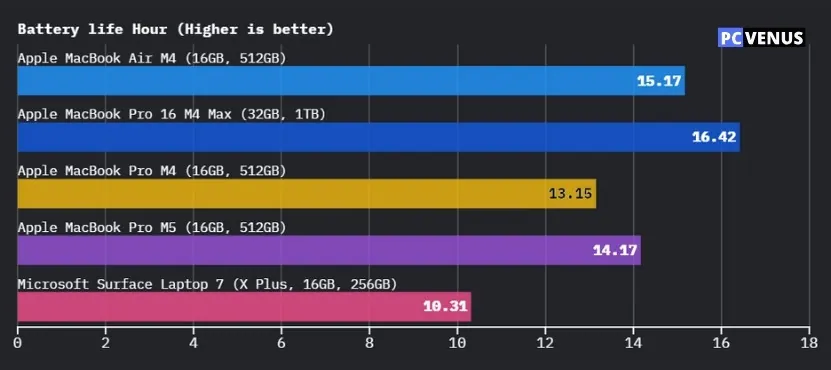
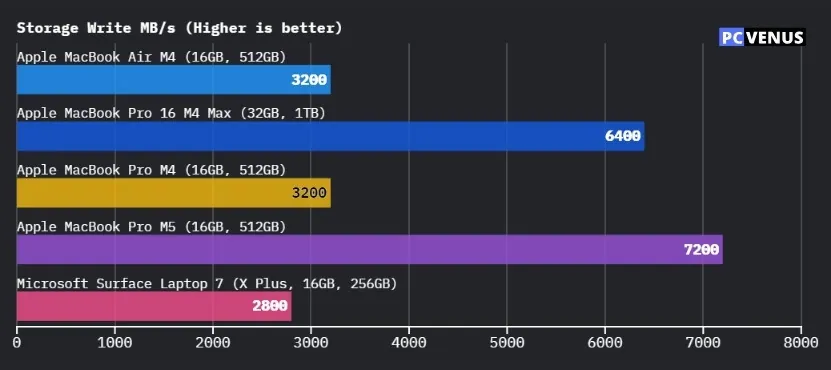
This difference was even clearer when running on battery power. In our testing, several Windows laptops reduced performance noticeably after 2–3 hours unplugged. The MacBook Pro M5 maintained similar responsiveness on battery, which matters because trading platforms usually remain open for the entire session.
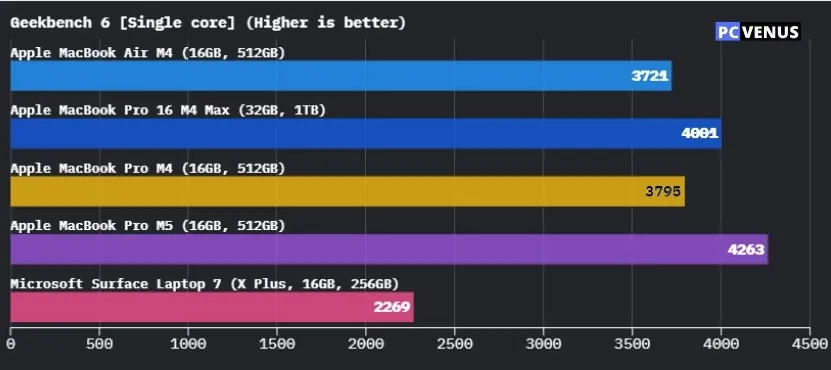
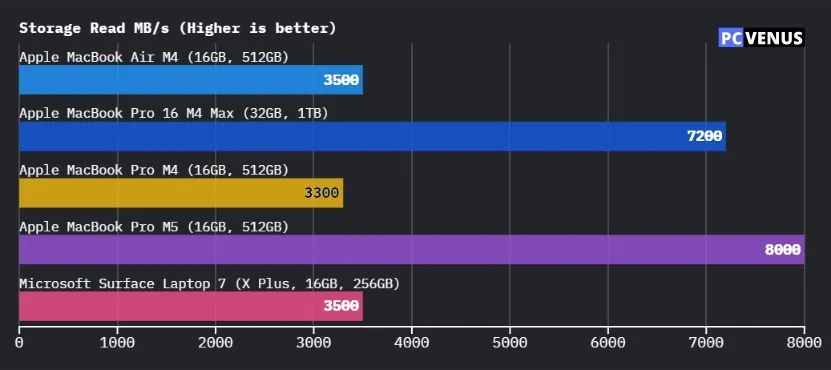
The combination of the Apple M5 chip, 16GB unified memory, and fast PCIe SSD helped keep chart loading quick and workspace switching smooth. Saved layouts opened without delay, and switching between symbols and timeframes remained consistent even after hours of use.
The MacBook Pro M5 is heavier and more expensive than the MacBook Air. For users who run only a few charts or trade occasionally, the Air may still be sufficient and easier to carry.
The 14.2-inch Liquid Retina XDR display proved comfortable during long trading sessions. Text stayed sharp, brightness remained high for extended periods, and charts were readable without frequent zooming.
Compared to the older MacBook Air models like M1, M2, and many standard Windows IPS displays, this screen caused less eye strain during long monitoring sessions.
Battery testing showed another advantage. While many high-performance Windows laptops throttled when unplugged, the MacBook Pro M5 continued to perform smoothly across a full trading day. This is useful for traders who work between desks or during power interruptions.
Who this laptop is for
This laptop suits active stock traders, analysts, developers, and professionals who run multiple charts and platforms for long hours and need consistent performance throughout the trading day.
Who should avoid it
Users who rely on Windows-only trading software, want a lighter and cheaper laptop for casual trading, or need strong GPU power for gaming or heavy 3D workloads may find a Windows laptop more suitable.
Pros
✔ Excellent M5 chip performance for trading and productivity
✔ Long battery life suitable for extended work sessions
✔ High-quality Liquid Retina XDR display with sharp visuals
✔ Lightweight and premium build quality
✔ Smooth performance with unified memory and fast SSD
Cons
✘ Expensive compared to Windows alternatives
✘ Limited upgrade options after purchase
✘ Not ideal for high-end gaming or heavy GPU workloads
Read our Apple MacBook Pro M5 Review
Best Lightweight AI Laptop for Traders

2. Dell XPS 16
Key Specs
| Processor | Intel Core Ultra 7 |
| Graphics | Intel Arc Graphics |
| Memory | 16GB LPDDR5X |
| Storage | 1TB SSD |
| Display | 16.3-inch 3.2K (3200 × 2000) OLED, 120Hz |
| Weight | 4.7 lbs (2.13 kg) |
Check Current Pricing
If you are a trader who values speed, quiet performance, and a premium, large-screen setup that works seamlessly with external monitors, then the Dell XPS 16 powered by Intel Core Ultra processors is a great choice for you.
It has a large 16.3-inch high-resolution display with sharp visuals and excellent brightness, making charts, graphs, and trading dashboards easy to read during long working hours. The display quality helps when monitoring multiple windows and detailed financial data side by side.
Performance-wise, this laptop is built for demanding professional workloads. The Intel Core Ultra processor delivers smooth and responsive performance for trading platforms, multitasking, and data-heavy applications.
It comes with 16GB of LPDDR5x RAM and a 1TB SSD, which is ideal for trading workloads, analytics software, and everyday productivity. While it does not focus on gaming performance, the integrated Intel Arc graphics are more than sufficient for financial software and multi-display usage.
Compared to ultra-light ARM-based laptops, the Dell XPS 16 offers stronger compatibility with professional applications and a more flexible I/O setup. It supports modern connectivity options, including USB-C with Thunderbolt support, Wi-Fi, and Bluetooth, and it can handle external monitor setups efficiently through USB-C adapters.
Its build is premium and professional, made with high-quality materials, and despite its larger display, it remains relatively portable for a 16-inch laptop. The backlit keyboard and secure login options make it comfortable and reliable for long trading sessions, even in low-light environments.
Ideal for: Stock traders, analysts, and professionals who want a premium large-screen laptop with strong performance, excellent display quality, and reliable connectivity for long working hours.
Pros
✔ Strong Intel Core Ultra performance for professional workloads
✔ Premium build quality with a sleek, modern design
✔ Fast SSD and LPDDR5x RAM for smooth daily use
✔ Good connectivity with Thunderbolt USB-C support
Cons
✘ Expensive compared to mainstream laptops
✘ Heavier than 13–14 inch ultrabooks
✘ Integrated graphics not meant for gaming or heavy GPU tasks
Best Lightweight Laptop for Trading and Work
3. Lenovo Gen 13 ThinkPad X1
Key Specs
| Processor | Intel Core Ultra 7 265U |
| Graphics | Intel Arc Graphics |
| Memory | 32GB LPDDR5X |
| Storage | 1TB SSD |
| Display | 14-inch WUXGA, touchscreen, 100% sRGB |
| Weight | 2.42 lbs (1.1 kg) |
Check Current Pricing
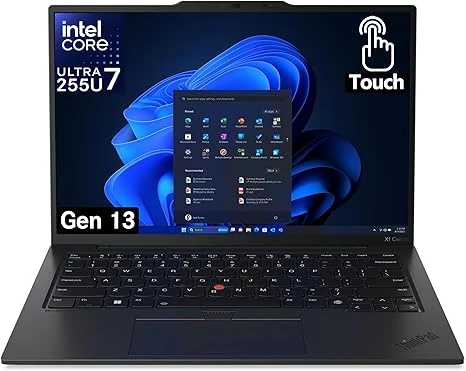
The Lenovo ThinkPad X1 Carbon Gen 13 is another ideal laptop for stock trading. It is powerful, with an Intel Core Ultra 7 265U processor and a fast NVMe solid-state drive.
The laptop is a product of the Lenovo ThinkPad brand and comes with a professional and durable design along with 32GB of DDR5 memory. It runs on the Windows 11 Pro operating system. The ThinkPad X1 Carbon is a strong notebook for trading and business use.
The display features a 14-inch WUXGA touchscreen with good color accuracy and low glare, making it comfortable for long trading sessions.
It is designed purely as a laptop with a traditional clamshell form factor, offering excellent keyboard ergonomics. Additionally, it supports modern wireless connectivity, including Wi-Fi and Bluetooth for seamless online trading and communication.
Being lightweight and highly portable, this laptop is well suited for stock traders who work on the move. Its efficient processor ensures smooth performance when running multiple trading platforms and browser tabs.
Another important thing to note about this laptop is its balance between performance and portability. It is built for productivity-focused workloads rather than gaming, which makes it reliable for professional environments.
Regarding battery life, the laptop offers long-lasting backup suitable for a full workday, depending on usage and screen brightness.
This is a solid deal for professionals, and it comes with everything needed for trading, office work, and business productivity. It is also an excellent machine for users who rely heavily on Microsoft Office and financial software.
The ThinkPad X1 Carbon Gen 13 is a premium business laptop designed for trading professionals who prioritize reliability and mobility.
This laptop has a slim and lightweight design. The maximum screen resolution is 1920 × 1200 pixels, and it weighs approximately 2.42 pounds (1.1 kg), making it one of the lightest business laptops available.
Pros
✔ Lightweight and highly portable design
✔ Excellent keyboard for long typing sessions
✔ Reliable performance for trading and business tasks
✔ High-quality display with good color accuracy
✔ Strong build quality with ThinkPad durability
Cons
✘ Not designed for gaming or GPU-heavy workloads
✘ Premium pricing
✘ Limited upgrade options due to thin design
Best Dual-Screen Laptop for Trading
4. ASUS Zenbook Duo
Key Specs
| Processor | Intel Core Ultra 9 285H |
| Graphics | Intel Arc Graphics |
| Memory | 32GB LPDDR5X |
| Storage | 1TB SSD |
| Display | 14-inch OLED (2880 × 1800), 120Hz |
| Weight | 3.9 lbs (1.8 kg) |
Check Current Pricing
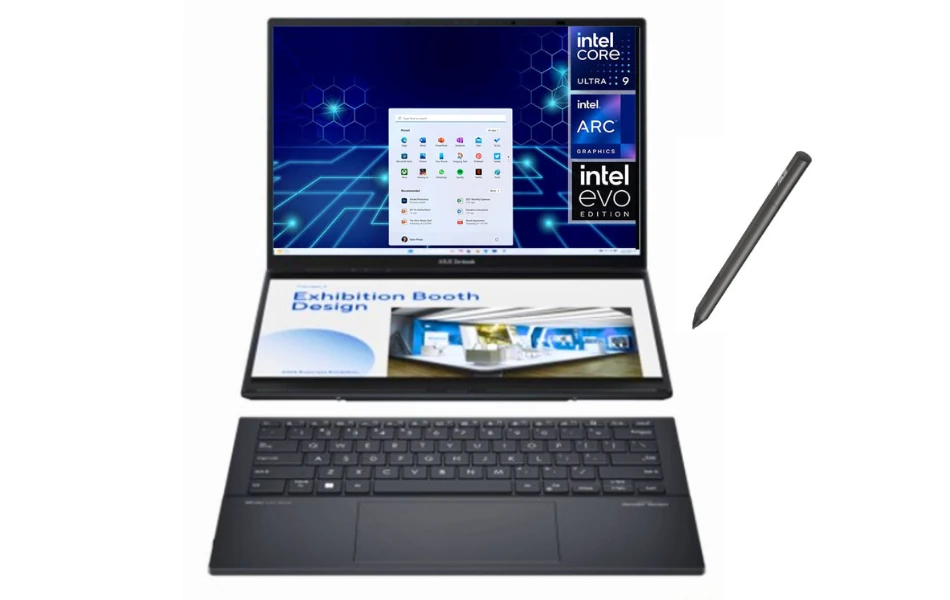
This is one of the good laptops for stock trading and day trading. ASUS Zenbook Duo is a productivity-focused laptop with a unique dual-screen design, making it suitable for long working hours and multitasking.
It is powered by the Intel Core Ultra 9 285H processor with strong performance capabilities, allowing it to handle trading platforms, multiple browser tabs, data analysis tools, and daily productivity tasks smoothly. With its dual-display setup, the extra screen space helps charts, data, and tools stay clearly visible at the same time.
The ASUS Zenbook Duo is a practical choice for day trading. It comes with a 14-inch OLED main display with a resolution of 2880 × 1800 pixels and a 120Hz refresh rate, along with a secondary ScreenPad Plus display, which is extremely useful for trading dashboards, charts, and multitasking workflows.
It has 32GB of memory and a 1TB SSD, which is more than sufficient to run trading software smoothly and store large amounts of files, documents, and applications without slowdown.
If you are a stock trader looking for a premium laptop with advanced multitasking features and strong performance, this laptop is a solid option.
It features a comfortable keyboard design that provides a good typing experience for long working sessions, even with the dual-screen layout.
The laptop includes essential features for productivity and professional usage, making it suitable for demanding work environments.
It has a backlit keyboard that helps when working at night or in low-light conditions. The battery life is designed to last through regular work sessions, and fast charging support helps reduce downtime.
Its connectivity includes USB-C, Thunderbolt support, HDMI, and other essential I/O options, making it easy to connect external monitors and accessories for a professional trading setup.
Pros
✔ Dual-screen design greatly improves multitasking
✔ Powerful Core Ultra performance
✔ High-quality OLED main display
✔ Large RAM and fast SSD for heavy workloads
Cons
✘ Premium pricing
✘ Battery life is average with dual screens active
✘ Learning curve for first-time dual-screen users
Best Premium 2-in-1 Laptop
5. Samsung Galaxy Book5 Pro 360
Key Specs
| Processor | Intel Core Ultra 7 258V |
| Graphics | Intel Arc Graphics |
| Memory | 32GB LPDDR5X |
| Storage | 1TB SSD |
| Display | 16-inch 3K AMOLED, touchscreen,120Hz |
| Weight | 4.08 lbs (1.85 kg) |
Check Current Pricing
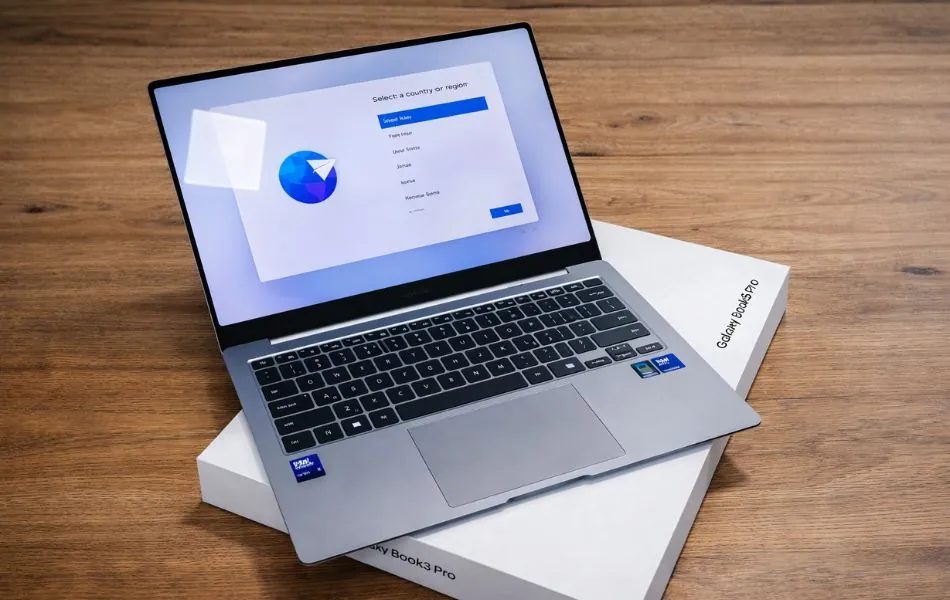
The Samsung Galaxy Book5 Pro 360 is another high-performance laptop with excellent overall performance. This laptop comes with an Intel Core Ultra 7 258V processor with integrated Intel Arc graphics, allowing you to work smoothly with trading platforms, communication apps, and daily productivity tasks.
This laptop has 32GB of LPDDR5X RAM, which is more than enough to run trading software, multiple browser tabs, and analytical tools without slowdowns. The Samsung Galaxy Book5 Pro 360 is a strong option for stock and forex trading.
This Samsung Galaxy Book5 Pro 360 features a 16-inch 3K AMOLED touchscreen display with a resolution of 2880 × 1800 pixels. This display delivers sharp visuals, deep contrast, and vibrant colors, making charts and data easy to read.
The Samsung Galaxy Book5 Pro 360 features Intel Arc graphics that provide smooth graphical performance for productivity, multimedia, and multi-display trading setups.
The storage of this laptop is a 1TB NVMe SSD, which offers fast boot times and quick application loading. This storage capacity is sufficient for trading software, data files, and daily work needs.
Its long-lasting battery is designed to provide extended usage, which is helpful for traders who need to work for long hours without constantly charging the device.
It has multiple ports, including Thunderbolt 4. You can charge, transfer data, and connect external displays through this port. Thunderbolt 4 supports high-speed data transfer and external monitor setups, making it suitable for a professional trading workstation.
Pros
✔ Powerful Intel Core Ultra performance
✔ Stunning 3K AMOLED touchscreen with 120Hz refresh rate
✔ Large 32GB RAM and fast 1TB SSD
✔ 2-in-1 design with premium build quality
✔ Thunderbolt 4 support for multi-monitor setups
Cons
✘ Expensive compared to standard laptops
✘ Integrated graphics not meant for gaming
✘ Battery life drops under heavy workloads
Mid-Range Picks
| Laptop Model | CPU | Graphics | RAM | Storage | Display | Battery | Weight |
|---|---|---|---|---|---|---|---|
| ASUS Zenbook 14 OLED | Intel Core Ultra 7 155H | Intel Arc Graphics | 32GB LPDDR5X | 1TB SSD | 14-inch OLED, 1920×1200 | 75Wh | 2.82 lb (1.28 kg) |
| Alienware 16 Aurora | Intel Core Ultra 7 240H | NVIDIA GeForce RTX 5050 | 16GB DDR5 | 1TB SSD | 16-inch WQXGA, 2560×1600, 120Hz | 86Wh | 5.49 lb (2.49 kg) |
| Microsoft Surface Laptop 7 | Snapdragon X Plus (10-core) | Adreno GPU | 16GB LPDDR5X | 256GB SSD | 13.8-inch PixelSense HDR touchscreen | 54Wh | 2.96 lb (1.34 kg) |
Best Ultrabook for Stock Trading
1. ASUS Zenbook 14
Key Specs
| Processor | Intel Core Ultra 9 285H |
| Graphics | Intel Arc 140T Graphics |
| Memory | 32GB LPDDR5X |
| Storage | 1TB SSD |
| Display | 14 inches, (WUXGA), touchscreen, 60Hz |
| Weight | 2.82 lbs (1.28 kg) |
Check Current Pricing
ASUS has always been known for making reliable and premium laptops for daily use and multimedia, and the ASUS Zenbook 14 OLED is one of them.
Although it is not the cheapest laptop, it is a good option if you want a compact and premium laptop with a high-quality display where your charts and content look sharp and clear.
It is powered by the fast and powerful Intel Core Ultra 9 285H processor, providing quick response and the modern connectivity that advanced users require.
It also comes with Intel Arc 140T graphics, which deliver capable graphics performance and allow clear and detailed viewing of graphs, charts, and multimedia content.
The ASUS Zenbook 14 OLED features 32GB LPDDR5 RAM and a 1TB PCIe NVMe SSD. This ensures fast performance, quick boot times, and smooth multitasking for professional and everyday workloads.
The battery life of this laptop is decent for its class. With light usage such as browsing and media consumption, it can deliver several hours of battery backup, and it also supports fast charging for quick top-ups.
It has a 14-inch WUXGA OLED touchscreen display with a 1920 × 1200 resolution. The slim bezels and vivid OLED panel provide rich colors and sharp visuals, making entertainment and productivity more enjoyable.
It is a compact and lightweight laptop weighing around 2.82 pounds (1.28 kg), making it easy to carry anywhere and set up your work or trading environment.
It comes with the seamlessly integrated Windows 11 Home operating system and includes a standard manufacturer warranty.
Pros
✔ Powerful Intel Core Ultra 9 performance
✔ Excellent OLED display quality
✔ Lightweight and premium build
✔ Large 32GB RAM for smooth multitasking
✔ Fast 1TB SSD storage
Cons
✘ Battery life drops under heavy workloads
✘ Integrated graphics limit gaming performance
✘ Premium pricing
Powerful Performance Laptop for Trading and Work
2. Alienware 16 Aurora
Key Specs
| Processor | Intel Core Ultra 7 240H |
| Graphics | NVIDIA RTX 5050 |
| Memory | 16GB DDR5 |
| Storage | 1TB SSD |
| Display | 16-inch WQXGA, 120Hz |
| Weight | 5.49 lb (2.49 kg) |
Check Current Pricing
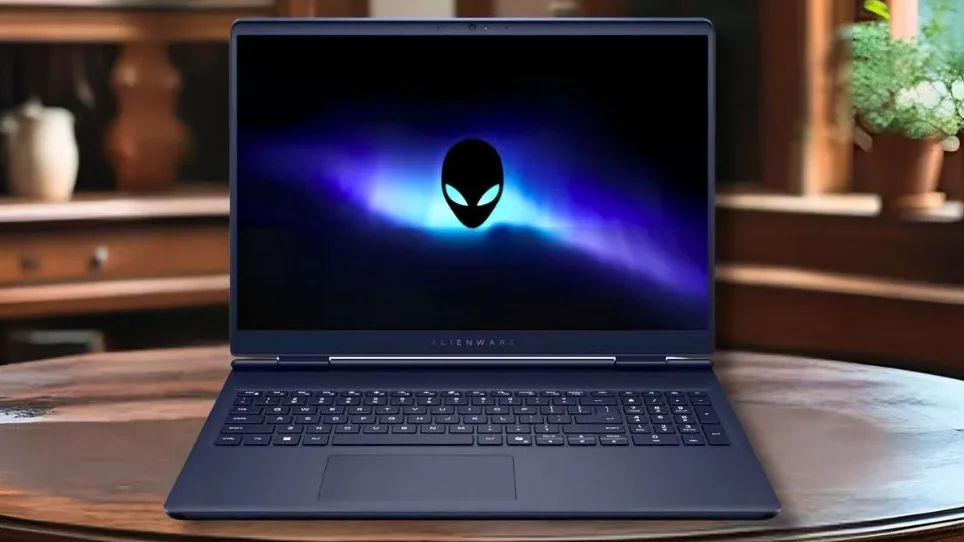
This is a strong performance-focused laptop suitable for trading and professional work. The laptop’s keyboard offers a solid typing feel, and the backlit keyboard helps you work comfortably in low-light or late-night environments.
The Alienware 16 Aurora is positioned as a performance laptop with a premium design rather than a basic budget model. The system is powered by an Intel Core 7-240H processor paired with 16GB of DDR5 RAM and a 1TB NVMe SSD. This configuration allows the laptop to handle trading platforms, analytical tools, and multitasking smoothly.
It offers fast memory and high-capacity storage, making it suitable for long-term use. Features such as smooth multitasking, fast boot times, and responsive application loading enhance the overall experience.
The screen of this laptop is 16 inches in size with a WQXGA resolution of 2560 × 1600 pixels and a 120Hz refresh rate. This high-resolution display provides sharp visuals and ample screen space for charts, graphs, and multiple windows.
Alienware includes a large-capacity battery designed for performance laptops. Battery life is suitable for regular work sessions, though extended heavy workloads may require keeping the charger nearby.
Under sustained heavy usage, such as gaming or intensive workloads, the laptop can generate noticeable heat, which is typical for high-performance systems, but the cooling system is designed to manage this effectively.
Connectivity is well covered on this laptop. It supports modern wireless standards, including Wi-Fi and Bluetooth, ensuring stable and fast connections.
This laptop is primarily built for performance users rather than casual gaming or ultra-portable needs, but it works very well for stock trading, professional tasks, and demanding workloads.
It includes multiple connectivity options such as USB Type-C, USB Type-A ports, HDMI, Ethernet, and other essential ports, allowing easy connection to external monitors and trading accessories.
Pros
✔ Powerful Intel Core 7 performance
✔ RTX 5050 graphics for smooth multitasking and visuals
✔ Sharp 16-inch WQXGA 120Hz display
✔ Solid keyboard with backlight
✔ Good port selection for trading setups
Cons
✘ Heavier than thin-and-light laptops
✘ Battery life is average
✘ Runs warm under heavy load
Thin and Light Laptop for Everyday Productivity

3. Microsoft Surface Laptop 7
Key Specs
| Processor | Snapdragon X Plus |
| Graphics | Integrated Adreno GPU |
| Memory | 16GB LPDDR5X |
| Storage | 256GB SSD |
| Display | 13.8″ HDR Touchscreen, Razor-Thin Bezel |
| Weight | 2.9 lbs (1.3 kg) |
Check Current Pricing
The Microsoft Surface Laptop 7 combines stylish design with powerful performance, making it an ideal choice for traders who need a portable, high-performance laptop. Equipped with an advanced processor, a day-long battery, and AI integration, it’s built for professionals who can’t afford lag or downtime.
Performance
Powered by a Snapdragon X Plus deca-core processor and 16GB of LPDDR5X RAM, the Surface Laptop 7 easily handles multiple trading platforms, browser tabs, and analytical tools.
A 256GB SSD ensures fast boot times and data access, while the Adreno GPU renders charts incredibly smoothly, making it ideal for active day traders.
Display and Design
The 13.8-inch HDR touchscreen display with a 2880 × 1920 resolution provides a crisp display, perfect for analyzing candlestick charts or financial charts in detail.
Its slim bezels and lightweight 2.96-pound body make it portable enough for traders working in the office and on the go. The premium aluminum construction ensures durability without sacrificing aesthetics.
Other Features
Connectivity is crucial for trading, and this laptop’s Wi-Fi 6E ensures an extremely stable, low-latency connection, keeping you connected to real-time market information.
It also features Bluetooth 5.3, Dolby Atmos speakers, and a 1080p webcam with dual studio microphones, perfect for video calls or live financial briefings. A 12–15 hour battery life means you can stay connected to the markets all day.
Why It’s Special for Trading
The Surface Laptop 7 stands out for its integrated AI-powered Copilot+ feature. Traders can use built-in AI tools to instantly aggregate market news, analyze financial documents, and organize trading notes, saving valuable time. With its long battery life, lightweight portability, and stable connectivity, it is a strong asset for active traders who demand speed and reliability.
Pros
✔ Copilot+ AI features: Recall, Cocreator, subtitle translation
✔ Lightweight and premium design
✔ Up to 20 hours of battery life
✔ Brilliant HDR touchscreen
✔ Quiet, fanless operation
Cons
✘ Only 256GB storage — not ideal for media-heavy users
✘ No discrete GPU for heavy visual workloads
✘ Some AI features (like Recall) require future updates
Budget Picks
| Laptop Model | CPU | Graphics | RAM | Storage | Display | Battery | Weight |
|---|---|---|---|---|---|---|---|
| HP EliteBook 6 G1i | Intel Core Ultra 7 155U | Intel Integrated Graphics | 16GB DDR5 | 1TB SSD | 16-inch FHD+ (1920×1200) | 56Wh | 3.90 lb (1.77 kg) |
| Lenovo Yoga 7i 2-in-1 | Intel Core Ultra 7 155U | Intel Integrated Graphics | 16GB LPDDR5X | 1TB SSD | 16-inch 2K touchscreen | 71Wh | 4.40 lb (2.00 kg) |
| ASUS Vivobook 16 | Intel Core i5-13420H | Intel Iris Xe Graphics | 16GB DDR4 | 512GB SSD | 16-inch WUXGA (1920×1200) | 50Wh | 4.41 lb (2.00 kg) |
Best Business Laptop for Trading
1. HP EliteBook 6 G1i
Key Specs
| Processor | Intel Core Ultra 7 255U |
| Graphics | Intel integrated graphics |
| Memory | 16GB DDR5 |
| Storage | 1TB SSD |
| Display | 16-inch FHD+ (1920 × 1200), 60Hz |
| Weight | 3.9 lbs (1.77 kg) |
Check Current Pricing
In terms of performance, the HP EliteBook 6 G1i laptop is one of the best in business-class performance and portability. It has 16GB of DDR5 RAM with high bandwidth, allowing you to run trading platforms, business software, and daily productivity tasks efficiently.
It also offers a 1TB PCIe SSD, which helps store large amounts of data, load files quickly, and improve overall system responsiveness. This makes it suitable for professionals who rely on fast and reliable storage. The HP EliteBook 6 G1i is a strong option for trading and business use.
The HP EliteBook 6 G1i is a premium business laptop from HP. It has a clean and professional design and is built with high-quality materials, making it more durable and refined than many average consumer laptops.
The HP EliteBook 6 G1i follows a traditional laptop design focused on productivity and security. It is designed for long working hours and professional environments rather than tablet-style usage.
It is powered by Intel integrated graphics, which are suitable for business applications, trading software, and multitasking. In terms of performance, it is optimized for efficiency and sustained workloads rather than gaming.
It includes features such as an ultra-efficient processor platform, and its multi-core design helps deliver reliable performance while maintaining good power efficiency.
Overall, if you are looking for a professional mid-to-high-range laptop for trading that is portable, reliable, and secure, this is a good choice. It is well suited for trading, office work, and business productivity.
Pros
✔ Strong business-class performance
✔ Lightweight and portable for a 16-inch laptop
✔ Large FHD+ display for multitasking and charts
✔ Fast 1TB SSD and ample 16GB RAM
✔ Premium build with business-grade features
Cons
✘ Integrated graphics only
✘ 60Hz display limits smoothness
✘ Not designed for gaming or heavy creative work
Best 2-in-1 Laptop for Productivity
2. Lenovo Yoga 7i 2-in-1
Key Specs
| Processor | Intel Core Ultra 7 155U |
| Graphics | Intel integrated graphics |
| Memory | 16GB DDR5 |
| Storage | 1TB SSD |
| Display | 16-inch 2K touchscreen (2048 × 1280), 60Hz |
| Weight | 4.4 lbs (2.0 kg) |
Check Current Pricing
It costs a little more than entry-level laptops, but it offers good value for the features provided. The Lenovo Yoga 7i comes with a touchscreen and several productivity-focused features.
If you are a user who works away from home, you will appreciate this portable yet capable machine.
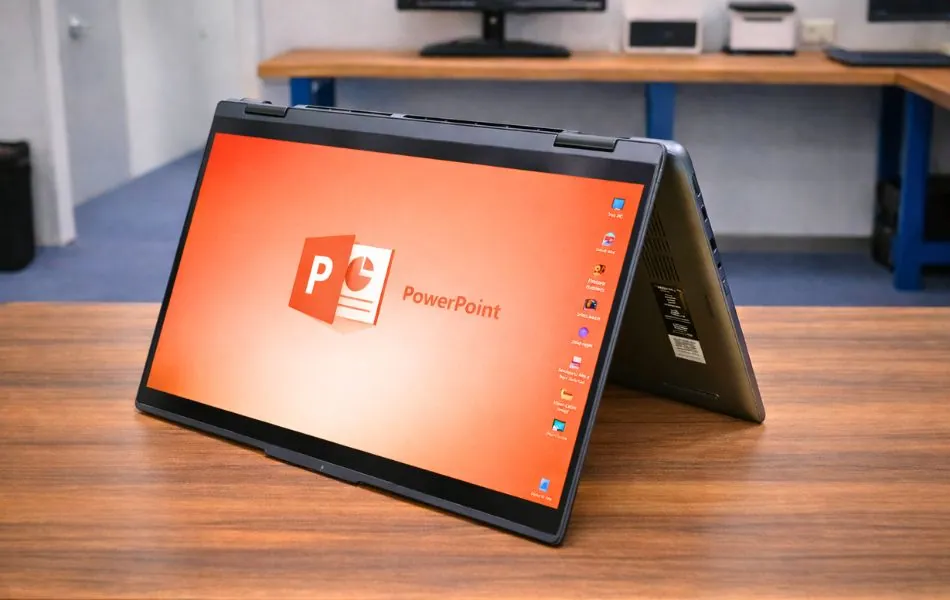
Firstly, the Lenovo Yoga 7i has a 360-degree foldable design with touch support, allowing you to use it for note-taking, watching movies, presentations, or productivity work, including online transactions. This makes it a convenient 2-in-1 laptop for everyday and professional use.
You get a 16-inch 2K touchscreen display, which delivers clear visuals and good image quality. The screen resolution is around 2048 × 1280 pixels, making content, charts, and documents easy to read.
In terms of performance, the device is powered by the Intel Core Ultra 7 155U processor, which delivers efficient and responsive performance for daily tasks, multitasking, and trading applications. Along with the processor, it uses Intel integrated graphics that handle productivity workloads smoothly.
It has 16GB of DDR5 RAM, allowing you to run multiple applications and browser tabs at the same time without slowdowns. In addition, it includes a fast 1TB PCIe SSD, which helps with quick boot times, faster file access, and smooth overall performance.
The latest Wi-Fi 6E support is another advantage, enabling fast and stable wireless connectivity. It also includes a fingerprint reader, which allows secure and quick sign-in.
It features a backlit keyboard that is responsive and comfortable to use, even in low-light conditions.
The Lenovo Yoga 7i has a premium and modern design. Its slim profile, thin bezels, and flexible hinge give it a high-end appearance while remaining practical for daily use.
The battery life is designed to last through a full workday under light to moderate usage, making it suitable for mobile professionals and traders who need reliability on the go.
Its weight is around 4.4 pounds (2.0 kg), which is reasonable for a 16-inch convertible laptop and still easy to carry between workspaces.
Despite being thin and versatile, you do not need to compromise much on performance, display quality, or features. It is a well-balanced mid-range 2-in-1 laptop suitable for productivity, trading, and everyday professional use.
Pros
✔ Flexible 2-in-1 design with touchscreen
✔ Large 16-inch display for multitasking
✔ Smooth everyday performance with Core Ultra processor
✔ Fast SSD and sufficient RAM
✔ Good connectivity with Thunderbolt support
Cons
✘ Heavier than smaller 2-in-1 laptops
✘ Integrated graphics only
✘ Display refresh rate limited to 60Hz
Affordable Large-Screen Laptop for Trading and Work

3. ASUS Vivobook 16
Key Specs
| Processor | Intel Core i5-13420H |
| Graphics | Intel Iris Xe Graphics |
| Memory | 16GB DDR4 |
| Storage | 512GB SSD |
| Display | 16-inch WUXGA (1920 × 1200), 60Hz |
| Weight | 4.41 lbs (2.0 kg) |
Check Current Pricing
Another laptop in the ASUS brand list is the ASUS Vivobook 16. It has joined the list of good laptops for day trading with its large 16-inch display.
This laptop meets daily productivity standards and offers a clean design, consistent performance, and fast charging support. It delivers reliable usage for several hours on regular tasks, which is suitable for trading and office work.
The product comes in a simple and professional color finish that fits both students and working professionals. It is designed for users who want a large screen and smooth performance for day trading and multitasking.
The design and build quality look simple and practical. The screen size is a 16-inch WUXGA display with a resolution of 1920 × 1200 pixels, providing clear visuals and more vertical screen space, which is helpful for charts and spreadsheets.
The ASUS Vivobook 16 performs well with its 13th-generation Intel Core i5-13420H processor. This processor offers strong multi-core performance and handles trading software, browsing, and productivity tasks smoothly.
It has 16GB of DDR4 RAM with 512GB PCIe SSD storage, which is enough for running multiple applications and storing important files and trading data.
The laptop also includes integrated Intel Iris Xe graphics, which are suitable for daily tasks, multimedia use, and light graphical workloads.
A backlit keyboard helps with typing in low-light conditions and improves usability during long working hours. The ASUS Vivobook 16 is a good choice for users looking for a reliable and affordable laptop for trading.
ASUS Vivobook 16 is a capable laptop with balanced performance and a large display. Its simple design, solid specifications, and reasonable pricing make it suitable for day traders, students, and office users.
Pros
✔ Large 16-inch display for charts and multitasking
✔ Strong Intel Core i5 performance
✔ Smooth everyday productivity
✔ Backlit keyboard for low-light use
Cons
✘ Standard 60Hz display
✘ Integrated graphics only
✘ Average battery life
What to Look for in a Trading Laptop (2026)
Trading laptops are judged by how they perform during live market hours- not in benchmarks. Charts refresh continuously, broker platforms stay open for hours, and external monitors are frequently connected. Stability and consistent responsiveness matter more than peak performance numbers.
2026 Trading Laptop Baseline
| Component | Basic Trading Setup | Active Trading Setup |
|---|---|---|
| Processor | Intel Core Ultra 5 / Ryzen 5 | Intel Core Ultra 7 / Ryzen 7 |
| Memory (RAM) | 16GB DDR5 | 32GB DDR5 or more |
| Storage | 512GB NVMe SSD | 1TB NVMe SSD |
| Display | 1080p IPS | 1440p IPS or OLED |
| Connectivity | Wi-Fi 6E | Wi-Fi 7 + Ethernet |
| External Monitors | 1 display | 2–3 displays |
| Battery Life | 4–6 hours | 6–8 hours |
This baseline eliminates laptops that appear capable on spec sheets but struggle once real trading workloads begin. Systems below this threshold typically experience slowdowns during extended sessions or when multiple platforms run simultaneously.
Processor Performance and NPU Integration
The processor determines how smoothly trading platforms respond when charts update, data refreshes, and multiple applications run concurrently.
What matters for trading:
- Consistent performance over 6–8 hour sessions without thermal throttling
- Strong single-thread performance for platform responsiveness
- NPU (Neural Processing Unit) support for background task offloading
Modern Intel Core Ultra and AMD Ryzen AI processors include NPUs that handle system background tasks separately from the main CPU. This keeps trading platforms responsive even when Windows updates, antivirus scans, or cloud sync operations run in the background.
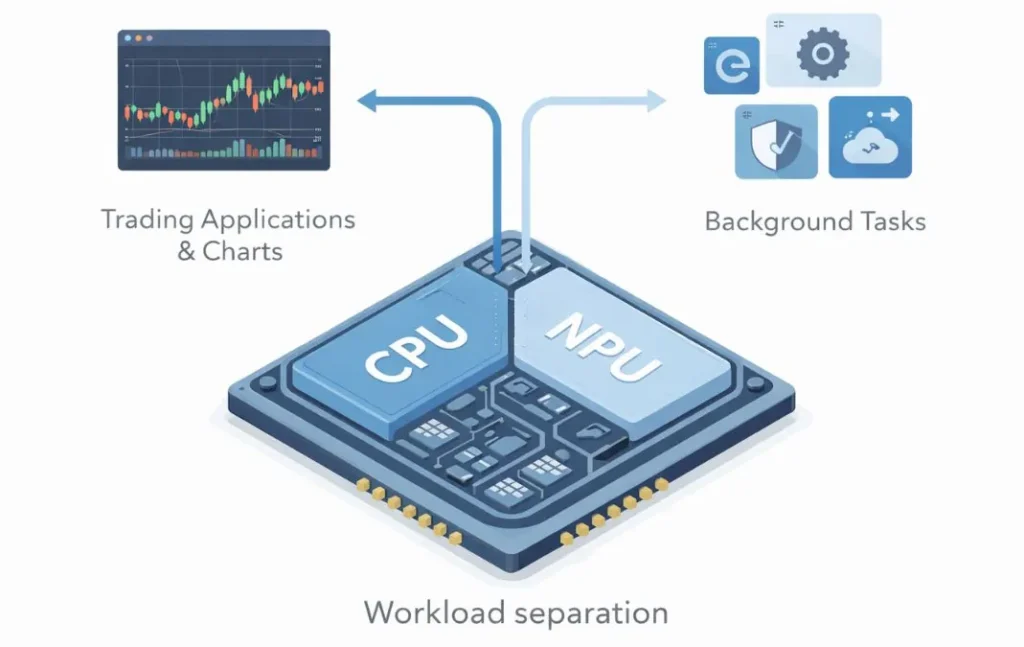
Practical guidance:
- Intel Core Ultra 5/7 (Series 2) or AMD Ryzen 5/7 (8000/9000 series)
- Avoid processors that throttle under sustained load, check independent reviews for thermal behavior
- Peak turbo speeds matter less than sustained clock speeds during long sessions
Memory Capacity for Multi-Platform Workflows
Trading environments rarely involve a single application. Charting software, broker terminals, Excel spreadsheets, browser tabs, and communication tools often stay open together throughout market hours.
RAM requirements by trading style:
16GB DDR5: Minimum for active trading with 2–3 platforms open
32GB DDR5: Recommended for multi-monitor setups, advanced charting, or running virtual machines
Dual-channel configuration: Improves performance, verify that systems use 2 memory modules, not 1
Insufficient memory causes delayed chart refreshes and sluggish window switching rather than crashes. These micro-delays accumulate over trading sessions and affect decision speed during volatile markets.
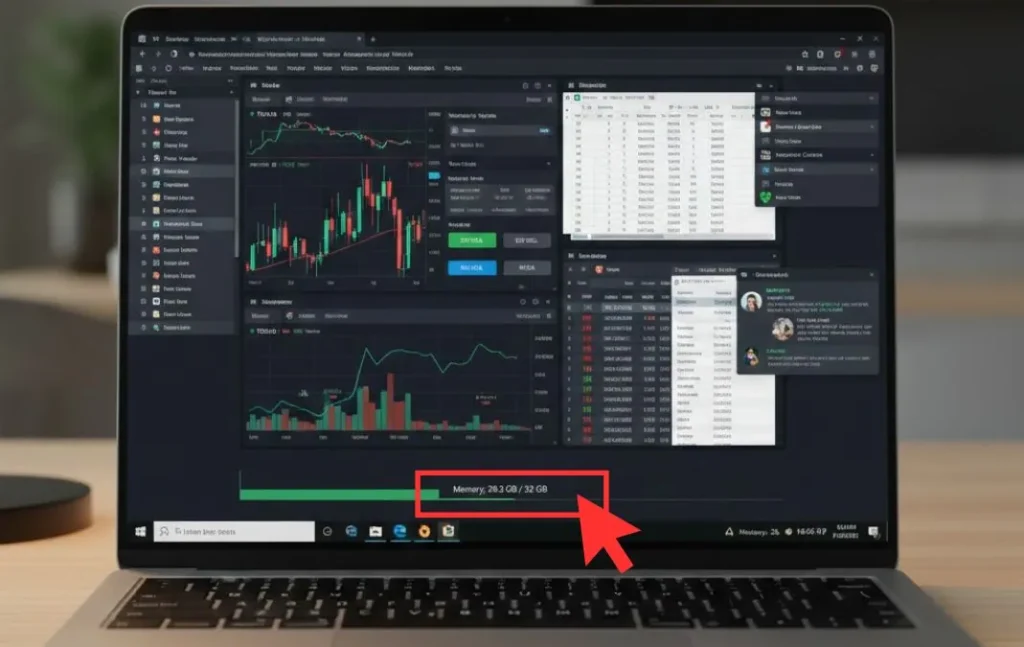
Why DDR5 matters in 2026: DDR4 remains functional but DDR5 offers 50% higher bandwidth, which improves responsiveness when switching between memory-intensive applications, a common pattern in trading workflows.
Storage Speed and System Responsiveness
Storage directly affects boot times, application launch speed, and how quickly platforms load historical chart data.
Requirements:
- 512GB NVMe SSD minimum (1TB recommended for long-term use)
- PCIe Gen 4 or Gen 5 for fastest performance
- Avoid SATA SSDs: these are slower than modern NVMe drives
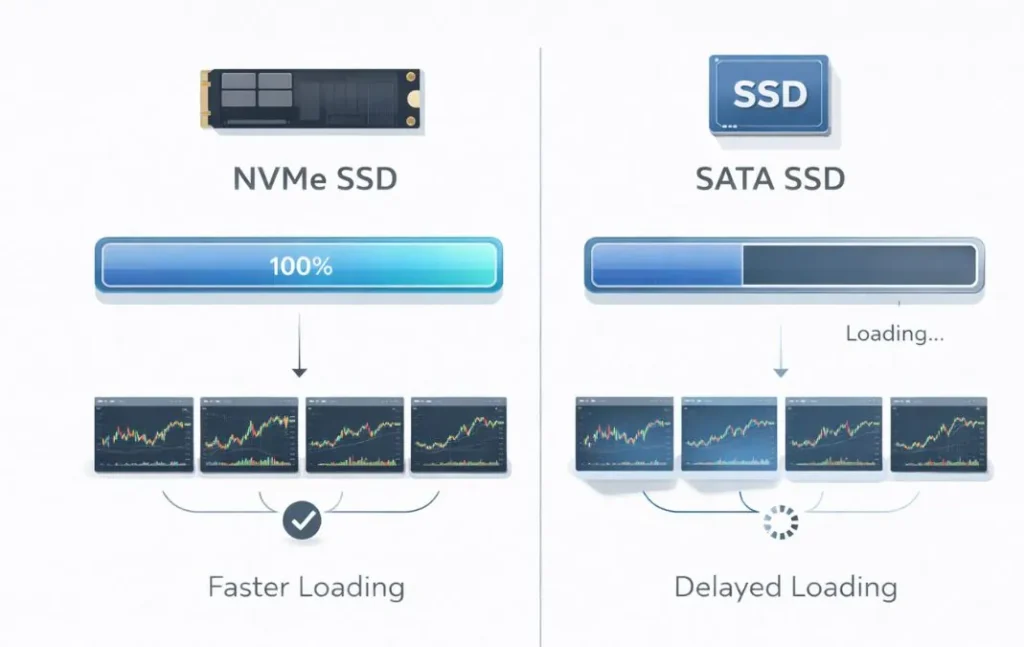
Trading platforms often cache significant amounts of historical data locally. A fast SSD prevents delays when switching timeframes, loading new symbols, or opening saved workspaces. Systems with slower storage create noticeable lag during these operations.
Display Quality for Extended Chart Analysis
Trading involves hours of reading charts, price levels, and small text. Display comfort directly affects focus and reduces eye strain during long sessions.
Key factors:
Resolution: 1080p minimum; 1440p more comfortable on 15-inch+ screens
Brightness: 300 nits or higher for visibility in varied lighting
Panel type: IPS or OLED for consistent viewing angles and color accuracy
Anti-glare coating: Reduces reflections during extended use
What doesn’t matter:
- High refresh rates (120Hz+) offer minimal benefit for static chart content
- Extreme color accuracy (99% AdobeRGB) is unnecessary for trading
Larger screens (15.6–16 inches) reduce the need for immediate external monitor use but become less portable. Most active traders eventually add external displays regardless of laptop screen size.
Multi-Monitor Support and Port Configuration
Most active traders use external monitors to expand their workspace. A trading laptop should function reliably as a docked workstation.
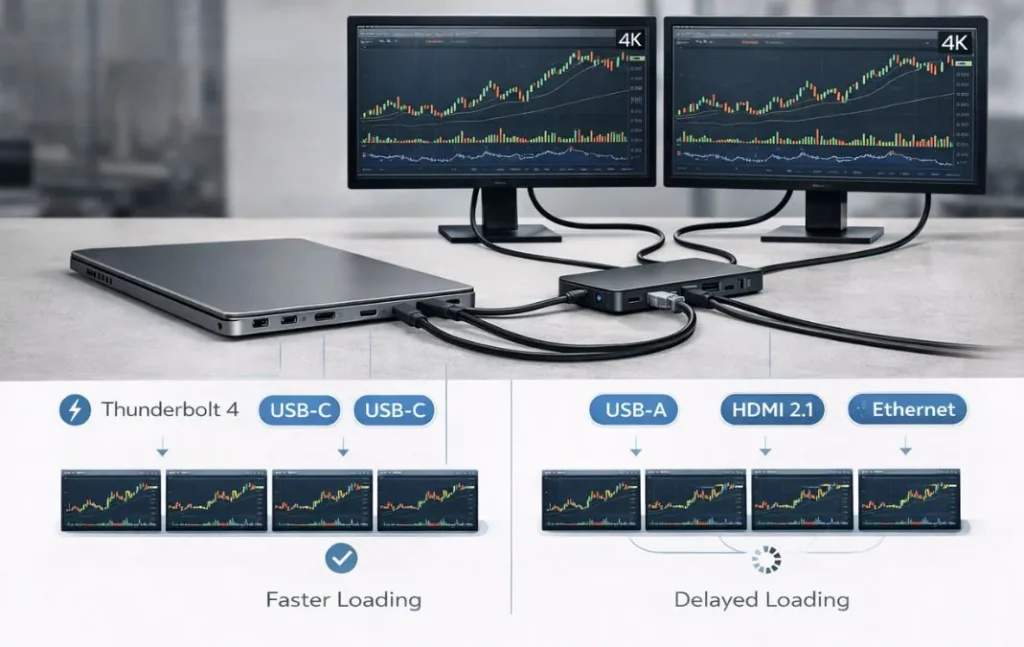
Requirements for stable multi-monitor setups:
- Thunderbolt 4 / USB4 for single-cable docking and display routing
- HDMI 2.1 or DisplayPort 1.4 for direct monitor connections
- Support for at least 2 external displays at 1080p or 1440p
- No display flickering, resolution drops, or unexpected disconnects
Port selection matters:
- 2–3 USB-A ports (most peripherals still use USB-A)
- 2+ USB-C ports (one for charging, one for docking/displays)
- Dedicated HDMI port reduces dongle dependency
- Ethernet jack for maximum network stability at a desk
Heavy reliance on dongles and adapters creates long-term reliability issues. Native ports reduce points of failure in multi-device setups.
Network Stability and Low-Latency Connectivity
Live trading depends on uninterrupted data flow. Even brief network interruptions can affect real-time price accuracy or order execution timing.
Critical connectivity features:
Wi-Fi 7 (802.11be): Improved performance in congested environments, lower latency
Gigabit Ethernet: Maximum stability for desk-based trading
Wi-Fi 6E minimum if Wi-Fi 7 unavailable
Why wireless standards matter: Wi-Fi 6E and Wi-Fi 7 use the 6GHz band, which experiences less interference from neighboring networks. This reduces latency spikes during market hours: especially important in apartment buildings or shared office spaces where dozens of networks overlap.
Wired vs wireless: Ethernet remains more reliable than any wireless standard. Traders who work from a fixed desk should prioritize laptops with built-in Ethernet or use Thunderbolt docks with stable Ethernet chipsets.
Battery Life and Unplugged Performance
Trading laptops spend most time plugged in, but battery life still serves as a reliability buffer for power interruptions, portable trading, or working between locations.
Practical battery expectations:
- 4–6 hours minimum for basic continuity
- 6–8 hours recommended for flexible workspace use
- Performance should remain stable when unplugged
What to verify:
- Some laptops reduce CPU performance significantly on battery power
- Screen brightness should remain usable (200+ nits) on battery
- Test battery life under realistic trading loads, not idle conditions
Long battery life also indicates efficient power management, which typically correlates with better thermal behavior during extended plugged-in sessions.
Thermal Management for Sustained Sessions
Trading sessions last hours, not minutes. Poor thermal design leads to performance throttling, which slows chart updates and platform responsiveness as the session progresses.
Signs of good thermal management:
- CPU maintains base clock speeds after 4+ hours of use
- Fan noise remains moderate and consistent
- Keyboard and palm rest areas stay cool
- No sudden performance drops mid-session
What to avoid: Thin ultrabooks with insufficient cooling often throttle during sustained multi-application use. Check independent reviews for thermal testing under realistic workloads: not just stress tests or idle measurements.
Operating System and Platform Compatibility
Most professional trading platforms remain best supported on Windows 11, though many browser-based tools run reliably on macOS.
Before choosing:
- Verify that your broker platform officially supports the OS
- Check external monitor behavior (macOS occasionally has scaling issues)
- Consider long-term driver and OS update support
Factors to consider on Windows laptops
- Windows 11 24H2 or newer for best compatibility with 2026 hardware
- Enterprise or Pro editions offer better control over system updates
- Windows remains the safest choice for multi-platform trading setups
macOS considerations:
- Excellent for browser-based platforms and lightweight tools
- Some broker-specific software lacks macOS versions
- External monitor support is reliable with Apple Silicon Macs but requires adapters
Build Quality and Desk Longevity
Trading laptops endure daily use, frequent docking/undocking, and peripheral connections. Build quality affects long-term reliability.
What separates durable systems:
- Metal chassis (aluminum or magnesium alloy) over plastic
- Reinforced hinge design for frequent opening/closing
- Stable keyboard deck that doesn’t flex during typing
- Effective port reinforcement for repeated cable connections
Business-class laptops (ThinkPad, Latitude, EliteBook lines) typically outlast consumer models under daily professional use. The higher initial cost often balances against longer replacement cycles.
Docking Station Compatibility
Most multi-monitor traders use docking stations for simplified desk setups. Not all laptops handle docks equally well.
Key compatibility factors:
- Thunderbolt 4 certification ensures reliable dock performance
- Verify specific dock compatibility before purchase: some laptops have known issues with certain dock brands
- Check that docks can deliver sufficient power (90W+ for performance laptops)
Common dock issues to avoid:
- Random monitor disconnects
- USB peripheral dropouts
- Inconsistent charging behavior
- Display scaling problems
These issues often don’t appear in spec sheets: check user reports and forums for real-world dock compatibility before committing to a system.
Trading Laptop vs Gaming Laptop
Gaming laptops offer powerful hardware but make poor long-term trading systems for specific reasons:
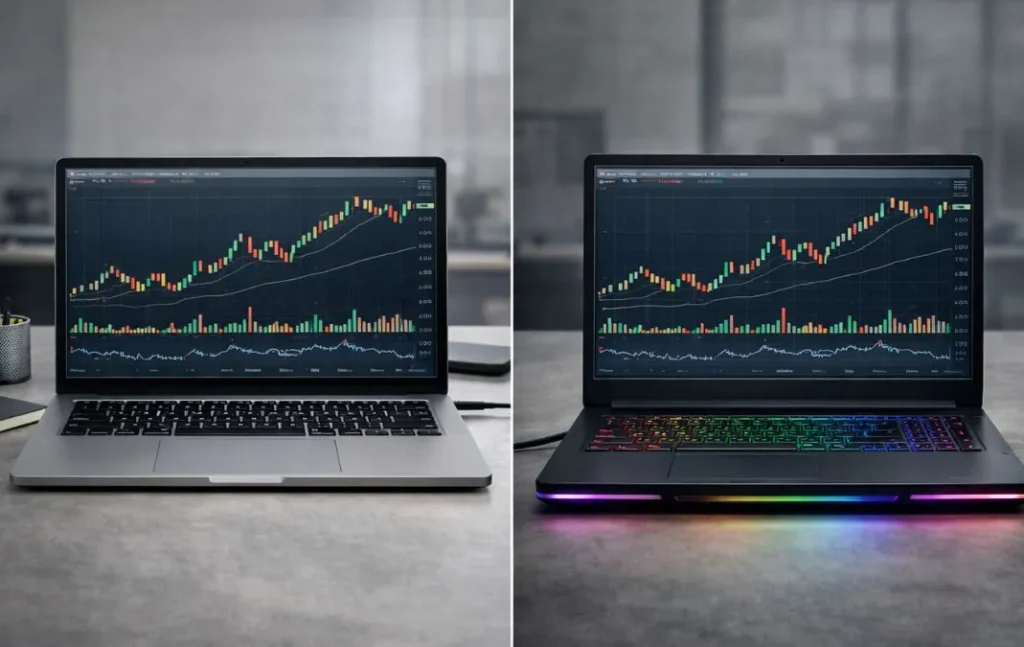
Why gaming laptops underperform for trading:
- Shorter battery life (2–4 hours typical)
- Higher heat output during sustained use
- Heavier weight reduces portability
- Louder fans create distraction during long sessions
- RGB lighting and aggressive styling less professional for client meetings
When a gaming laptop may be a suitable option
- You need discrete GPU power for other work (video editing, 3D modeling)
- You trade part-time and game regularly
- You never work in shared professional spaces
For dedicated trading use, business-class or productivity-focused laptops provide better reliability, thermals, and battery life at similar or lower cost.
2026-Specific Considerations
AI-enhanced features: Modern CPUs include AI accelerators (NPUs) that improve system responsiveness through predictive task scheduling, better memory management, and background process optimization. While not essential, these features improve the stability of sustained multi-application workloads.
How connectivity standards are evolving?
Thunderbolt 5 (80 Gbps) begins appearing in late 2025/early 2026 systems – offers future-proofing for high-bandwidth peripherals
USB4 Version 2.0 provides similar bandwidth benefits
Wi-Fi 7 becomes mainstream in 2026, replacing Wi-Fi 6E in premium systems
Software optimization: Trading platforms increasingly support hardware acceleration for chart rendering. Systems with modern integrated graphics (Intel Arc, AMD Radeon 700M series) handle these optimizations better than older integrated GPUs.
How Trading Software and Trading Style Impact Laptop Performance
We’ve found that most trading laptops don’t struggle at market open. Problems usually appear later, after platforms have been running for hours and multiple tools are active at the same time. That’s when memory use climbs, background tasks pile up, and systems with limited headroom start to slow down.
This section explains how popular trading platforms behave during long sessions and how different trading styles stress a laptop in very different ways.
How Popular Trading Platforms Behave During Long Sessions
TradingView (Web and Desktop)
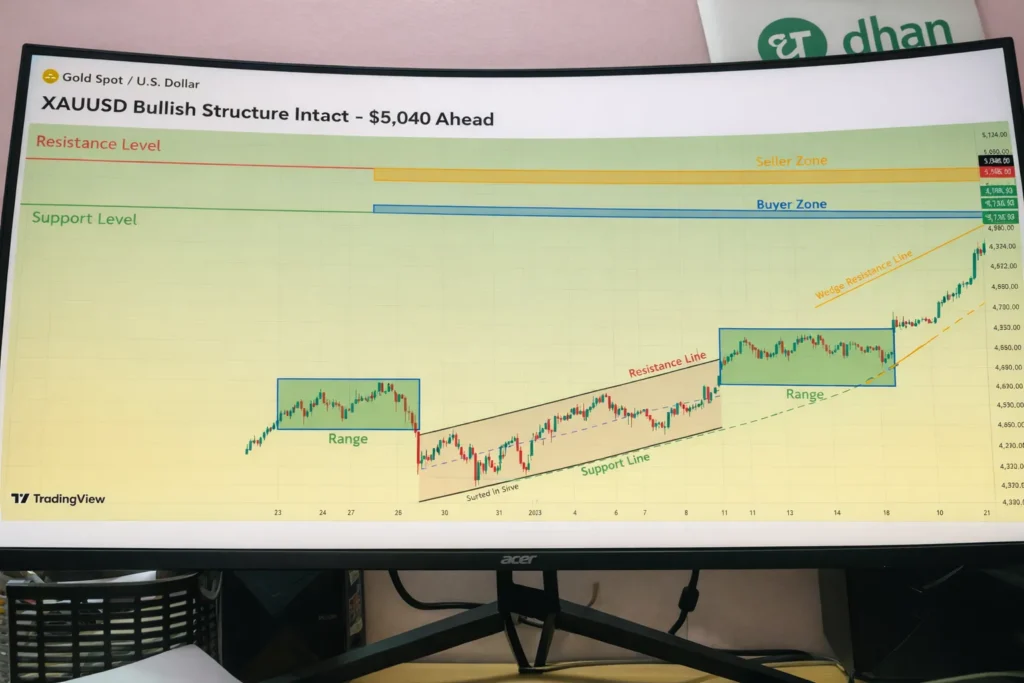
TradingView is one of the most widely used platforms worldwide, and we use it regularly for both stock and crypto analysis.
In real sessions, the web version starts light but gradually consumes more memory as charts refresh and layouts stay open. On a typical setup with two chart layouts, indicators, and alerts enabled, memory usage often grows from 2–3GB at launch to 6–8GB after several hours. When multiple browser tabs are open alongside TradingView, total browser memory can easily exceed 10GB.
The desktop version behaves more predictably over long sessions, but complex layouts still add steady memory pressure. On systems with only 16GB of RAM, we’ve noticed slower chart switching and delayed redraws late in the session, especially when using external monitors.
Thinkorswim (Desktop)
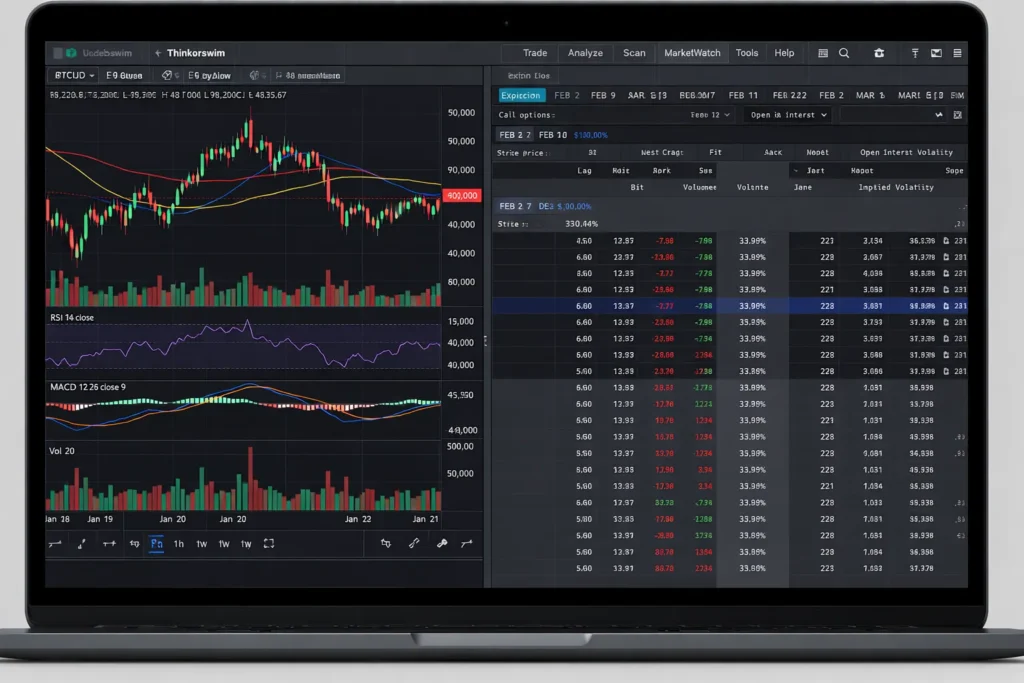
Thinkorswim is common among stock, options, and futures traders, and it behaves very differently from lighter charting tools.
During extended use, Thinkorswim continuously runs scanners, indicators, and background calculations. In our experience, memory usage often starts around 3–4GB and climbs toward 8–12GB by mid-session, depending on the number of charts and option chains open.
On laptops with limited cooling, we’ve seen performance dip later in the day, not because the CPU is weak, but because sustained load causes throttling. This shows up as lag when switching symbols or resizing chart layouts during volatile periods.
MetaTrader 4 and MetaTrader 5
MetaTrader is widely used for forex trading and is relatively lightweight at launch. However, long sessions change its behavior.
With several currency pairs open and multiple indicators running, MetaTrader maintains steady CPU usage while memory slowly accumulates. In extended sessions, we typically see 3–6GB of RAM usage, which is manageable, but systems with only 8GB total memory often feel less responsive later in the day.
Traders who leave MetaTrader running continuously, especially with alerts enabled, benefit noticeably from extra memory headroom.
NinjaTrader
NinjaTrader is more demanding and is often used by futures traders who rely on fast interface response.
In real use, NinjaTrader places higher pressure on both CPU and memory, especially when depth-of-market tools and multiple timeframes are active. Memory usage frequently reaches 8–12GB, and CPU load stays elevated during volatile sessions.
We’ve noticed that laptops relying on short boost speeds rather than sustained performance feel inconsistent here. Systems with better cooling and stable clocks maintain smoother order entry and chart interaction throughout the session.
Interactive Brokers Trader Workstation (TWS)
Trader Workstation is widely used by professional and institutional traders, and its behavior reflects that.
Because TWS is Java-based, it runs multiple background processes and gradually accumulates memory use. In long sessions, memory consumption often reaches 6–10GB, particularly when monitoring several instruments and accounts.
On systems with limited RAM, this shows up as slower workspace switching and delayed UI response later in the trading day.
Browser-Based Broker Platforms
Platforms like Webull, Zerodha Kite, and many crypto exchanges run entirely in the browser. While they feel light at first, long sessions tell a different story.
With several tabs open, browser memory usage can climb past 10–12GB over the course of the day. We’ve seen noticeable slowdowns on systems with 16GB of RAM once charting tools, order books, and news feeds are all active together.
This gradual performance drop is one of the most common complaints from traders using browser-only setups.
How Trading Style Changes Laptop Stress Patterns
Stock Trading
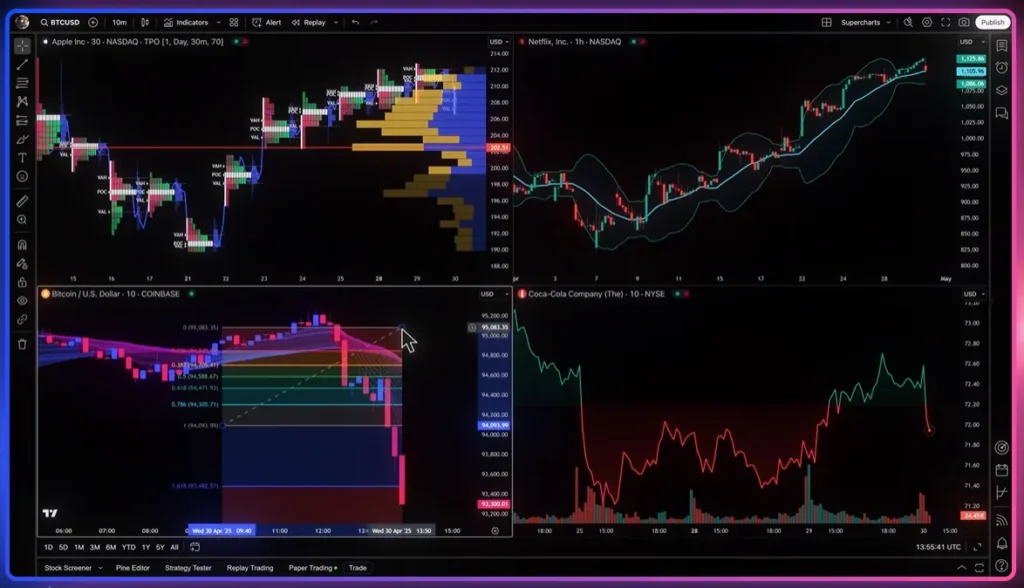
Stock trading usually follows fixed market hours, but the workload within those hours can be intense. Traders often run TradingView or Thinkorswim alongside broker platforms, news feeds, and spreadsheets.
From our experience, performance issues tend to appear in the afternoon rather than at market open, once memory usage has accumulated and scanners have been running for hours. Consistency matters more than peak speed here.
Crypto Trading
Crypto markets run around the clock, and that changes everything.
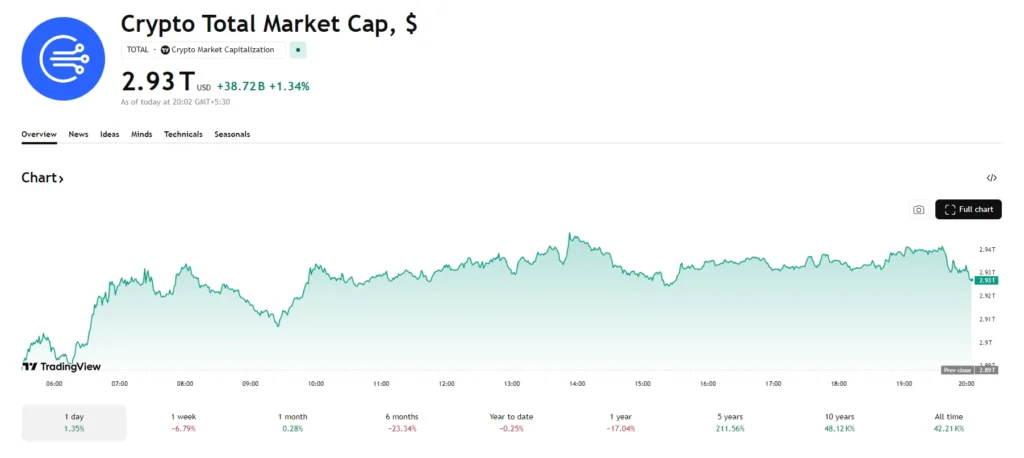
We’ve found that laptops used for crypto trading are often left running far longer than stock-trading systems. Over time, heat buildup and memory accumulation become the limiting factors. Systems that feel fine for short sessions often struggle overnight unless they have efficient cooling and enough RAM to absorb the load.
Forex Trading
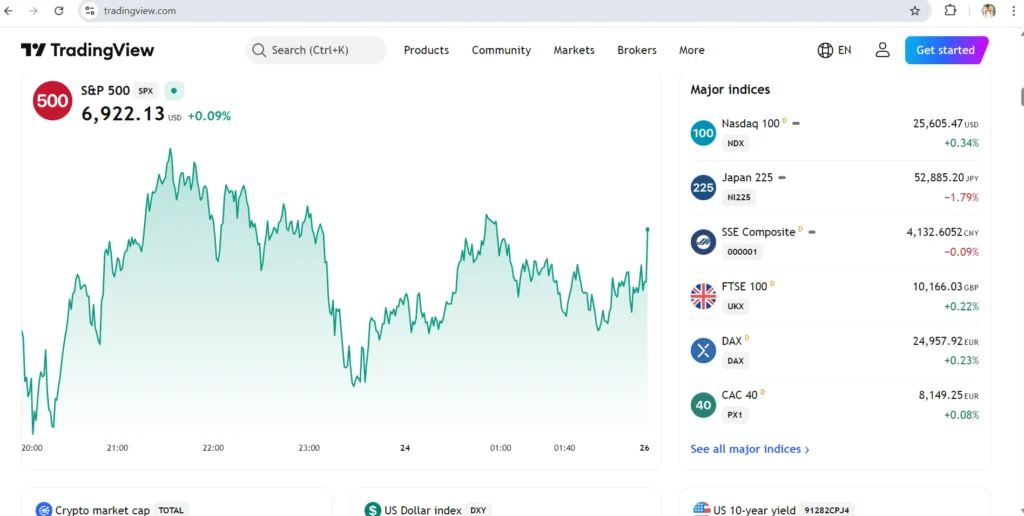
Forex trading involves steady, continuous data updates rather than sharp spikes. MetaTrader and similar platforms place constant background load on the system.
In long sessions, systems with limited RAM or poor sustained CPU behavior feel slower even though they handled short tests without issues. Stability over time is the key factor here.
Futures Trading
Futures trading is the most demanding in terms of responsiveness. Depth-of-market data, rapid price movement, and multi-monitor layouts all stress the system simultaneously.
In our experience, futures traders notice performance differences immediately when a laptop can’t sustain load. Delays in chart redraws or order entry become obvious during volatile periods.
What This Means in Practice
Across all trading styles, the most reliable laptops are not the ones with the highest benchmark scores, but the ones that stay responsive after 6–8 hours of continuous use.
From real trading sessions, the patterns are clear:
- Memory usage grows steadily throughout the day
- Performance drops usually appear mid-session, not at launch
- Cooling and sustained performance matter more than short boosts
- Multi-monitor stability separates good systems from frustrating ones
A laptop that feels fast at market open but slows down by midday is not a good trading machine. Stability across the full session is what actually matters.
Frequently Asked Questions
How much RAM do I need for a trading laptop in 2026?
For modern trading workflows, 16GB RAM is the practical minimum. Traders using multiple platforms, external monitors, or advanced charting tools benefit from 32GB RAM for smoother long-session performance.
Is a dedicated graphics card necessary for trading?
No. Modern integrated graphics from Intel Core Ultra or AMD Ryzen processors handle trading platforms and chart rendering without issue. A dedicated GPU is only useful if the laptop is also used for video editing or 3D workloads.
Are MacBooks good for stock trading?
MacBooks work well for browser-based trading platforms and offer strong battery efficiency. However, many broker-specific desktop platforms are better supported on Windows, so software compatibility should be checked before choosing macOS.
What screen size is best for trading?
A 15–16 inch display offers better comfort for chart analysis and long sessions. Smaller screens are usable, but most traders rely on external monitors for efficient multi-chart workflows.
Can a trading laptop handle multiple external monitors?
Yes. Most modern trading laptops support two or more external monitors through HDMI, USB-C, or Thunderbolt. For the most stable multi-monitor setups, Thunderbolt 4 or USB4 is preferred.
Is a gaming laptop suitable for trading?
Gaming laptops offer strong performance but are generally less suitable for dedicated trading use due to higher heat output, louder fans, heavier designs, and shorter battery life. Productivity-focused or business-class laptops are usually a better fit.
Do trading platforms benefit from AI or NPU features?
Most trading platforms do not directly use NPUs yet. However, NPUs help by offloading background system tasks, which improves overall responsiveness during long trading sessions.
How much storage space do trading platforms use?
Trading platforms can consume 100GB over time due to cached historical data, saved layouts, and logs. A 1TB NVMe SSD offers better long-term flexibility than smaller drives.
Does laptop cooling affect trading performance?
Yes. Poor cooling can lead to thermal throttling, which slows chart updates and platform responsiveness over time. Strong thermal design is more important than peak benchmark performance.
Final Words
A trading laptop is a long-term work tool that supports daily routines. Over time, small differences in responsiveness, screen clarity, and desk compatibility become more noticeable than headline specifications.
The laptops selected here are chosen to support different trading environments, from portable setups to full desk-based workflows with multiple monitors. Each option is suited to a specific way of working rather than a single definition of performance.
Choosing a trading laptop is about avoiding interruptions during market hours. When the system behaves consistently, your focus stays on trading instead of managing hardware issues.


Awesome Aricle sir. This helped me a lot to get the best trading laptop for me. I bought Apple MAcbook pro and it is giving excellent performance.
Well, keep searching for a laptop for gaming, education, and other tasks on the GuideToCart website and you will get the best one.