
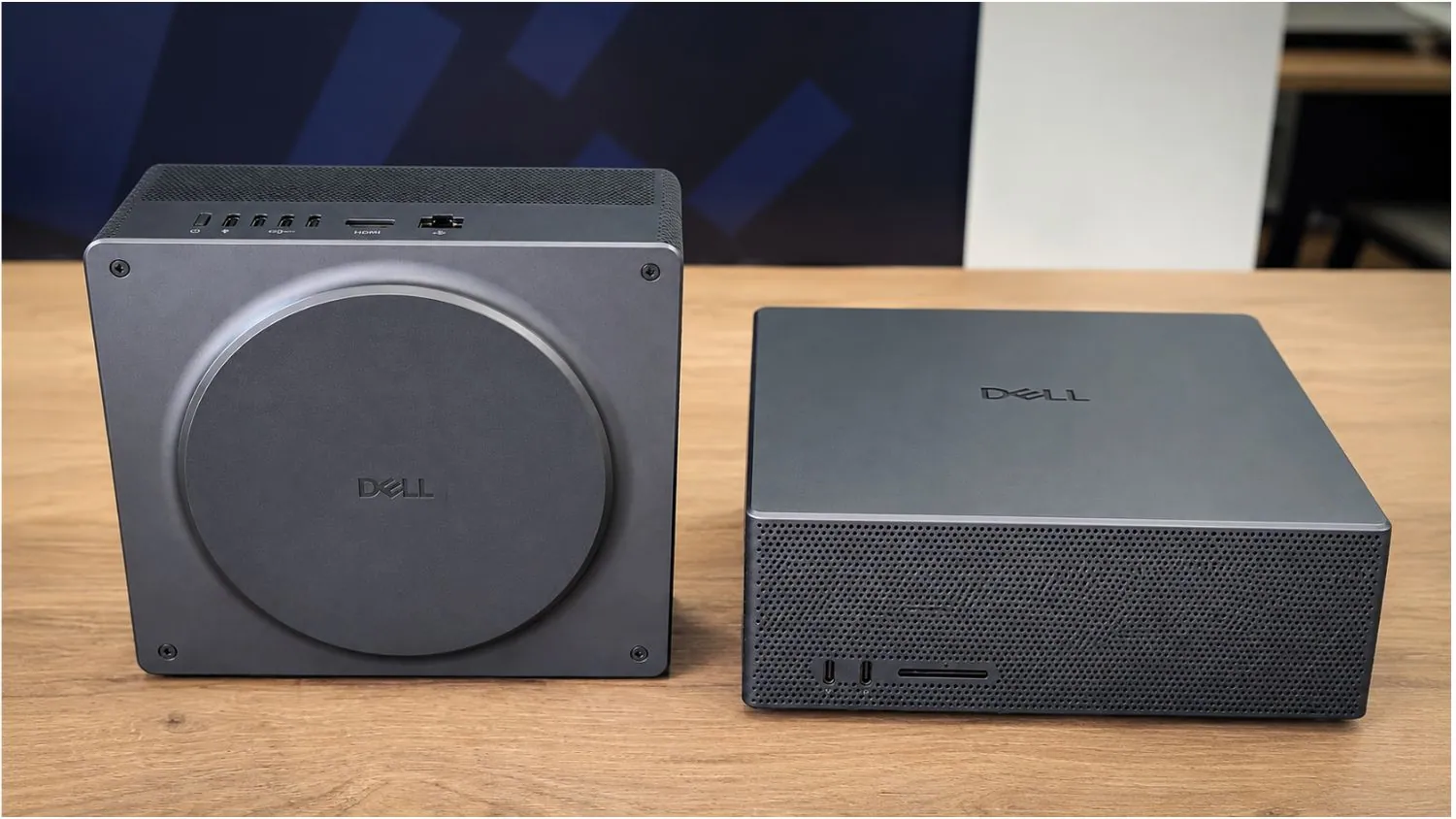
Dell’s XPS RTX Spark Desktop takes a different route from many compact desktops shown at Computex 2026. Instead of focusing entirely on internal hardware, Dell has given equal attention to everyday usability with front-facing USB-C ports, a built-in SD card reader, and a chassis that provides access to internal storage through a removable bottom panel.
The desktop includes two USB-C ports and a full-size SD card reader on its front panel for quick access. This makes it easier to transfer files from cameras, drones, portable SSDs, and memory cards without having to reach around to the back of the system. While many compact desktops keep most of their ports on the rear panel, Dell has taken a more convenient approach for everyday use.
The SD card reader is particularly useful because it eliminates the need for separate adapters and dongles. Photographers, video editors, and content creators often rely on SD cards throughout the day, and having a reader built directly into the desktop simplifies file transfers.
More connectivity is available on the rear panel. Dell comes with the XPS RTX Spark with additional USB-C ports, including a Power Delivery connection and a high-speed 20Gbps USB-C port. HDMI output is present for display connectivity, while Ethernet networking provides a wired network connection for users who prefer stable network performance.
The desktop itself follows a compact design with a dark gray finish and ventilation running along the sides of the chassis. Images shown during Computex indicate that the lower section of the enclosure can be removed to access internal storage. This makes storage upgrades and replacements easier than on many sealed mini PCs.
Powering the desktop is NVIDIA’s RTX Spark platform. Based on NVIDIA’s published specifications, the platform can be configured with up to 20 Grace-based Arm CPU cores alongside up to 6,144 Blackwell CUDA cores.
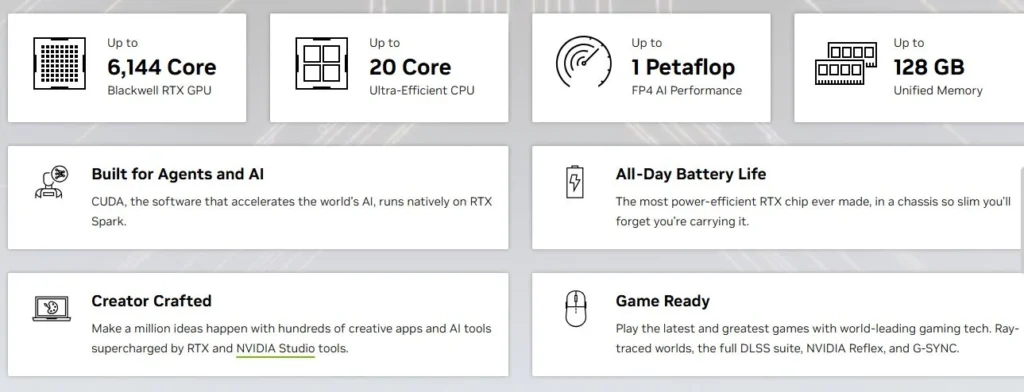
Memory capacity is up to 128GB of LPDDR5X unified memory with bandwidth of up to 300GB/s. The shared memory design allows processing and graphics resources to work from the same memory pool, reducing the need to move data between separate memory areas.
NVIDIA includes support for CUDA-accelerated applications, real-time ray tracing, DLSS, NVIDIA Reflex, and G-SYNC technologies. The platform targets a wide range of workloads, including software development, 3D rendering, engineering tasks, content creation, and modern PC gaming.
The memory capacity is a noteworthy aspect of the compact desktop. Small-form-factor systems rarely offer this much memory, making the 128GB limit particularly useful for users working with large datasets, complex rendering projects, virtual machines, and other demanding professional workloads.
Dell has not disclosed cooling specifications, storage configurations, pricing, or retail availability for the XPS RTX Spark Desktop. More information is expected as RTX Spark products move closer to commercial availability.
While several manufacturers are building desktops around NVIDIA’s RTX Spark platform, Dell has focused heavily on practical connectivity. Front USB-C ports, a built-in SD card reader, removable storage access, and support for up to 128GB of memory give the XPS RTX Spark a distinctive position among the latest compact desktops shown during Computex 2026.
Source: NVIDIA via Overclockzone