

Mesa 26.0.0 is now officially available, bringing substantial ray tracing performance improvements for AMD Radeon GPUs on Linux while expanding Vulkan capabilities across multiple vendors. Announced on February 11 by release manager Eric Engestrom, the update marks the first major Mesa feature release of 2026 and delivers meaningful changes for gamers, developers, Linux distributions, and even Windows Subsystem for Linux (WSL) users.
As part of its continued standards alignment, Mesa 26.0 implements Vulkan 1.4 alongside OpenGL 4.6, OpenGL ES 3.2, and OpenCL 3.0, reinforcing its position as the primary open-source graphics stack across Linux and cross-platform environments.
The headline improvement centers on AMD’s RADV Vulkan driver. Since the Mesa 25.3 series, RADV has seen significant ray tracing performance gains, with much of the optimization work credited to Valve’s Linux graphics team and broader upstream collaboration.
While competitors largely stop at “performance improvements,” the architectural implications are more important. Ray tracing pipelines are highly sensitive to shader compilation strategy and inlining behavior. Mesa developer Natalie Vock detailed substantial pipeline restructuring work ahead of the 26.0 release, describing a shift toward proper function calls and reduced excessive shader inlining in hot execution paths.
In one cited example involving Ghostwire Tokyo on a Radeon RX 7900 XTX, pure ray tracing passes reportedly improved by more than 2×, with overall frame rates rising from roughly 30 FPS to around 40 FPS under the tested workload. These gains illustrate how structural compiler and pipeline decisions can materially impact real-world rendering performance rather than merely boosting synthetic benchmarks.
Mesa 26.0 reduces overhead in critical rendering loops, improving both average frame rates and frame pacing consistency. In practice, that means fewer stutters and better scaling in demanding scenes, especially in Vulkan-first engines and Proton-driven Windows compatibility scenarios.
This strengthens Linux’s position in high-end gaming. Vulkan-first engines and Proton-based Windows compatibility layers increasingly rely on stable and efficient RT execution. With Mesa’s open source RADV driver closing performance gaps in Vulkan ray tracing workloads, Linux gaming moves closer to parity in scenarios that were previously dominated by proprietary stacks. For Steam Deck-class devices and desktop Radeon users, this release reinforces the viability of AMD hardware in ray traced titles.
Mesa 26.0 also streamlines driver configuration. Deprecated RADV_DEBUG environment options have been removed in favor of modern driconf variables, simplifying long-term maintenance and reducing legacy tuning complexity for advanced users and distribution maintainers.
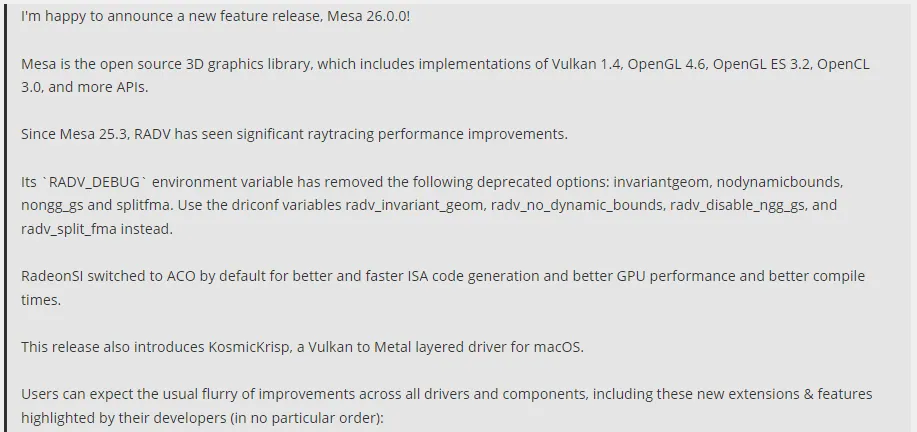
Beyond Vulkan ray tracing, AMD’s OpenGL stack sees a meaningful backend shift. RadeonSI now defaults to the ACO compiler backend, a move expected to deliver better ISA code generation, improved GPU performance, and faster compile times. This consolidation reduces divergence between AMD’s Vulkan and OpenGL optimization strategies, strengthening long-term maintainability of the open-source Radeon driver ecosystem.
The 26.0 cycle introduces new and promoted extensions across AMD RADV, Intel ANV, NVIDIA’s open source NVK driver, PowerVR, PanVK, and other platforms. Several maintenance and robustness extensions are now promoted where previously optional, improving standards compliance and reducing edge-case instability.
Rather than viewing this as a raw extension list, the changes fall into three broader impact categories. First, stability and robustness promotions improve application reliability and sandbox behavior. Second, swapchain and presentation maintenance updates enhance frame delivery consistency and reduce synchronization edge cases. Third, shader and memory extensions expand flexibility for engine developers targeting advanced Vulkan features.
Mesa 26.0 also introduces KosmicKrisp, a Vulkan-to-Metal layered driver for macOS. Although still early in maturity, this layered approach signals growing cross-platform ambition within the Mesa ecosystem and could reduce friction for Vulkan applications targeting Apple hardware over time.
Also Read: Ways to Improve Gaming Performance
Mobile and alternative GPU platforms receive notable updates as well. Qualcomm’s Adreno Gen 8 graphics, expected in Snapdragon X2-class laptops, see readiness improvements, reinforcing Mesa’s growing role in ARM-based Linux systems. Updates for PowerVR and PanVK drivers accompany new features such as sparse residency support, memory reporting extensions, and additional maintenance promotions.
HDR-related fixes and broader driver polish also land in this release cycle, improving compatibility for modern high dynamic range displays across supported hardware stacks.
From a distribution perspective, Mesa’s predictable cadence means 26.0.0 will first reach rolling releases such as Arch Linux and development branches like Fedora Rawhide before filtering into stable channels. A bug-fix point release is expected within roughly two weeks, consistent with the project’s standard release schedule.
For developers, Mesa 26.0 improves Vulkan feature parity, strengthens compliance coverage, and simplifies long-term maintenance through extension promotions and compiler consolidation. For gamers, especially Radeon users, it represents one of the most meaningful open source ray tracing optimizations in recent cycles.
Taken together, Mesa 26.0 is not just another incremental driver drop. It signals continued maturation of the Linux graphics stack, deeper Vulkan 1.4 alignment across vendors, measurable real-world ray tracing gains, and expanding relevance across desktop, handheld, ARM laptop, and cross-platform graphics ecosystems.
Sources: Phoronix, GamingOnLinux