
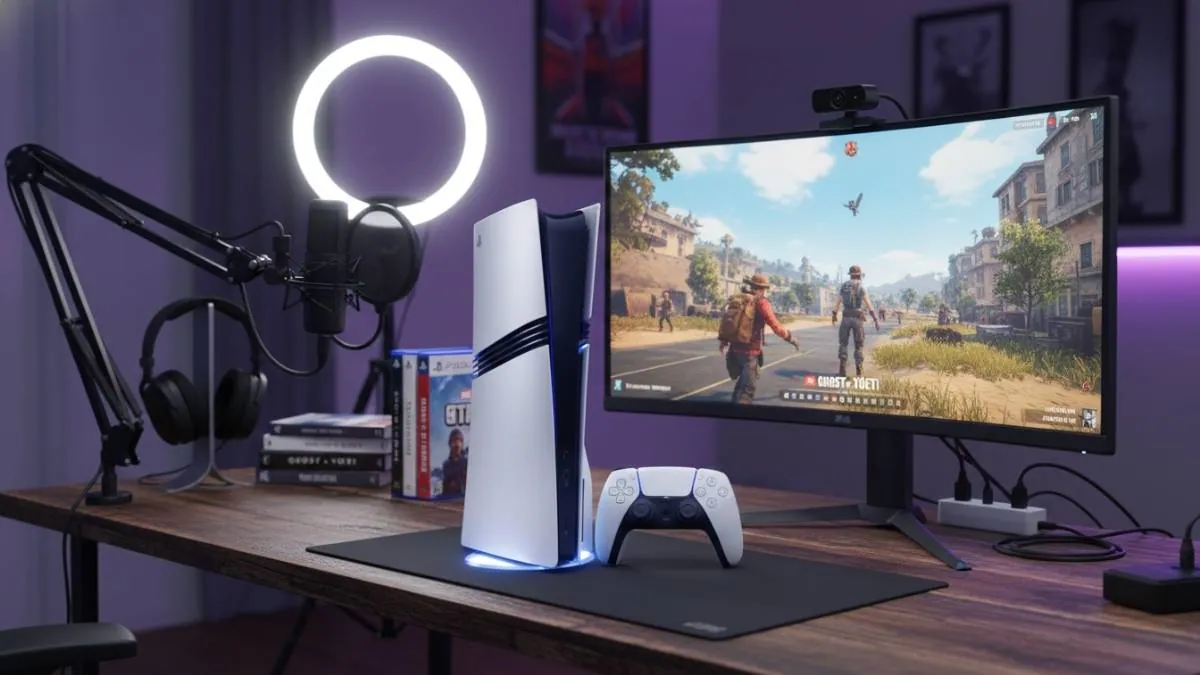
Sony has expanded its current-generation console lineup with the PlayStation 5 Pro, a mid-cycle hardware refresh designed for players who want higher visual fidelity, stronger ray tracing, and more consistent frame rates as game demands continue to rise.
Rather than replacing the standard PlayStation 5, the PS5 Pro sits above it as a performance-focused option. The console prioritizes GPU improvements, AI-assisted upscaling, and long-term relevance while maintaining full compatibility with the existing PS5 ecosystem and game library.
In 2026, the PS5 Pro represents Sony’s most capable console to date, targeting users with modern displays who want smoother gameplay without waiting for the next full generation.
PS5 Pro Overview and Market Positioning
Sony followed its established mid-generation strategy, similar to the PS4 Pro era, by introducing the PS5 Pro midway through the PlayStation 5 lifecycle. Instead of redefining the platform, Sony positioned the Pro model as a refinement console aimed at visual and performance improvements.
The PS5 Pro is primarily targeted at:
- Players using 4K and 120Hz displays
- Gamers who prioritize visual quality alongside performance stability
- Users planning to remain in the PS5 ecosystem for several more years
This approach allows developers to push higher graphical targets while still supporting the large base of standard PS5 owners.
PS5 Pro Release Date
The PS5 Pro officially launched on November 7, 2024, with global availability shortly afterward. By 2026, supply has stabilized across most regions, avoiding the shortages that affected the original PS5 launch.
The timing aligns with Sony’s typical 6–7 year console lifecycle, giving developers room to scale visuals upward without abandoning the base hardware.
Also Read
PS5 Pro Price
At launch, the PS5 Pro entered the premium console segment.
Official launch pricing
- United States: $699.99
- United Kingdom: £699.99
- Europe: €799.99
As of 2026, seasonal sales occasionally reduce the price closer to $649 in select markets.
This makes it the most expensive PlayStation console to date, reflecting its mid-generation performance upgrade rather than a full generational leap.
PS5 Pro Specifications and Performance Improvements
Key Specifications
| Specification | PlayStation 5 Pro |
|---|---|
| CPU | Custom AMD Zen 2 |
| GPU | Custom AMD GPU |
| Ray Tracing | Supported |
| AI Upscaling | PSSR |
| System Memory | 16GB GDDR6 |
| Internal Storage | 2TB NVMe SSD |
| Storage Expansion | M.2 NVMe SSD |
| Video Output | Up to 4K @ 120Hz |
| HDMI | HDMI 2.1 |
| Networking | Wi-Fi 6, Gigabit Ethernet |
| Optical Drive | Optional (modular disc drive) |
| Model Type | Digital-only |
GPU and Rendering Performance
The largest performance gains come from the upgraded GPU.
Confirmed improvements over the standard PS5 include:
- 67% more compute units
- 28% higher memory bandwidth
- Up to 45% faster rendering performance in GPU-bound workloads
These upgrades allow developers to deliver higher resolutions and smoother frame rates without forcing players to choose between fidelity and performance modes as often.
PSSR (PlayStation Spectral Super Resolution)
One of the most important additions is PSSR, Sony’s AI-based upscaling technology.
PSSR reconstructs higher-resolution images from lower internal render resolutions, similar in concept to NVIDIA DLSS. In real-world use, this allows many PS5 Pro-enhanced games to output sharp 4K visuals while maintaining stable performance, especially in demanding scenes.
Ray Tracing Performance Improvements
Ray tracing sees a substantial uplift on the PS5 Pro.
Sony confirms:
- 2× to 3× faster ray-tracing performance compared to the base PS5
This enables more realistic lighting, reflections, and shadows with fewer compromises, particularly in visually intensive titles such as Marvel’s Spider-Man 2 and Alan Wake 2.
Storage Capacity
Storage is one of the most practical upgrades.
- 2TB internal SSD included by default
- Continued support for M.2 NVMe SSD expansion
The jump to 2TB significantly reduces storage management issues, especially as modern AAA titles frequently exceed 100GB.
Design, Cooling, and Disc Support
The PS5 Pro retains the tall profile of the original PS5 while adopting the slimmer design language introduced with the 2023 PS5 Slim revision.
Notable design changes include:
- Triple-stripe side panel detailing
- Improved internal cooling for sustained performance
- Quieter operation under heavy gaming loads
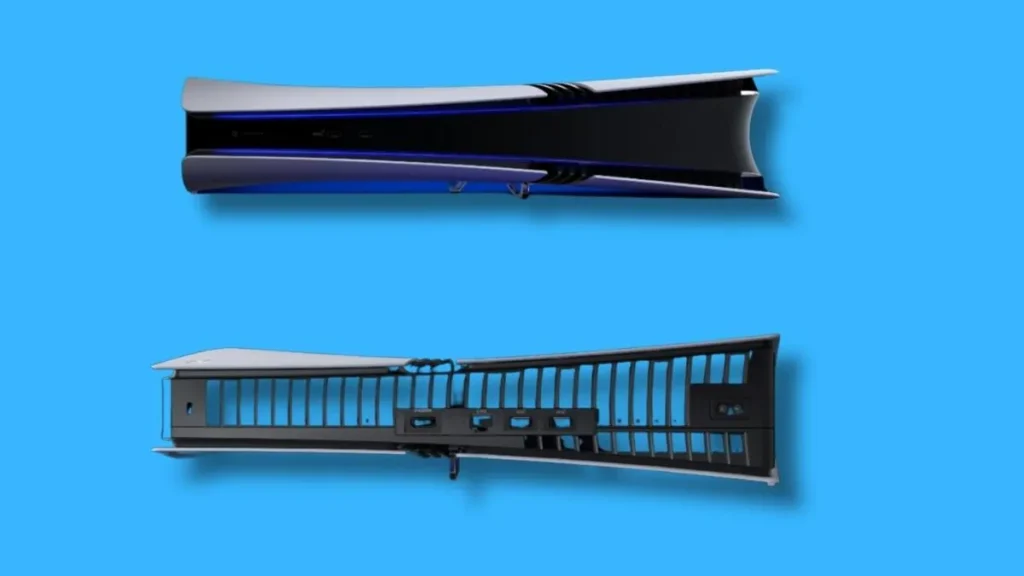
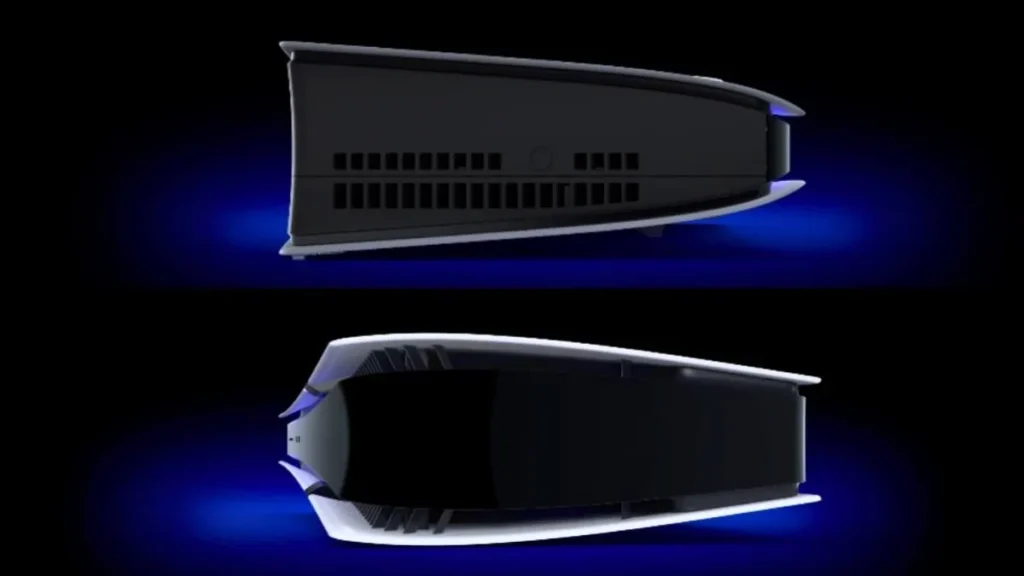
The console is digital-only by default. Physical disc support requires purchasing Sony’s modular Disc Drive separately.
PS5 vs PS5 Pro: Key Differences
| Feature | PS5 | PS5 Pro |
|---|---|---|
| GPU Performance | Base RDNA 2 | Significantly upgraded GPU |
| Ray Tracing | Limited | 2×–3× faster |
| AI Upscaling | No | PSSR supported |
| Internal Storage | 825GB | 2TB |
| Target Experience | 4K or 60fps | 4K + stable 60fps or higher |
| Disc Drive | Included (standard model) | Optional accessory |
The PS5 Pro does not introduce exclusive games. Instead, it enhances how existing and future PS5 titles perform.
What the PS5 Pro Actually Improves Over the Standard PS5
The PS5 Pro doesn’t change what you can play, but it noticeably changes how many games feel, especially in visually demanding scenes.
In Pro-enhanced titles, frame pacing is more consistent at higher resolutions, meaning fewer dips during combat-heavy or effects-heavy moments. Ray tracing effects are also more usable, with reflections and lighting enabled without forcing aggressive performance compromises.
The biggest difference shows up on modern displays. If you are using a 4K or 120Hz TV or monitor, the PS5 Pro makes better use of that hardware, often removing the need to choose between a “performance” or “quality” mode entirely.
For players coming from a standard PS5, the upgrade feels incremental rather than dramatic, but the improvements are easy to notice once you spend time with Pro-optimized games.
Should You Upgrade to PS5 Pro in 2026?
Whether the PS5 Pro is worth upgrading to in 2026 depends more on your display and expectations than on the console itself.
If you already own a 4K or 120Hz display and care about visual consistency, lighting quality, and smoother frame rates, the PS5 Pro offers a clear upgrade. It is particularly appealing for players who plan to stay on the PS5 platform for several more years rather than waiting for the next generation.
On the other hand, if you mostly play at 1080p, are happy with 60fps performance, or feel satisfied with how current PS5 games run, the standard PS5 remains more than capable. The PS5 Pro does not unlock exclusive content, and the difference may feel subtle without the right setup.
With early PlayStation 6 timelines pointing toward a possible 2027–2028 window, the PS5 Pro works best as a long-term refinement option rather than a short-term upgrade.
FAQs
Is the PS5 Pro worth buying in 2026?
For players with modern displays who value smoother performance and improved visuals, the PS5 Pro remains a worthwhile upgrade in 2026.
Does the PS5 Pro support 120Hz gaming?
Yes, the PS5 Pro fully supports 120Hz output on compatible displays, with improved performance stability in supported titles.
Are there PS5 Pro-exclusive games?
No. All PS5 Pro games are compatible with the standard PS5, but Pro-enhanced titles run better on the upgraded hardware.
Is the PS5 Pro digital-only?
Yes. The console ships without a disc drive, but Sony offers a modular disc drive accessory for physical media support.
Will PS5 Pro games run on the standard PS5?
Yes. Developers are required to maintain compatibility across the PS5 family.
Why is the PS5 Pro expensive?
The PS5 Pro costs more because it includes a stronger GPU, improved ray-tracing hardware, AI upscaling support, and a larger 2TB SSD compared to the standard PS5.
Final Verdict
The PlayStation 5 Pro represents Sony’s most refined version of current-generation console gaming. Rather than redefining the platform, it strengthens what already works by delivering smoother gameplay, stronger ray tracing, and higher visual consistency as game demands continue to rise.
For players seeking the best PlayStation experience available today, the PS5 Pro stands as Sony’s most capable console so far.