
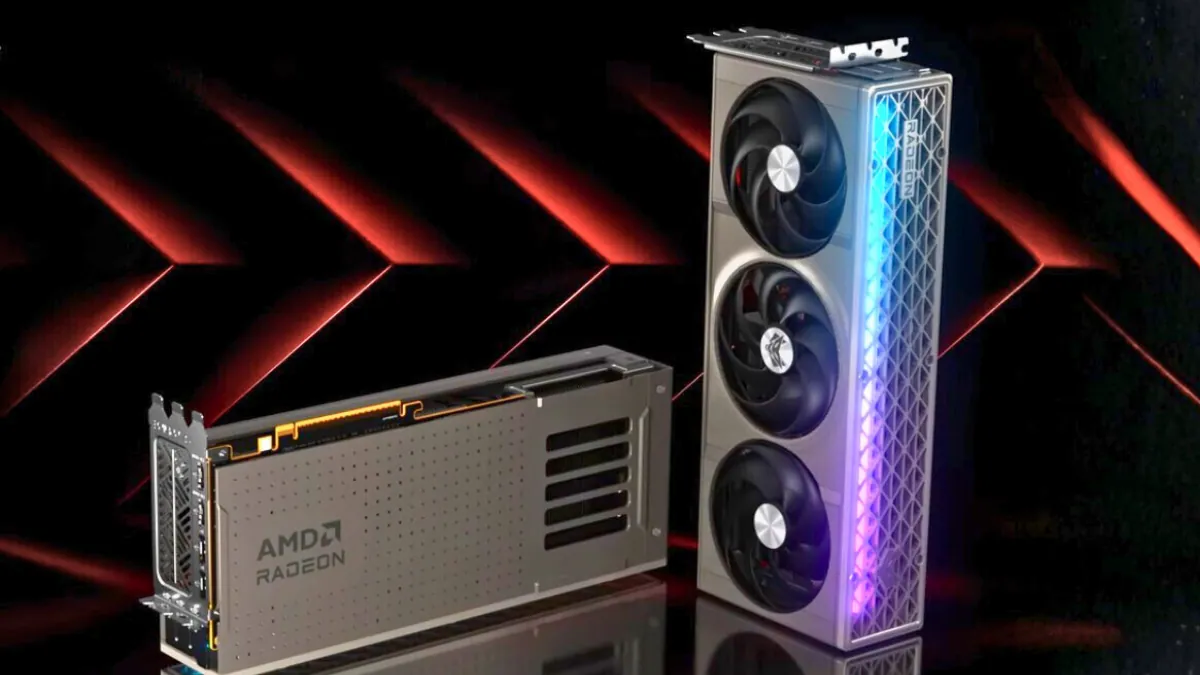
Sapphire has confirmed a limited-edition NITRO+ Radeon RX 9070 XT themed around Pearl Abyss’s upcoming action RPG Crimson Desert, with retail availability scheduled for February 2026. The launch aligns with AMD’s wider Crimson Desert game bundle campaign, positioning the RX 9070 XT as both a performance-focused GPU and a showcase product for the RDNA 4 generation.
The Crimson Desert Edition is built on Sapphire’s existing NITRO+ RX 9070 XT OC platform rather than a new silicon revision. Core specifications remain unchanged. The card features 4,096 stream processors, 16GB of 20Gbps GDDR6 memory across a 256-bit interface, and 64MB of Infinity Cache. Boost clocks reach up to 3060MHz, with a 2520MHz game clock, matching the previously released NITRO+ OC variant.
What sets the Crimson Desert Edition apart is its visual identity. Sapphire replaces the standard industrial backplate with full-game artwork and adds themed branding to the fan hubs and shroud accents. The Quick Connect MagniPlate design remains in place, allowing aesthetic customization without dismantling the cooler. Full-length ARGB lighting continues to serve system builders targeting cohesive, high-end builds.
Underneath the cosmetic layer, the hardware reflects AMD’s broader RDNA 4 strategy. The Navi 48 GPU returns to a monolithic 4nm design, integrating memory controllers and Infinity Cache on a single die. Compared to previous chiplet-based implementations, this simplifies latency paths and can improve efficiency consistency under sustained workloads.
RDNA 4 is also positioned around AI-accelerated rendering improvements. The RX 9070 XT integrates updated ray tracing accelerators and dedicated AI hardware designed to support AMD’s next-generation FidelityFX stack.
Popular games such as Crimson Desert are expected to showcase machine-learning-assisted upscaling, frame generation, and ray reconstruction features tied to FSR 4. Rather than serving as a late-stage patch addition, the game is being aligned with RDNA 4’s hybrid rendering capabilities from launch.
Although Sapphire has not published performance data specific to the Crimson Desert Edition, identical clock speeds to the NITRO+ OC model allow reasonable positioning estimates. At 2520MHz game clock and 3060MHz boost, the RX 9070 XT is expected to compete directly with the RTX 5070 at 1440p Ultra settings, while challenging RTX 5070 Ti-class performance in raster-heavy titles. With FSR 4 enabled, 4K gaming becomes increasingly viable, and ray tracing performance is projected to show measurable gains over RDNA 3.
The 16GB GDDR6 buffer on a 256-bit interface remains a practical differentiator, especially as modern AAA titles continue to push VRAM usage beyond 12GB at higher texture settings. While NVIDIA has transitioned portions of its latest lineup to GDDR7, AMD is relying on architectural efficiency improvements and 64MB of Infinity Cache to maintain competitiveness.
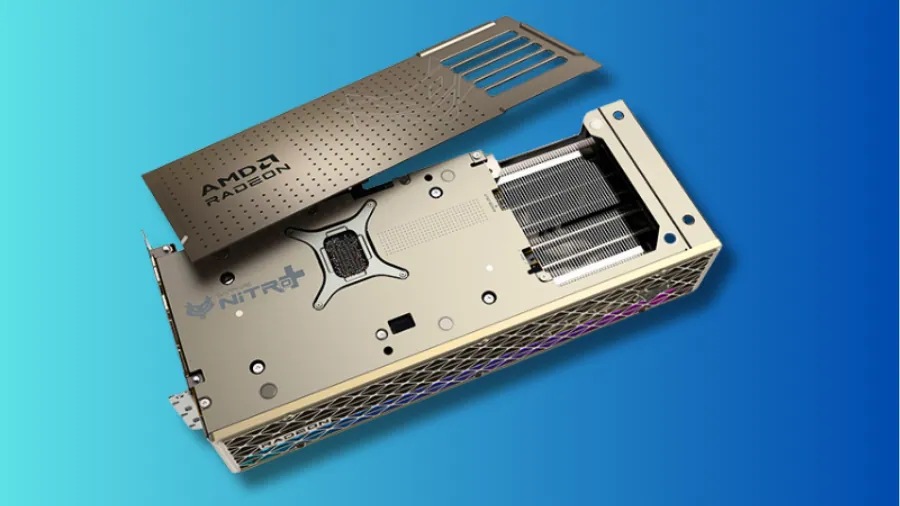
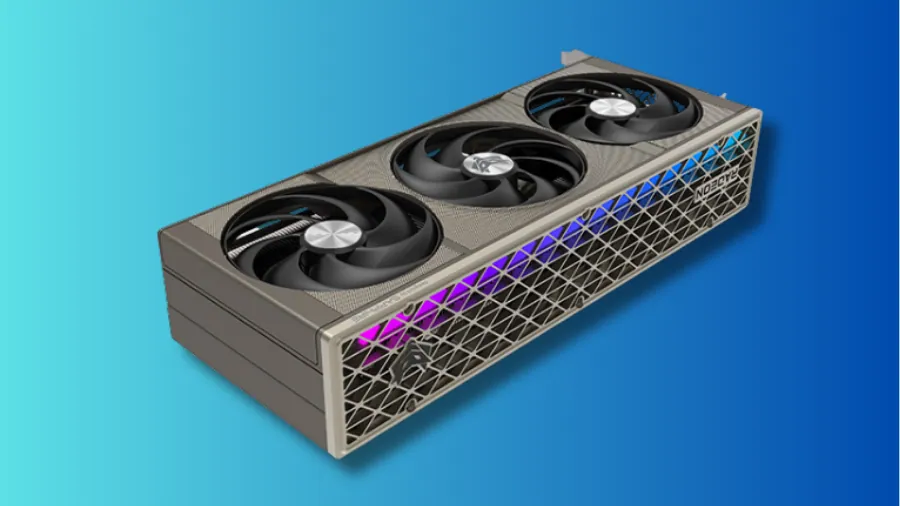
AMD’s reference RX 9070 XT carries a starting MSRP of $600. Sapphire’s NITRO+ variants traditionally command a premium due to enhanced cooling, reinforced build quality, elevated clocks, and expanded RGB implementation. Historically, this premium has ranged between $100 and $150 over baseline MSRP. If that trend holds, the Crimson Desert Edition could land in the $700 to $750 range, placing it close to RTX 5070 Ti pricing territory. That would intensify upper midrange competition and make value positioning a critical factor.
Power delivery uses the 12V-2×6 connector, rated for a 330W typical board power. Sapphire includes a bundled 12V-2×6 to triple 8-pin adapter. Adoption of 12V-2×6 across more AMD board partner designs reflects broader industry consolidation around higher-density connectors and cleaner cable routing. At 330.8mm long and 3.2 slots thick, the card requires a spacious chassis and adequate airflow, reinforcing its enthusiast-tier positioning.
Key Specifications
| Specification | Details |
|---|---|
| GPU | AMD Navi 48 (RDNA 4, 4nm) |
| Compute Units | 64 |
| Stream Processors | 4,096 |
| Game Clock | Up to 2520 MHz |
| Boost Clock | Up to 3060 MHz |
| Memory | 16GB GDDR6 |
| Memory Speed | 20Gbps |
| Memory Bus | 256-bit |
| Infinity Cache | 64MB |
| Interface | PCIe 5.0 x16 |
| Typical Board Power | 330W |
| Power Connector | 12V-2×6 (adapter included) |
| Display Outputs | 2x HDMI, 2x DisplayPort 2.1a |
| Dimensions | 330.8mm length, 3.2-slot |
The launch also coincides with AMD’s broader Crimson Desert promotional bundle. Eligible RX 9070 and RX 9070 XT purchases during the promotional window qualify for a digital copy of the game through AMD’s redemption platform. The current bundle period runs from February 10, 2026 through April 25, 2026, with redemption closing in late May. The game itself is scheduled to release in March 2026. This coordinated GPU and CPU bundle strategy highlights AMD’s ongoing ecosystem alignment approach.
You can receive the same factory-overclocked NITRO+ hardware with cosmetic exclusivity and bundle eligibility. Strategically, the release reflects a broader shift in GPU positioning. Rather than competing purely on specification charts, vendors are increasingly tying premium hardware to high-profile software launches to reinforce ecosystem alignment.
RX 9070 XT Reference vs Sapphire NITRO+ RX 9070 XT vs Crimson Desert Edition
| Model | RX 9070 XT Reference | Sapphire NITRO+ RX 9070 XT | Crimson Desert Edition |
|---|---|---|---|
| GPU | Navi 48 (RDNA 4) | Navi 48 (RDNA 4) | Navi 48 (RDNA 4) |
| Stream Processors | 4,096 | 4,096 | 4,096 |
| Game Clock | ~2400 MHz | 2520 MHz | 2520 MHz |
| Boost Clock | ~2970 MHz | 3060 MHz | 3060 MHz |
| Memory | 16GB GDDR6 | 16GB GDDR6 | 16GB GDDR6 |
| Board Power | ~330W | 330W | 330W |
| Power Connector | 12V-2×6 | 12V-2×6 | 12V-2×6 |
| Cooling | Standard AIB | Enhanced triple-fan | Enhanced triple-fan |
| Aesthetics | Standard design | RGB + custom styling | Game-themed artwork + RGB |
As February retail availability draws near, Sapphire’s Crimson Desert Edition arrives as one of the earliest limited-run cards in the RDNA 4 era. Still, once the novelty of the themed design fades, the real test will be performance. How the RX 9070 XT stacks up in sustained benchmarks against NVIDIA’s RTX 5070 and RTX 5070 Ti will ultimately determine whether it’s remembered as more than just a collector’s piece in an increasingly competitive upper-midrange market.
Source: Sapphire