

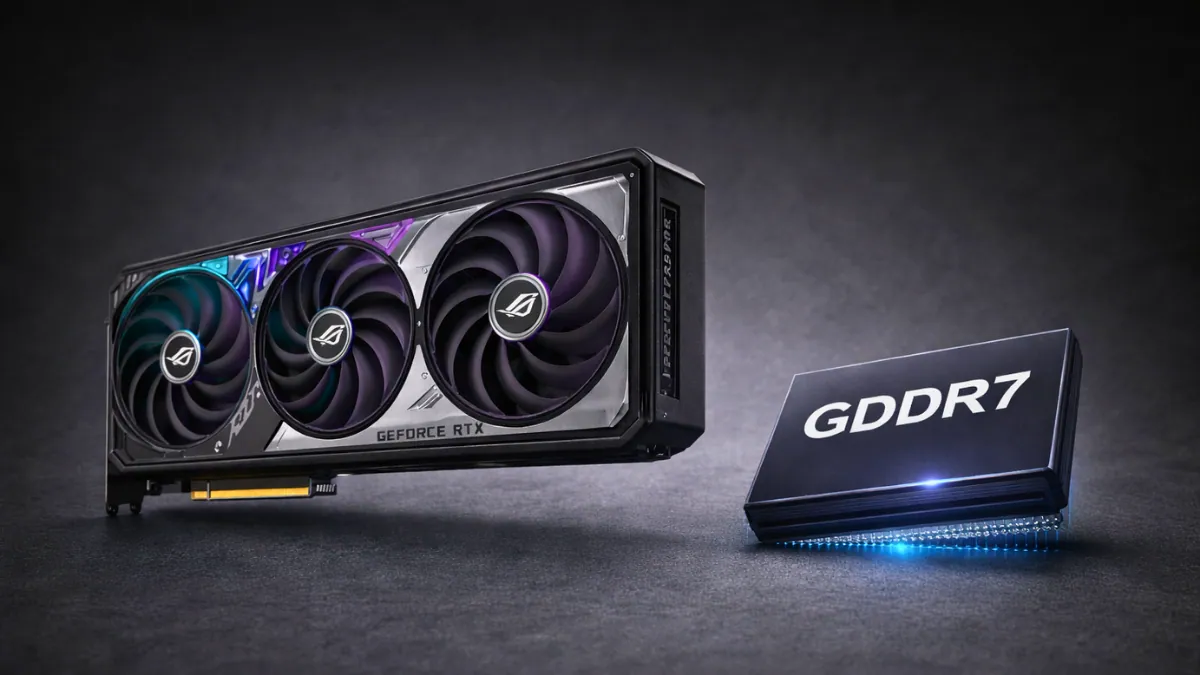
Micron has introduced new 24Gb GDDR7 memory modules rated for speeds of up to 36 Gb/s, establishing a higher speed tier for upcoming NVIDIA GeForce and AMD Radeon GPUs, and emerging AI PCs. The announcement positions Micron at the forefront of next-gen VRAM development as GPU makers race to increase memory bandwidth, expand frame buffer capacity, and reduce memory limitations in AI-driven workloads.
The new chips deliver 24 gigabits (3GB) per die and a peak data rate of 36 Gb/s, exceeding the speeds used in any currently shipping consumer GPU. For comparison, existing GDDR7 implementations, including NVIDIA’s RTX PRO 6000 Blackwell and GeForce RTX 5090 Laptop GPU, operate around 28 Gb/s. Micron’s new speed grade creates substantial architectural headroom for upcoming GPU generations expected to follow the Blackwell family.
A 512-bit memory bus running at 36 Gb/s would push total bandwidth past 2.3 TB/s. Today’s 28 Gb/s setups sit around 1.8 TB/s, so the jump is noticeable even without widening the bus. For high-end GPUs, that means more headroom without redesigning the entire memory layout or driving power too much higher.
The density jump to 24Gb (3GB per module) is equally consequential. Higher-density GDDR7 enables board partners to scale memory capacity more efficiently across common 128-bit, 192-bit, and 256-bit interfaces. That opens cleaner paths to 12GB, 18GB, 24GB, or even 48GB VRAM configurations without immediately widening memory buses. For US gaming and creator markets, that means larger frame buffers without a full memory subsystem redesign.
GDDR7, standardized under JEDEC, introduces improved signaling and power efficiency compared to GDDR6X. Micron highlights performance-per-watt gains alongside raw throughput increases an important consideration as AI-enhanced graphics pipelines, frame generation, upscaling technologies, and local inference workloads become more memory-intensive.
GPU vendors are contending with rising demand for 4K and 8K gaming, high-refresh-rate ray tracing, real-time rendering, generative AI integration, and AI-assisted content creation. Memory bandwidth and VRAM capacity are becoming increasingly important factors in overall GPU performance.
From a competitive standpoint, Micron’s 36 Gb/s speed grade reflects intensifying competition in high-bandwidth memory development. Rival DRAM manufacturers, including Samsung and SK Hynix, are advancing their own next-generation memory technologies, making bandwidth leadership strategically significant ahead of future GeForce and Radeon launches.
While 3GB GDDR7 modules are already present in high-end mobile and professional systems, mainstream desktop adoption will depend on controller readiness, yields, and cost dynamics. Past GPU cycles have shown that memory pricing can materially influence SKU segmentation and launch timing in the US retail market.
No consumer GPU currently operates at 36 Gb/s, making this development forward-looking rather than immediately productized. However, it establishes a new performance reference point for architectures expected beyond NVIDIA’s Blackwell generation and AMD’s next Radeon roadmap.
By increasing density to 24Gb and speeds up to 36 Gb/s, Micron expands the design flexibility available to future graphics cards and AI accelerators. This could enable higher-capacity gaming GPUs, AI-focused workstation cards, and premium creator systems to ship with significantly more memory bandwidth than current designs, raising the bandwidth and density targets for upcoming graphics architectures.
Source: Micron