
Lenovo is set to show its Legion Go Fold Concept at Mobile World Congress 2026 in Barcelona on March 2. The device is a foldable Windows gaming handheld that blends portable gaming with full Windows 11 functionality.
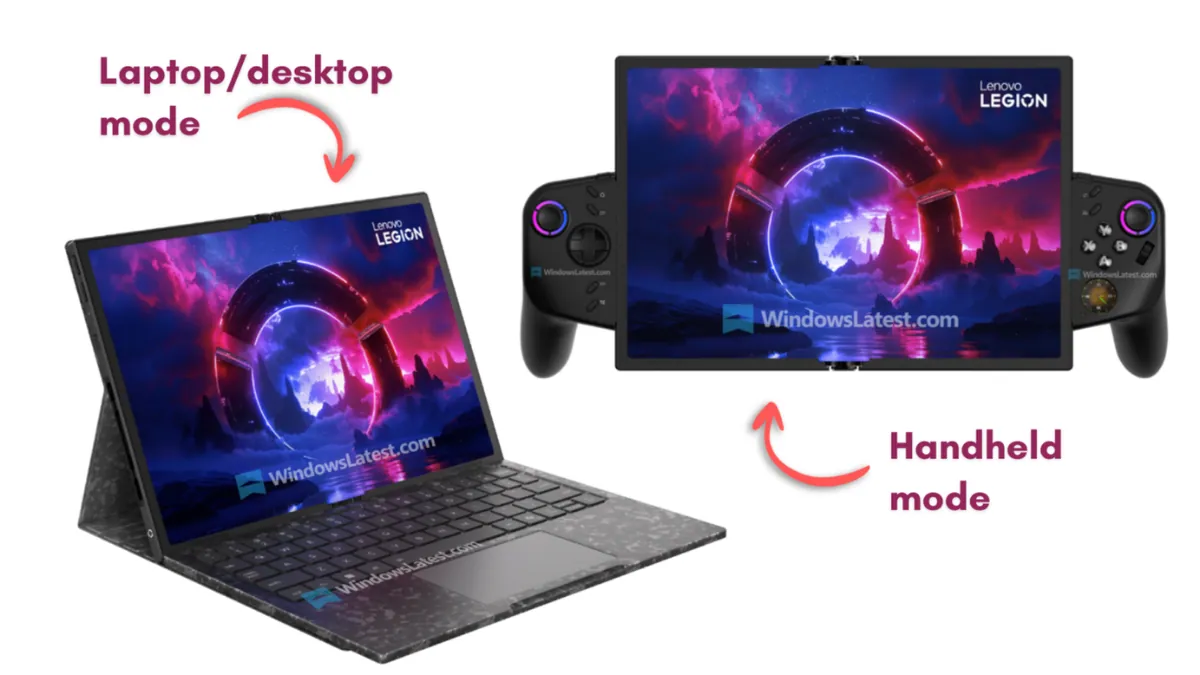
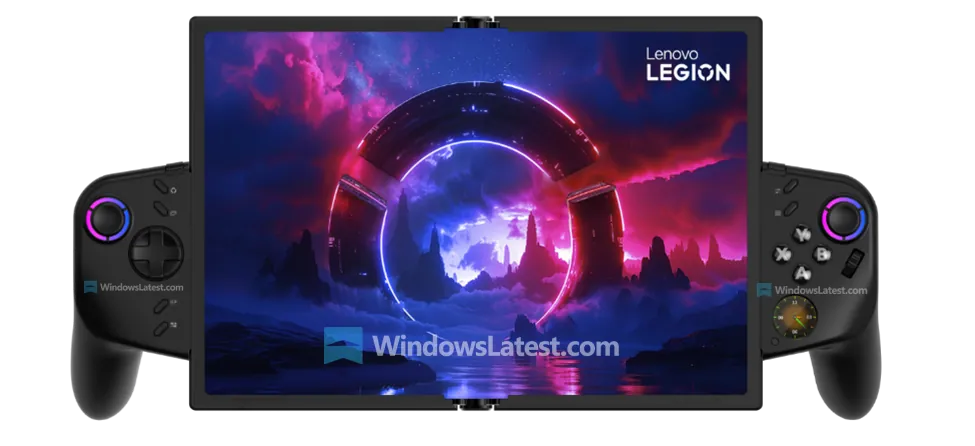
The Legion Go Fold starts as a compact 7.7-inch handheld. When unfolded, it expands into an 11.6-inch POLED display, turning into something closer to a small Windows laptop. If Lenovo brings it to market, it would sit alongside devices like the ASUS ROG Ally, Steam Deck OLED, and Lenovo’s own Legion Go Gen 2, but with a different design approach.
In handheld mode, detachable wireless controllers attach to both sides of the screen, similar to other Windows gaming handhelds. Once unfolded, the larger display offers more space for games, browsing, or multitasking.
Lenovo also demonstrates a split-screen layout. One side of the display can run a game while the other shows apps like Discord, streaming tools, guides, or a web browser. This setup reflects how many PC gamers use multiple windows instead of staying in full-screen mode.
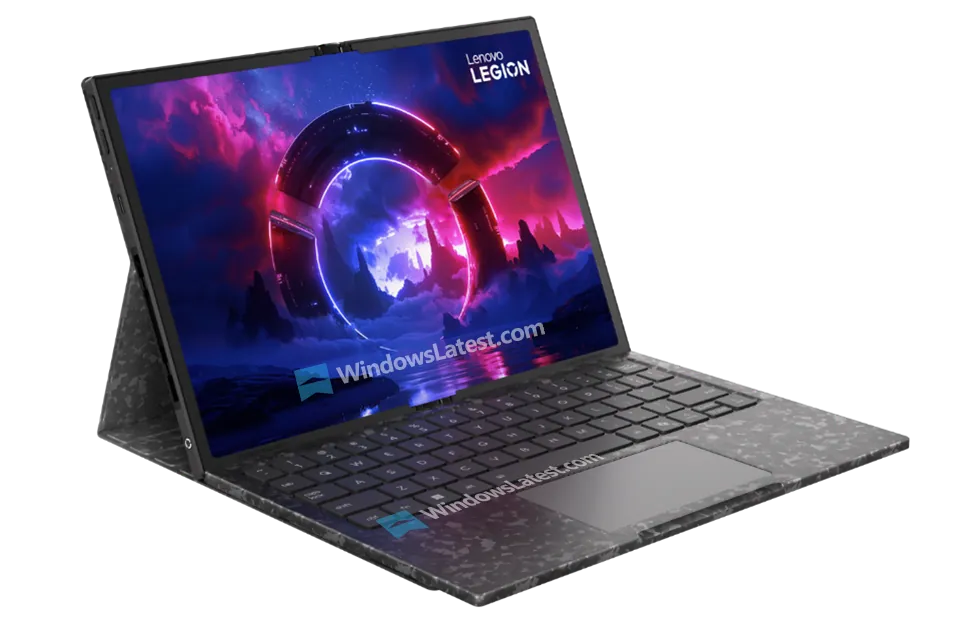
The device can also be paired with a wireless keyboard that includes a built-in touchpad. In this setup, it works like a compact clamshell-style Windows laptop, similar in flexibility to detachable systems such as the ThinkPad X13 Detachable.
The goal is to combine gaming and everyday computing into a single device. Many handheld owners still carry a separate laptop for work or school, and Lenovo appears to be addressing that gap.
Whether an 11.6-inch screen can fully replace a traditional 13- or 14-inch laptop remains to be seen. Still, the concept shows Lenovo exploring a single-device option for gaming, streaming, and light productivity.
The prototype runs on an Intel Core Ultra 7 258V processor with 32GB of RAM and a 48Wh battery. On paper, those specifications are closer to thin-and-light laptops than typical handheld consoles. This Intel-based configuration also contrasts with emerging ARM-focused PC platforms such as the NVIDIA N1X ARM laptop CPU, which aim to bring high-efficiency performance to future Windows systems.
Compared to AMD Z1 Extreme-based competitors like the ROG Ally and Steam Deck OLED, Lenovo’s configuration leans toward full Windows 11 PC performance rather than console-level optimization. That distinction may appeal to US power users who prioritize compatibility with native Windows applications, game launchers, and creative software. However, this hardware profile introduces legitimate engineering challenges.
Sustaining high-performance AAA gaming workloads inside a compact foldable chassis raises airflow and thermal dissipation concerns. Foldable form factors inherently reduce internal cooling volume, and prolonged gaming sessions demand far more thermal headroom than web browsing or office productivity.
Battery capacity may also become a limiting factor. A 48Wh battery is modest for a Windows gaming PC expected to power an 11.6-inch display under sustained GPU load. Without substantial efficiency gains in Windows 11’s gaming stack and Intel’s power management, extended sessions could result in shortened battery endurance.
Microsoft’s continued efforts to optimize Windows 11 for handheld gaming, including scheduler refinements, performance tuning, and deeper Xbox integration, will play a decisive role in determining whether hardware like this can deliver consistent frame rates without aggressive thermal throttling. Durability remains another critical variable.
Foldable displays have matured in smartphones, but gaming PCs introduce additional mechanical stress. Hinge longevity, controller attachment stability, and repeated thermal cycling under load will ultimately determine long-term reliability, particularly at premium pricing tiers.
A foldable POLED display, Intel Core Ultra silicon, and 32GB of memory strongly suggest that if commercialized, the Legion Go Fold could exceed $1,200 in US retail pricing.
At that level, the device would compete less with handheld consoles and more directly with premium gaming laptops and ultraportables. American consumers will evaluate whether the flexibility of a foldable hybrid justifies that premium over established 14-inch gaming notebooks.
Windows-based handheld gaming PCs have grown rapidly in popularity across the US, but most remain secondary devices. Users still rely on separate laptops for productivity software, editing workflows, or business travel. Lenovo appears to be targeting this gap precisely.
Rather than simply pushing higher frame rates, the Legion Go Fold Concept explores a new hardware form factor that blurs the line between console, tablet, and laptop. It reflects Lenovo’s broader experimentation with unconventional display formats, similar to its Legion Pro Rollable OLED concept, as foldable and expandable screen technology continues to mature.
If Lenovo successfully brings this device to market with competitive pricing and durable engineering, it could define a new premium segment: the foldable Windows gaming PC.
If not, it may remain a high-profile proof of concept, an ambitious demonstration of how far portable gaming hardware can stretch before thermal, economic, and ergonomic realities intervene.
For now, the Legion Go Fold remains a concept ahead of its expected MWC 2026 reveal in Barcelona, with no confirmed US launch timeline. Still, it sends one of the clearest signals yet that the future of Windows gaming hardware may be defined as much by form factor innovation as by raw silicon performance.
Key Specifications
| Processor | Intel Core Ultra 7 258V |
| RAM | 32GB |
| Display | Foldable POLED 7.7-inch handheld to 11.6-inch expanded |
| Battery | 48Wh |
| Usage Modes | Handheld, Vertical Split Screen, Horizon Full Screen, Expanded Desktop |
| Controllers | Detachable, right controller doubles as a vertical mouse with a mini display |
| Accessories | Wireless keyboard with integrated touchpad |
| Expected Reveal | MWC 2026, Barcelona – March 2 |
Source: Windows Latest