
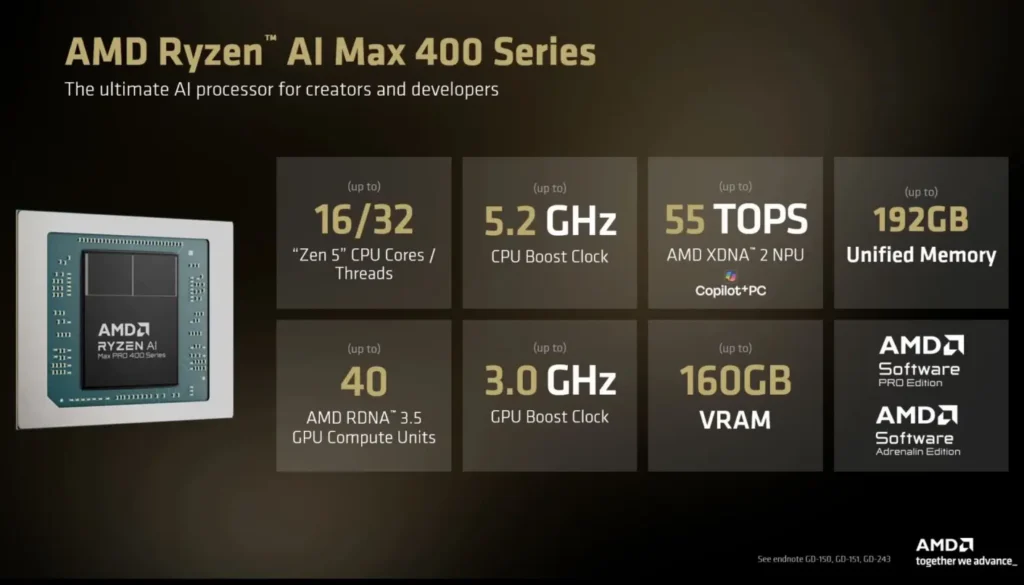
AMD has shared new details about its upcoming Ryzen AI Max 400 series, codenamed “Gorgon Halo,” revealing a major jump in memory capacity for local AI systems. The new platform supports up to 192GB of unified LPDDR5X memory, with as much as 160GB configurable as VRAM for GPU workloads.
The announcement appeared during AMD’s recent workstation and AI developer presentation, where the company focused heavily on running large AI models locally instead of relying on cloud-based inference services.
Rather than replacing Strix Halo with a completely different architecture, Gorgon Halo appears to build on the same foundation. AMD is still using Zen 5 CPU cores, RDNA 3.5 graphics, and XDNA 2 AI acceleration, but with higher clocks, larger memory configurations, and updated workstation positioning.
AMD lists the chip with up to 16 CPU cores and 32 threads, boost clocks reaching 5.2 GHz, up to 40 RDNA 3.5 compute units, and as much as 55 TOPS of NPU performance. Current Ryzen AI Max+ 395 systems top out at 50 TOPS, so the new lineup brings a modest increase on the AI side as well.
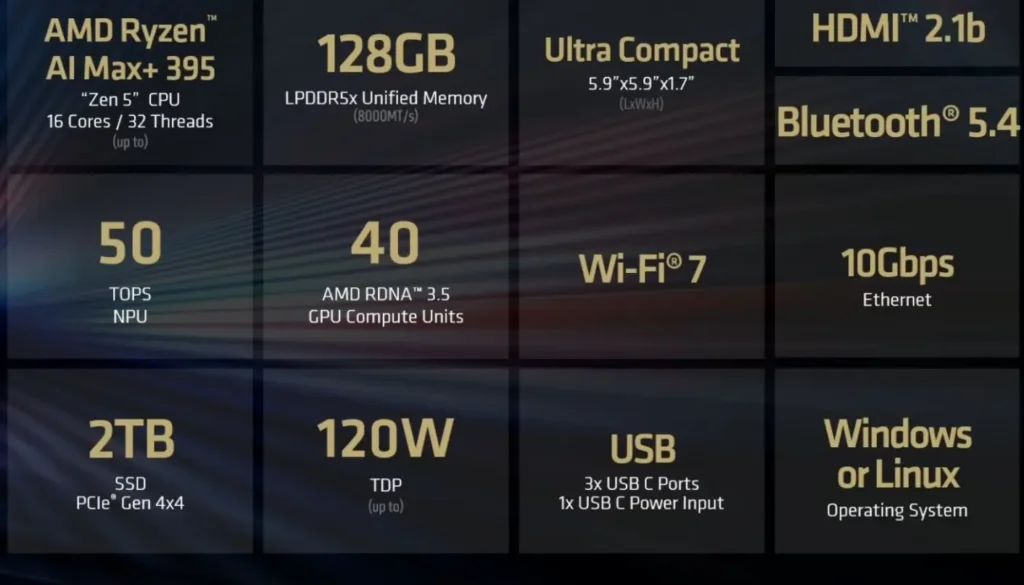
The biggest change is clearly memory capacity. Existing Strix Halo systems stop at 128GB LPDDR5X memory, while the new Ryzen AI Max 400 platform pushes that limit to 192GB. AMD also confirmed that up to 160GB can be allocated as VRAM, which matters for developers running large AI models locally without splitting workloads across slower storage or cloud hardware.
AMD spent a large part of the presentation comparing the platform against NVIDIA’s DGX Spark systems. According to the company’s internal figures, Ryzen AI Halo can generate tokens around 4% to 14% faster in some inference workloads, although NVIDIA still maintains an advantage in tensor-heavy compute and prompt processing tasks.
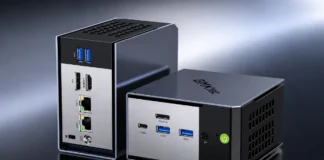
One demo system shown during the event used an ultra-compact 5.9 × 5.9 × 1.7-inch chassis powered by a Ryzen AI Max+ 395 processor with 128GB LPDDR5X-8000 memory and up to 256 GB/s memory bandwidth. AMD says that configuration can run models with up to 200 billion parameters at 4-bit precision.
AMD is also positioning the platform as a lower-cost alternative to cloud AI development. During the presentation, the company claimed developers using local AI models could avoid roughly $750 per month in cloud API costs by moving workloads onto local hardware instead.
Unlike NVIDIA’s DGX approach, AMD keeps standard x86 compatibility intact. Systems based on Ryzen AI Halo can run either Windows or Linux without relying on a customized operating system. AMD also plans to offer validated software environments and deployment playbooks for frameworks including PyTorch, TensorFlow, Ollama, vLLM, and ComfyUI.
Networking is more limited compared to NVIDIA’s larger AI systems. AMD’s compact AI Halo workstation includes a single 10Gbps Ethernet connection, while NVIDIA’s DGX Spark platform supports much higher-bandwidth clustering hardware.
Pre-orders for the first Ryzen AI Halo developer versions are expected to begin next month (June-July 2026) starting around $3,999. AMD also confirmed that higher-capacity 192GB variants are already being prepared.
Source: The Register