

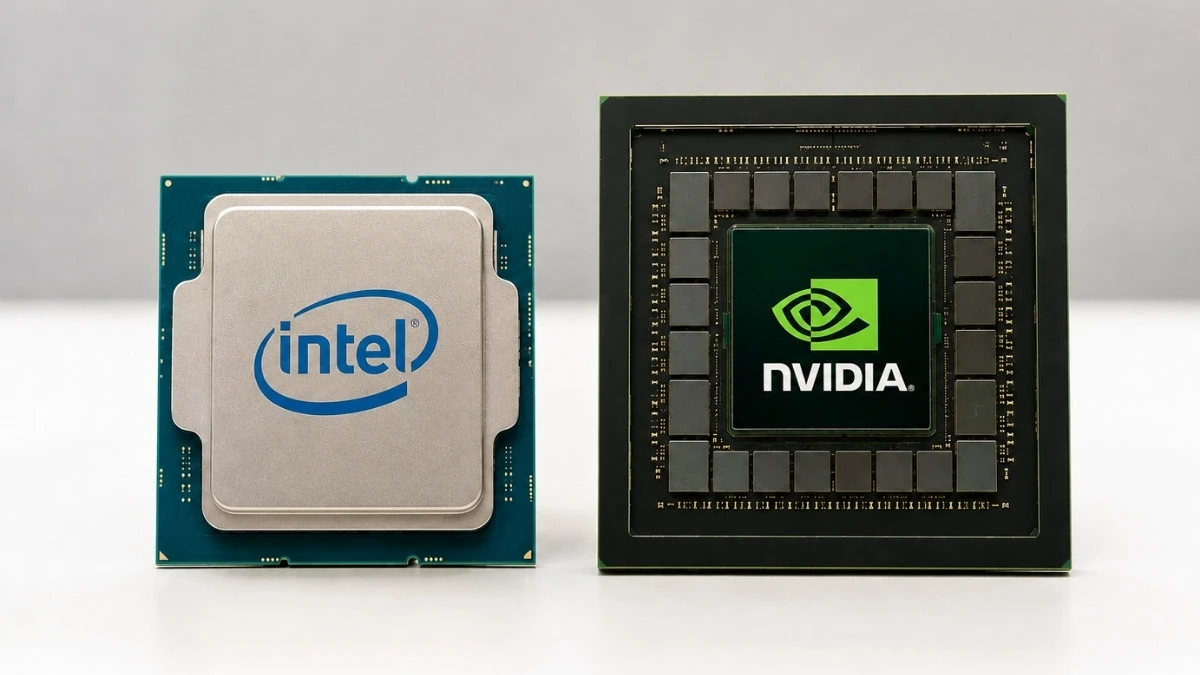
Intel and NVIDIA could end up sharing silicon inside the same processor package if a newly surfaced roadmap proves accurate.
The claim comes from Turkish technology journalist Erdi Özüağ, who says Intel’s current roadmap targets the first quarter of 2028 for processors featuring NVIDIA graphics technology. If those plans stay on track, CES 2028 could become the launch venue.
Neither Intel nor NVIDIA has commented on the report.
While details remain limited, the rumor has attracted attention because it would represent a major shift in Intel’s processor strategy. Intel has spent years building its Arc graphics business, making any move toward NVIDIA graphics a notable development.
This would not be the first time Intel worked with a rival GPU company.
Back in 2018, Intel released Kaby Lake-G processors that combined Intel CPU cores and AMD Radeon RX Vega M graphics inside a single package. The project lasted only one generation before disappearing from Intel’s lineup.
Even so, Kaby Lake-G showed that Intel was willing to partner with outside graphics vendors when it believed the hardware made sense for a specific market.
Exactly how NVIDIA technology could be integrated remains unknown. Modern Intel processors already use a tile-based design that separates CPU, graphics, and I/O functions into different sections of the package.
One possibility is that Intel could replace its graphics tile with an NVIDIA-designed GPU tile while retaining Intel CPU cores. Another approach could involve a more tightly integrated design that combines technologies from both companies.
The latest claim also lines up with earlier Titan Lake rumors.
Previous roadmap leaks suggested some Titan Lake processors could use NVIDIA GPU chipsets, while other variants may transition to Intel’s first-generation Unified Core architecture. None of those reports have been officially confirmed.
If the rumor proves accurate, it would raise questions about Intel’s long-term graphics plans. The company continues investing in Arc graphics for consumer and professional products while developing future Xe-based architectures.
Bringing NVIDIA graphics into selected processors would create an unusual situation where Intel’s own graphics technology and NVIDIA-based solutions coexist within different product categories.
Özüağ’s report also includes a separate claim involving Intel’s foundry business.
According to the journalist, discussions between Apple and Intel are continuing around Intel’s 18A manufacturing process. The report points to late 2027 as a possible target timeframe.
It also claims the 18A node still needs improvements in efficiency, cost, and manufacturing readiness before broader adoption becomes realistic.
Recent industry reports have also linked NVIDIA to Intel’s foundry efforts. Several publications have reported that NVIDIA is evaluating Intel’s advanced manufacturing technologies as part of broader plans to diversify production capacity beyond TSMC.
Those reports focus on manufacturing rather than processors, but they add context to the growing number of connections emerging between Intel and NVIDIA.
Also Read: NVIDIA Enters the PC Processor Market With RTX Spark
For now, the story remains firmly in rumor. Any launch would still be years away, and roadmap plans can change significantly before products reach the market.
Still, Intel processors carrying NVIDIA graphics would rank among the most unexpected developments in the PC industry if the project ultimately reaches production.