
Apple’s MacBook lineup has undergone significant changes over the past few years, such as the introduction of Retina displays and the shift to Apple Silicon. However, since the MacBook Pro’s redesign in 2021, most upgrades have focused on performance rather than major hardware overhauls.
This situation could soon change. Several analysts – including Ross Young, Ming-Chi Kuo, and Bloomberg’s Mark Gurman—have reported that Apple is working on its first OLED MacBook. Current reports suggest that a major redesign could arrive alongside the M6 generation of Apple Silicon.
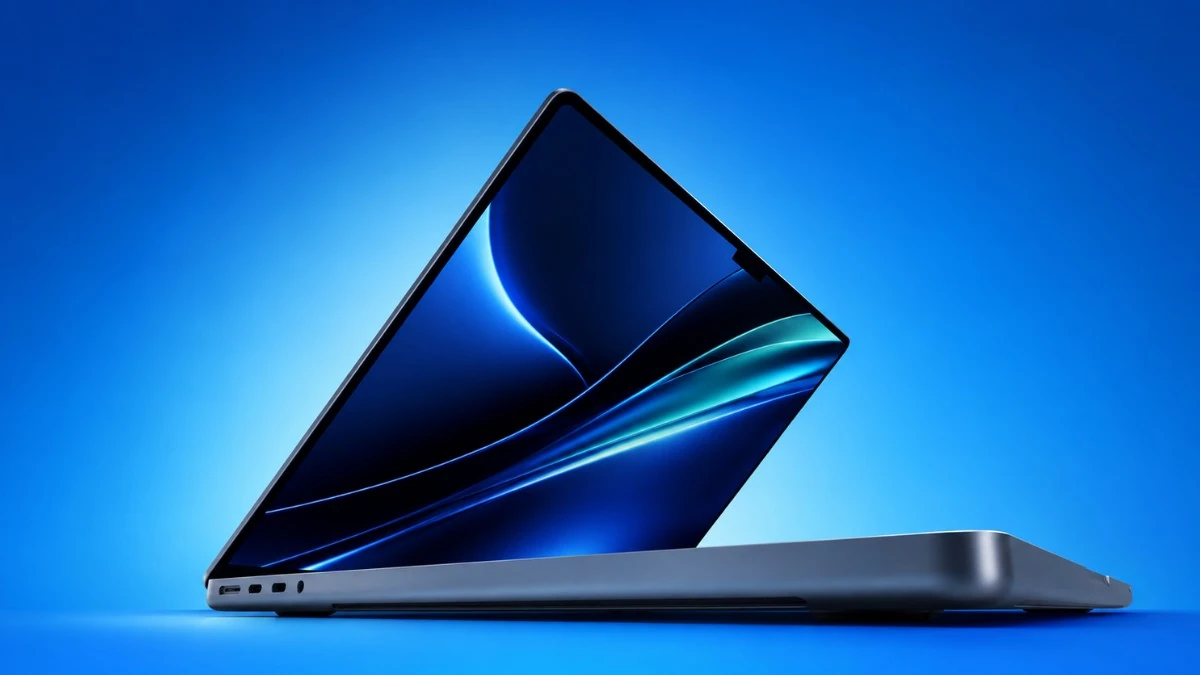
This Apple OLED MacBook Ultra is trending because it appears to be far more than a standard MacBook Pro series. Features like OLED technology, a thinner chassis, and potential touchscreen support could make this Apple’s most significant notebook upgrade in years.
Apple has not yet officially announced the MacBook Ultra. Here is everything we know so far.
Apple MacBook Ultra: Full Specifications (Rumored)
Click Here to See Full Specifications
Processor (CPU)
| Processor Model Name | Apple M6 Pro / M6 Max (Ultra-Tier) |
| Processor Speed | Up to 4.90 GHz |
| Cores | 12 to 16 |
| Threads | 12 to 16 |
| L3 cache | 24 MB to 48 MB Shared System |
| Fabrication process | 2 nm |
Video Card
| Graphics Processor | Apple M6 Pro (16/20-Core) / M6 Max GPU (30/40-Core) |
| Graphics Memory Capacity | System Shared |
| Graphic Type | Integrated |
| Memory Type | LPDDR6 |
| GPU Frequency | Base: 600 MHz Boost Clock: 2400 MHz |
| Fabrication process | 2 nm |
RAM
| Memory Capacity | 24/32 GB |
| Channels | Unified Memory Bus (Up to 512-bit width) |
| Memory Type | LPDDR6 |
| Frequency | 10,667 MHz |
| Memory Slots | Soldered |
| Upgradable | No |
| Maximum RAM size | Up to 128 GB / 192 GB |
Storage
| Storage Capacity | 512 GB / 1 TB SSD |
| Storage Type | SSD (M2) |
| Drive Interface | PCIe Gen 5.0 |
| Channels | Custom Multi-Channel Controller Array |
| Total Slots | 1 |
| Upgradable | No |
Display
| Screen Size | 14.3 inches or 16.3 inches |
| Screen Resolution | 3120 × 2016 pixels (14.3″) / 3520 × 2270 pixels (16.3″) |
| Refresh Rate | 120Hz ProMotion |
| Display Screen Type | Ultra Retina XDR (Tandem OLED) |
| Display Screen Technology | Hybrid Tandem Stack, Oxide TFT Backplane |
| HDR Support | Yes, Dolby Vision, HDR10 |
| PPI | 254 ppi |
| Pantone Validated | P3 Wide Color |
| Response Time | Less than 1 ms |
| Touch Input | Yes (Native On-Cell Touch Integration) |
| Coating | Glossy (Anti-reflective) / Optional Nano-Texture Glass |
| Maximum Brightness | 1,000 nits full-screen sustained / 1,600 nits peak HDR |
| Contrast | 2,000,000:1 (Infinite true blacks) |
| sRGB Color Gamut | 100% |
| Sync Technology | Apple ProMotion Dynamic Variable Sync |
Battery
| Capacity | 72.4 Wh (14.3″) / 99.6 Wh (16.3″) |
| Full Charge Time | 1:20 Hr |
| Battery Type | Lithium-Polymer (High-density internal architecture) |
| Removable | No |
| Fast Charging | Yes |
| USB Power Delivery | Yes, up to 140 W / 240 W EPR compliant |
| Charging Connector Location | Left, Right, (via MagSafe 3 or USB-C Thunderbolt) |
| Charging Power | 96 W / 140 W USB-C Power Adapter |
| Output | 28V / 5.0A |
| Charger Weight | ~290 / 385 Grams |
Frame
| Weight | ~1.42 kg (3.13 lbs for 14.3″) / ~1.95 kg (4.30 lbs for 16.3″) |
| Dimensions | 14.3″: 314.1 x 222.5 x 12.9 mm (12.36 x 8.76 x 0.50 inches) 16.3″: 357.5 x 249.1 x 13.8 mm (14.07 x 9.80 x 0.54 inches) |
| Area | 698 cm² (14.3″) / 890 cm² (16.3″) |
| Screen-to-Body Ratio | ~88.2% |
| Side Frames | ~2.5 mm |
| Material | Machined Recycled Aluminum Chassis / Internal Titanium Structural Support Elements |
| Colors | Space Black, Silver, Dark Titanium |
| Transformer | No |
| Screen Opening Angle | 135° |
Thermal Management
| Cooling Type | Active Dual-Fan Design |
| Liquid Metal | No |
| Evaporation Chamber | Yes (Integrated ultra-slim copper vapor plate structure) |
| Number of Coolers | 2 |
| Noise Level | 44 dB (Max load) |
Sound
| Audio Chip | Apple-designed Spatial Audio Core System |
| Audio Format | Dolby Atmos, Spatial Audio with Dynamic Head Tracking |
| Speaker Power | 5.0W Six-Speaker System with force-cancelling woofers |
| Dolby Atmos | Yes |
| Max. Volume | 86.2 dBM |
| Microphones | 3 Studio-quality array with high signal-to-noise ratio |
| Noise-Canceling Technology | Yes (Voice Isolation via Neural Engine hardware block) |
| Audio Recording | Directional beamforming studio-grade recording |
Communications
| Wi-Fi version | Wi-Fi 7 (802.11be) native protocol |
| Bluetooth | v5.4 |
| Fingerprint Scanner | Yes (Touch ID integrated into Power Key) |
| Drive | No |
| Webcam | Housed inside screen cutout area |
| Webcam Resolution | 12MP Center Stage Ultra-Wide module with Desk View |
IO and Ports
| USB-A | No |
| USB Type-C | 3x USB 4.0 / Thunderbolt 5 Type-C Architecture |
| Thunderbolt | Thunderbolt 5 (Up to 120 Gbps asymmetric bandwidth) |
| HDMI | 1x HDMI 2.1 |
| Display Port | Yes (Alt-Mode tunneling via Thunderbolt 5) |
| VGA | No |
| Audio Port (3.5mm) | Yes (With advanced high-impedance headphone load adaptation) |
| Ethernet (RJ45) | No |
| SD Card Reader | Yes (SDXC UHS-II / SD Express compatible) |
| Separate Charging Port | Yes (MagSafe 3 structural connector interface) |
Keyboard and Touchpad
| Key Type | Island backlit layout |
| Numeric Block | No |
| Backlight | Yes (Ambient light auto-sensing adaptive micro-LED matrix) |
| Key Travel | 1.1 mm |
| Keyboard Type | Redesigned Magic Keyboard, Oversized Haptic Force Touch Glass Trackpad |
| Keyboard Layout | macOS QWERTY |
| Size | 14.5 × 9.3 cm (Enlarged pointer tracking target boundary) |
| Surface | Matte chemically-etched glass |
| Windows Precision | No (Native Apple CoreTouch Multitouch Haptic Engine API) |
What Is the Apple MacBook Ultra?
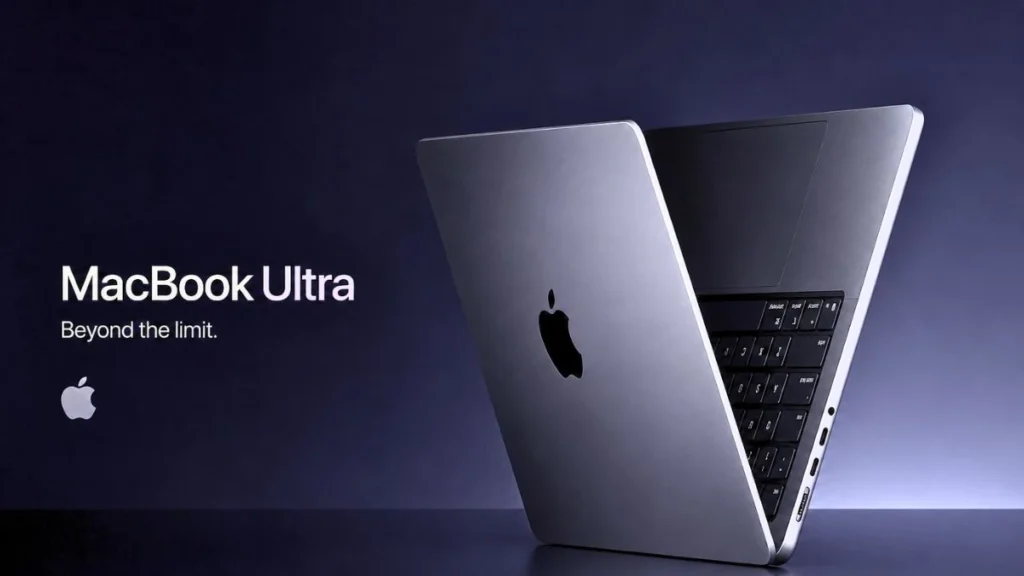
The MacBook Ultra is the rumored name for Apple’s next major high-end laptop. Current reports suggest it could sit above today’s MacBook Pro lineup and serve as Apple’s most premium notebook.
The biggest rumor is not the name itself. It is the hardware overhaul behind it. Multiple analysts and supply-chain reports point to Apple’s first OLED MacBook, a thinner chassis, touchscreen support, and next-generation M6-series chips.
Bloomberg’s Mark Gurman has reported that Apple is preparing a major MacBook redesign for the OLED transition. Some reports suggest Apple could use the “Ultra” branding to highlight those changes, similar to how it uses Ultra branding on products like the Mac Studio and Apple Watch Ultra.
Apple has not confirmed the MacBook Ultra name. The same hardware could ultimately launch as a redesigned MacBook Pro. At this stage, the OLED display, M6 platform, and new design appear more credible than the branding itself.
Important: Most analyst reports refer to future OLED MacBook Pro models rather than a confirmed MacBook Ultra product. Throughout this guide, "MacBook Ultra" refers to the rumored flagship notebook project that may ultimately launch under a different name.
Apple OLED MacBook Ultra: Expected Release Date and Launch Timeline
Late 2026 remains the most widely reported launch window for Apple’s first OLED MacBook. Display analyst Ross Young has repeatedly forecast an OLED transition around that timeframe, while supply-chain reports point to panel production beginning during the second half of 2026.
The timing also aligns with expectations for Apple’s M6 chip generation, allowing the company to launch a new display technology and hardware platform together.
A delay into early 2027 remains possible. Large OLED laptop panels are more difficult and expensive to manufacture than smartphone displays, and Apple has a history of adjusting launch schedules when supply-chain targets are not met.
Based on current reporting, late 2026 is the most likely launch window, with early 2027 serving as the fallback scenario.
MacBook Ultra Rumor Timeline
| Date | Development |
|---|---|
| Oct 2023 | Ross Young says OLED MacBook Pro models are unlikely before 2026–2027 |
| Sep 2024 | Omdia says Apple is highly likely to launch OLED MacBook Pro models in 2026 |
| Sep 2025 | Ming-Chi Kuo says touchscreen OLED MacBook Pro models could enter mass production in late 2026 |
| 2025–2026 | Bloomberg reports a major MacBook redesign tied to OLED displays and M6 chips |
| 2026 | Reports suggest Samsung Display is preparing OLED notebook panel production for Apple |
| Late 2026–Early 2027 | Most analyst forecasts place the first OLED MacBook launch in this window |
OLED Display: The Biggest Upgrade Expected
| Year | Display Milestone |
|---|---|
| 2012 | Retina MacBook Pro |
| 2021 | Mini-LED MacBook Pro |
| 2024 | Tandem OLED iPad Pro |
| 2026–2027 | OLED MacBook (Rumored) |
The OLED display is one of the most consistently reported MacBook rumors. Ross Young, Ming-Chi Kuo, Bloomberg’s Mark Gurman, Omdia, and multiple supply-chain reports have all linked Apple’s next-generation MacBook redesign to OLED technology.
Current MacBook Pro models (M5) comes with mini-LED displays, which already offer excellent brightness and HDR performance. OLED could improve black levels, contrast, response times, viewing angles, and power efficiency while enabling a thinner display assembly.
Apple’s adoption of tandem OLED technology in the iPad Pro is widely viewed as an early indication of its long-term display roadmap for larger devices.
Hybrid OLED Technology Explained
Most reports point to a tandem OLED or hybrid OLED panel rather than a conventional OLED display.
Tandem OLED uses multiple emissive layers instead of one. This allows higher brightness, improved efficiency, and longer panel lifespan while reducing burn-in concerns compared to traditional OLED designs.
The technology is already used in Apple’s latest iPad Pro and is considered one of the leading candidates for future MacBooks.
Why Apple Is Moving Beyond Mini-LED
Mini-LED remains one of the most advanced LCD technologies, but it still relies on a backlight system.
OLED pixels generate their own light, allowing individual pixels to turn completely off. This produces true black levels and eliminates blooming around bright objects.
OLED panels are also thinner than LCD-based displays, supporting Apple’s reported efforts to reduce device thickness across future hardware generations.
Expected Display Improvements
Current reports suggest the first OLED MacBook could offer:
- Tandem OLED panel technology
- ProMotion refresh rates up to 120Hz
- Improved HDR performance
- Better black levels and contrast
- Faster pixel response times
- Reduced display thickness
- Improved power efficiency
OLED Display Suppliers
Samsung Display is widely expected to be Apple’s primary OLED supplier. Multiple reports indicate the company has been preparing large OLED panels for future Apple notebooks.
LG Display is also frequently mentioned as a secondary supplier. Apple typically works with multiple display partners to improve production capacity and reduce supply-chain risk.
Will the MacBook Ultra Have a Touchscreen?
Apple has historically argued that touchscreens are better suited to tablets than laptops. Steve Jobs criticized touchscreen notebooks, and Apple largely maintained that position throughout the Intel and early Apple Silicon eras.
Bloomberg’s Mark Gurman has reported that Apple is actively developing touchscreen Mac hardware, with several follow-up reports linking the feature to future OLED MacBooks.
Why Apple May Be Reconsidering
Many premium Windows laptops now include touchscreen support, including models from Dell, Lenovo, ASUS, HP, and Microsoft. Apple remains one of the few major notebook manufacturers without a touch-enabled laptop.
The OLED transition gives Apple an opportunity to introduce touch support alongside a broader hardware redesign rather than adding the feature to an existing platform.
How Apple Could Implement Touch Input
Most reports point to on-cell touch technology integrated directly into the OLED panel.
Current reporting does not suggest Apple plans to merge macOS and iPadOS. Instead, touch input would likely complement the keyboard, trackpad, and mouse rather than replace them.
M6 Pro, M6 Max, or Something More Powerful?
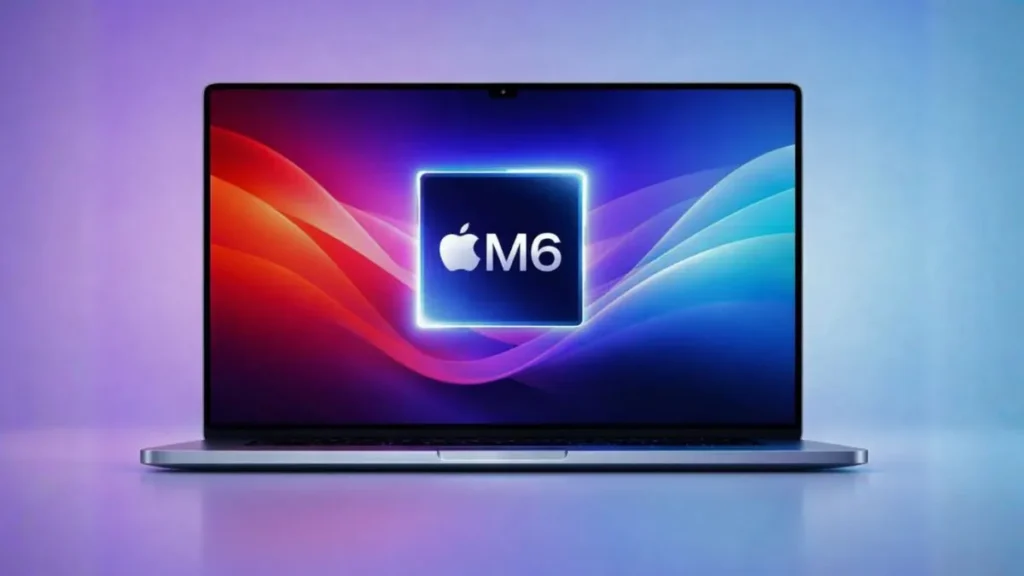
Most reports suggest Apple’s OLED MacBook lineup will launch with M6 Pro and M6 Max processors.
The new chips are expected to deliver improvements in performance, efficiency, and AI processing while supporting Apple’s broader redesign goals.
Expected Manufacturing Process
Several analysts believe the M6 family could use TSMC’s 2nm manufacturing process.
A transition from 3nm to 2nm would allow higher transistor density and improved power efficiency, two factors that become increasingly important in thinner laptops.
Performance Expectations
No benchmark data has surfaced yet, but analysts expect gains in:
- CPU performance
- GPU efficiency
- Sustained workloads
- Battery life
- AI processing capabilities
The combination of a new manufacturing process and architectural improvements could make the M6 generation one of Apple’s most significant chip updates since the transition to Apple Silicon.
Apple Intelligence Could Be a Major Focus
Apple’s software strategy is increasingly centered on on-device AI.
Multiple reports suggest the M6 family could receive Neural Engine upgrades designed to support larger AI models and future Apple Intelligence features.
What About an M6 Ultra Chip?
An Ultra-branded MacBook does not necessarily mean an Ultra-class processor.
Apple has never shipped an Ultra chip in a laptop, and current reports focus primarily on M6 Pro and M6 Max configurations.
Because Ultra chips consume significantly more power and generate more heat, bringing one to a notebook would present major thermal and battery-life challenges. For now, an M6 Ultra MacBook remains speculative.
Rumored Design Changes
The current MacBook Pro design debuted in 2021 and has remained largely unchanged since then. Multiple reports suggest Apple’s OLED transition could arrive alongside its biggest MacBook redesign in years.
A Thinner and Lighter Chassis
A thinner design is one of the most consistent rumors surrounding the project.
OLED panels require fewer display layers than mini-LED displays, giving Apple more flexibility to reduce thickness while maintaining display quality. Bloomberg’s Mark Gurman has also reported that Apple is pursuing thinner designs across multiple product categories.
A New Display Cutout Could Replace the Notch
Several reports suggest Apple could replace the current notch with a smaller camera cutout or a Dynamic Island-style design.
This rumor carries significantly less confidence than OLED or touchscreen support because it has not been widely corroborated by multiple independent sources.
Ports Are Expected to Stay
Current reports do not suggest major port removals. Most expectations include:
- Thunderbolt
- HDMI
- SD card reader
- MagSafe charging
- 3.5mm headphone jack
MacBook Ultra vs Current MacBook Pro
| Feature | Current MacBook Pro | Rumored MacBook Ultra |
|---|---|---|
| Display | Mini-LED | Tandem OLED |
| Touch Support | No | Rumored |
| Design | 2021 chassis | New redesign |
| Display Cutout | Notch | Smaller cutout or Dynamic Island |
| Thickness | Current design | Thinner |
| Processor | M5 Pro / Max | M6 Pro / Max |
| AI Hardware | Current Neural Engine | Next-generation Neural Engine |
The most credible design changes remain OLED, a thinner chassis, and a redesigned display assembly. Dynamic Island, Face ID, and other visual changes remain speculative.
Apple Intelligence and AI Features
Apple’s long-term Mac roadmap is increasingly tied to Apple Intelligence, the company’s on-device AI platform introduced in 2024. While Apple has not announced any MacBook Ultra-specific AI features, future M6-powered Macs are expected to play a larger role in running AI workloads locally.
A More Powerful Neural Engine
Multiple reports suggest the M6 family could include Neural Engine improvements designed to support future Apple Intelligence capabilities. Apple’s recent chip generations have steadily increased AI performance, and that trend is expected to continue as AI becomes a larger part of macOS.
A faster Neural Engine could improve the responsiveness of features such as:
- Writing Tools
- Image Playground
- Genmoji
- AI-powered summaries
- Siri enhancements
- AI-assisted coding workflows
More On-Device AI Processing
Apple’s AI strategy differs from many competitors because it prioritizes on-device processing whenever possible. Running AI tasks locally can improve privacy, reduce latency, and decrease reliance on cloud servers.
Future M6 chips are expected to deliver additional AI performance through a combination of Neural Engine upgrades, faster CPUs, improved GPUs, and higher memory bandwidth.
Unified Memory Could Become More Important
As AI models grow larger, memory capacity becomes increasingly important. Apple’s unified memory architecture already allows the CPU, GPU, and Neural Engine to share a single memory pool, which can benefit AI workloads.
If future MacBook models offer larger memory configurations, they could be better suited for running local AI models, developer tools, and machine-learning workloads directly on the device.
Apple Intelligence Will Likely Shape Future Macs
Apple has not revealed how Apple Intelligence will evolve by the time the M6 generation arrives. However, the company’s recent software roadmap suggests AI features will become a larger part of macOS, productivity tools, developer workflows, and content creation applications.
While hardware specifications remain unconfirmed, Apple Intelligence is expected to be one of the key technologies influencing future MacBook development.
Expected Battery Life and Efficiency Improvements
OLED technology is expected to improve display efficiency compared to current mini-LED panels, particularly when displaying darker content.
Additional gains may come from the M6 generation if Apple adopts TSMC’s 2nm process, which is expected to improve performance-per-watt.
No credible reports have revealed battery capacity or endurance figures. Based on current information, analysts generally expect battery life to remain similar to or better than current MacBook Pro models.
Most realistic expectations include:
- Similar or longer battery life than current MacBook Pro models
- Improved display efficiency through OLED
- Better performance-per-watt from M6 chips
- Continued MagSafe and USB-C fast charging support
Expected Pricing
Apple has not announced pricing, and no reliable leak has revealed exact figures.
The current 14-inch MacBook Pro with M5 Pro starts at $1,999, while the 16-inch model starts at $2,499. Higher-end M5 Max configurations can exceed $4,000 once additional memory and storage are added.
An OLED display, potential touchscreen support, and a redesigned chassis would likely increase manufacturing costs compared to today’s MacBook Pro models. If Apple introduces a new flagship tier above the MacBook Pro, pricing could move even higher.
Estimated US Pricing
| Model | Estimated Price |
|---|---|
| MacBook Ultra 14-inch | $2,499–$2,999 |
| MacBook Ultra 16-inch | $3,499–$4,999+ |
These estimates are based on current M5-series MacBook Pro pricing, OLED production costs, and Apple’s historical approach to premium product launches. Actual pricing remains unknown until Apple officially unveils the device.
MacBook Ultra vs MacBook Pro
Reports suggest the MacBook Ultra would sit above the current MacBook Pro lineup rather than replace it outright.
| Feature | Current MacBook Pro (M5 Series) | Rumored MacBook Ultra |
|---|---|---|
| Display | Liquid Retina XDR (mini-LED) | Tandem OLED |
| Touchscreen | No | Rumored |
| Processor | M5 Pro / M5 Max | M6 Pro / M6 Max |
| Design | 2021 chassis | New redesign |
| AI Hardware | Current Neural Engine | Next-generation Neural Engine |
| Thickness | Current design | Expected thinner |
| Starting Price | $1,999 (14-inch M5 Pro) | Expected premium pricing |
The largest upgrades are expected to come from the display, chassis redesign, and OLED-related improvements rather than a dramatic jump in raw computing performance.
MacBook Ultra vs Windows Flagship Laptops
Apple’s rumored OLED notebook would enter a category where OLED displays and touchscreens are already common.
| Feature | MacBook Ultra | XPS 16 | Galaxy Book Ultra | ProArt P16 |
|---|---|---|---|---|
| OLED | Yes (Rumored) | Yes | Yes | Yes |
| Touchscreen | Rumored | Yes | Yes | No |
| CPU | M6 Pro/Max | Intel Core Ultra | Intel Core Ultra | AMD Ryzen AI |
| GPU | Apple Silicon | Intel Arc | NVIDIA | NVIDIA |
| OS | macOS | Windows | Windows | Windows |
Where Apple could differentiate itself is through battery life, Apple Silicon efficiency, macOS integration, and Apple Intelligence features.
Every MacBook Ultra Rumor Ranked by Credibility
Not all rumors are supported equally. Some are backed by multiple analysts and supply-chain reports, while others rely on isolated claims.
| Rumor | Confidence | Why |
|---|---|---|
| OLED Display | High | Supported by Ross Young, Ming-Chi Kuo, Omdia, and supply-chain reporting |
| M6 Pro / M6 Max | High | Aligns with Apple’s established silicon roadmap |
| Thinner Chassis | High | Consistently linked to Apple’s OLED redesign plans |
| Launch in Late 2026–Early 2027 | High | Supported by multiple analyst forecasts |
| Touchscreen Support | Medium | Reported by Bloomberg and other sources, but unconfirmed |
| New Hinge Design | Medium | Often linked to touchscreen implementation, but limited evidence |
| MacBook Ultra Branding | Medium | Mentioned in reporting, though not widely corroborated |
| Dynamic Island | Low | Limited supporting evidence |
| Face ID | Low | No strong reporting and technical challenges remain |
| Cellular Connectivity | Low | Little support from reliable sources |
| Satellite Features | Very Low | No credible reporting currently supports the feature |
| M6 Ultra Laptop Chip | Very Low | Apple has never shipped an Ultra-class chip in a MacBook |
The strongest evidence currently supports an OLED display, M6-generation processors, a thinner chassis, and a launch window around late 2026 or early 2027. Features such as Face ID, cellular connectivity, Dynamic Island, and an M6 Ultra chip remain significantly more speculative.
What Apple Has Actually Confirmed So Far
Apple has not announced a MacBook Ultra or confirmed any of the rumors surrounding the device.
The company has also not confirmed OLED MacBooks, touchscreen support, Dynamic Island, Face ID, cellular connectivity, or any rumored specifications.
What Apple has publicly demonstrated is the direction of its broader hardware strategy:
- Continued investment in Apple Silicon
- Expansion of Apple Intelligence and on-device AI features
- Tandem OLED technology through the latest iPad Pro
- A focus on power efficiency and custom silicon
- Ongoing development of advanced display technologies
Everything else currently comes from analyst reports, supply-chain information, and industry sources rather than official Apple announcements.
Frequently Asked Questions
What is the Apple MacBook Ultra?
The MacBook Ultra is the rumored name for Apple’s next-generation flagship notebook. Apple has not confirmed the product or its branding.
Will the MacBook Ultra have an OLED display?
Multiple analysts and supply-chain sources have linked Apple’s next major MacBook redesign to OLED technology, making it one of the most credible rumors.
Will the MacBook Ultra support touch input?
Bloomberg and other sources have reported that Apple is developing touchscreen Mac hardware, but the company has not confirmed the feature.
When could the MacBook Ultra launch?
Most analyst forecasts point to late 2026, with early 2027 remaining possible if production timelines shift.
Which chips are expected?
Current reports focus on M6 Pro and M6 Max processors. Support for an M6 Ultra laptop chip remains limited.
Will the MacBook Ultra replace the MacBook Pro?
Most reports suggest it would sit above the MacBook Pro as a more premium model rather than replace the lineup.
How much could the MacBook Ultra cost?
Based on current MacBook Pro pricing and OLED manufacturing costs, estimates generally place the starting price above today’s MacBook Pro models.
How reliable are the current rumors?
OLED displays, M6-generation chips, and a major redesign are supported by multiple independent sources. Features such as Face ID, Dynamic Island, and cellular connectivity remain far less certain.
Conclusion
Reports from Ross Young, Ming-Chi Kuo, Mark Gurman, Omdia, and supply-chain sources increasingly point to Apple’s first OLED MacBook arriving in the late-2026 to early-2027 timeframe.
The strongest evidence supports three major changes: OLED display technology, a redesigned chassis, and M6-generation Apple Silicon. Those elements appear consistently across multiple independent reports.
Whether Apple ultimately introduces a new MacBook Ultra brand or delivers the upgrades through a future MacBook Pro remains unclear. Until Apple makes an official announcement, the product’s name is less certain than the technologies expected to power it.