
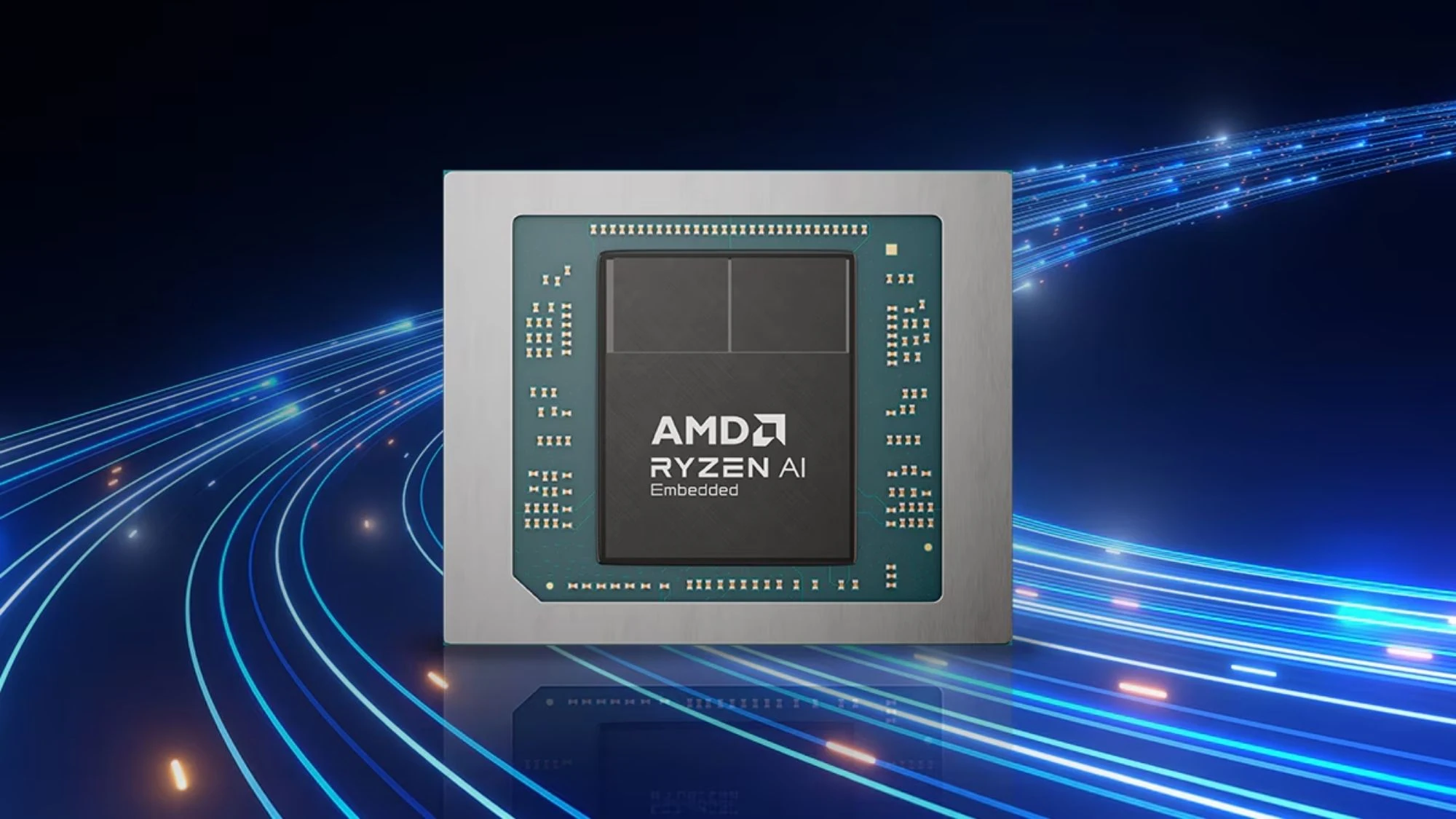
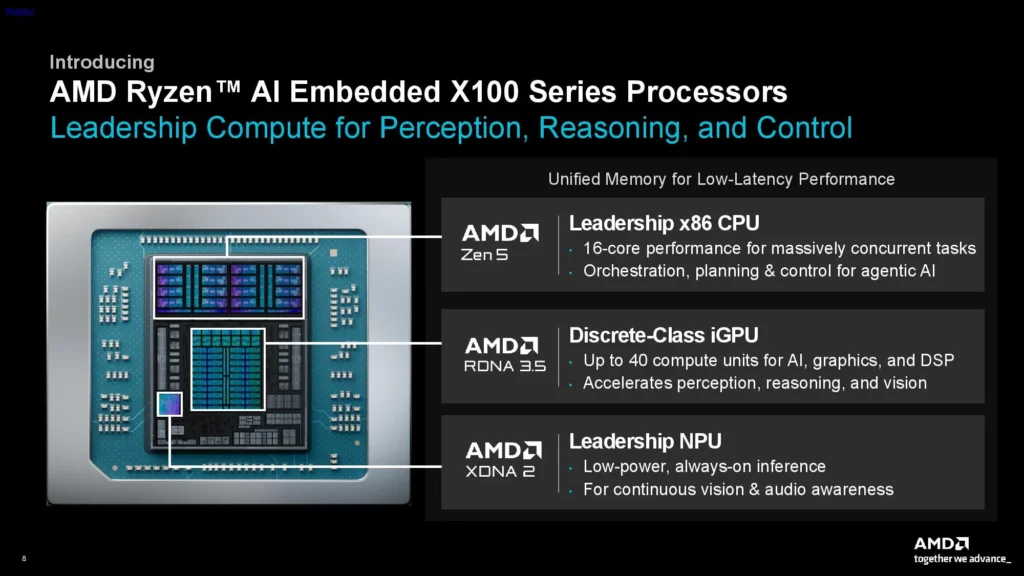
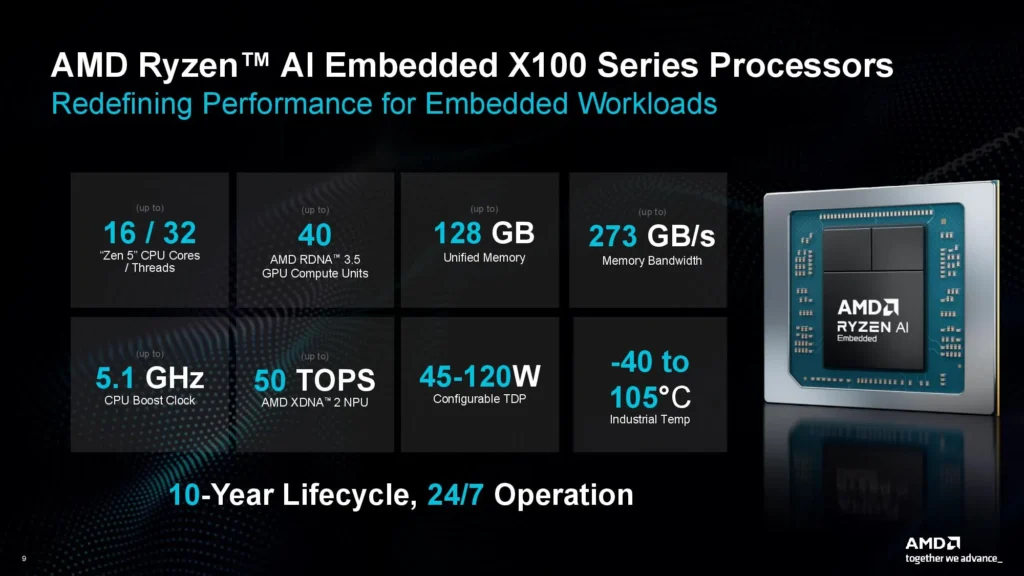
AMD is bringing its Strix Halo architecture into the embedded market. The new Ryzen AI Embedded X100 Series packs up to 16 Zen 5 CPU cores, RDNA 3.5 graphics, an XDNA 2 AI engine, and support for up to 128GB of unified LPDDR5X memory for industrial and commercial hardware.
Memory is where these processors separate themselves from many embedded chips. They support as much as 128GB of LPDDR5X-8533 memory with 273GB/s of bandwidth, while the CPU, GPU, and AI engine work from the same memory pool. AMD also adds a 32MB MALL cache to keep data closer to the processor during heavy workloads.
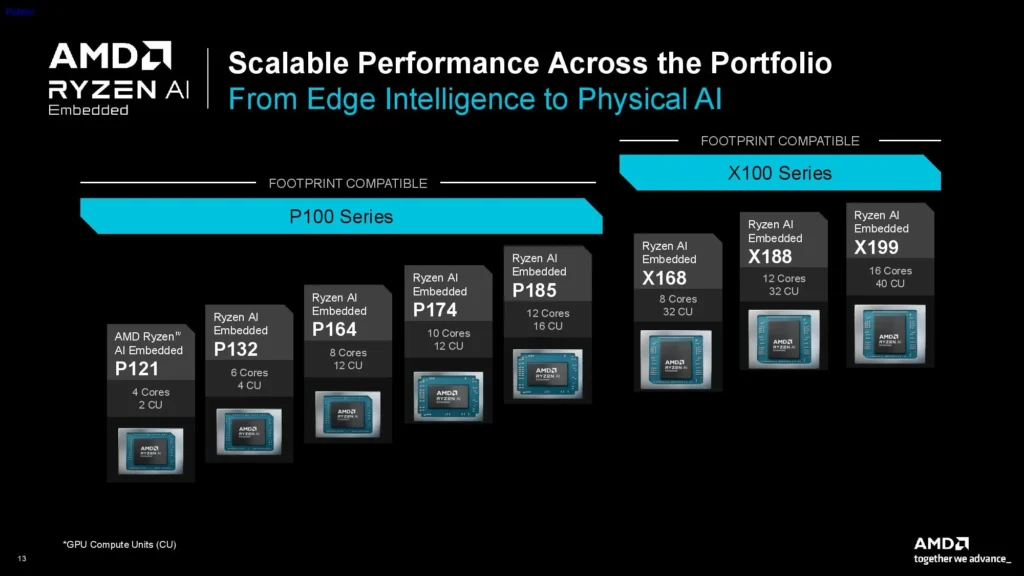
The series starts with six models. Ryzen AI Embedded X199 sits at the top with 16 cores, 32 threads, 40 RDNA 3.5 Compute Units, and an XDNA 2 NPU rated for up to 50 TOPS. Ryzen AI Embedded X188 trims the CPU to 12 cores, while Ryzen AI Embedded X168 comes with eight cores for lower-power deployments.
Graphics performance is built into every chip through the RDNA 3.5 GPU. It can power four 4K displays at 120Hz or two 8K displays at 60Hz, giving manufacturers plenty of display bandwidth for control centers, medical equipment, simulators, digital signage, and broadcast hardware.
The X100 Series is built for products that stay in service for years. AMD plans to manufacture these processors for 10 years, supports round-the-clock operation, and offers industrial models that work across a junction temperature range from -40°C to 105°C. Chip-down designs and COM-HPC modules are both available.
Developers can build software with Linux, AMD ROCm, Xen Hypervisor, PyTorch, TensorFlow, and ONNX. HIPIFY is included for projects that need to move CUDA code to the ROCm platform with less manual work.
AMD is also rolling out COM-HPC System-on-Module products and a Kria AI Robotics Developer Platform around the new processors. Commercial hardware is expected from Arbor, congatec, iBase, IEI, Sapphire, and Seavo.
Also Read: How to choose a CPU? Pick the Right Processor
AMD shared benchmark numbers comparing the X100 Series with Intel Core Ultra Series 3 processors. Internal testing shows up to 2.1× higher multi-threaded CoreMark performance, 1.7× higher OpenGL graphics performance, and 3.5× faster AI token generation. Those results were measured on a Ryzen AI Max+ 395 configured to match the Ryzen AI Embedded X199 rather than final production hardware.
Customer sampling began in June 2026. AMD expects volume production of the Ryzen AI Embedded X100 Series to start in the fourth quarter of 2026.
Source: AMD