
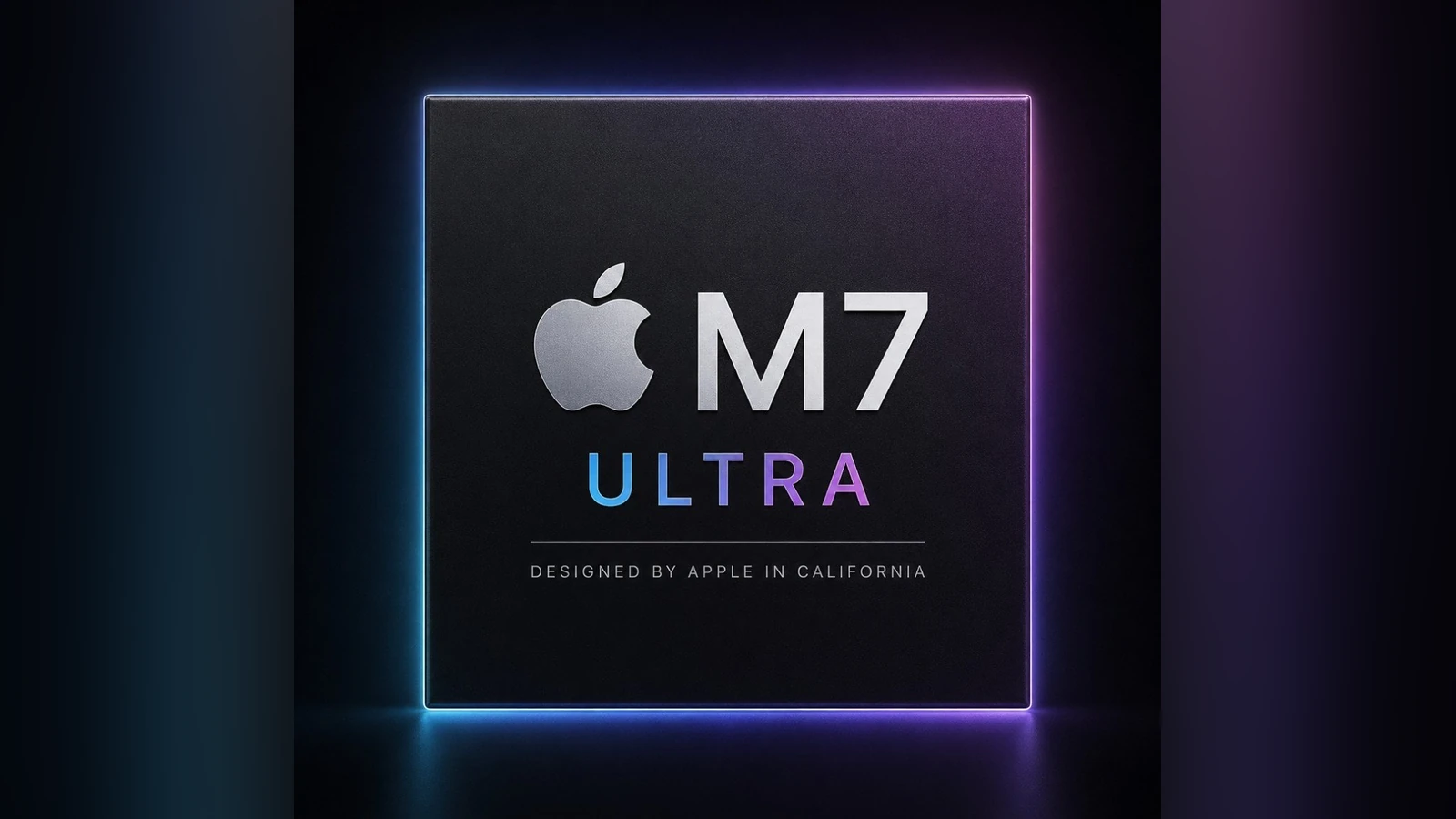
Apple is reportedly developing an M7 Ultra processor that supports up to 1.5 TB (about 1,500 Gigabytes) of unified memory, according to Bloomberg’s Mark Gurman. The roadmap shift involves scrapping the launch of the M6 Pro and M6 Max processors. Instead, Apple will jump directly to the M7 family for its upcoming high-performance desktop hardware.
Attentive developers note that the 1.5 TB memory limit is three times the 512 GB (about 512,000 Megabytes) maximum supported by the M3 Ultra. In comparison, the upcoming M5 Ultra chip is expected to support roughly half that amount, or about 768 GB (about 768,000 Megabytes) of unified memory. The M5 Ultra is currently in testing with 36 CPU cores and 80 GPU cores for the next-generation desktop models.
Also read: Best Intel Ultra 9 Laptops
The base M6 processor is still on track to launch later this year in a base MacBook Pro laptop. The entry-level chip uses 12 GPU cores and delivers a memory bandwidth of 200 GB/s, up from the 123 GB/s limit on the current M5 chip. However, the subsequent high-performance models will skip the M6 generation entirely and arrive as M7 variants.
Next year’s base M7 chip will launch in the first half of 2027 and will upgrade memory bandwidth to 240 GB/s. The company previously discontinued the highest RAM configurations for the M3 Ultra-powered Mac Studio, so it remains to be seen if the retail M7 Ultra will offer the full 1.5 TB configuration. The M7 Ultra version is expected to debut in early 2028 inside a refreshed Mac Studio computer with a better cooling layout.
This massive memory ceiling puts Apple’s flagship desktop processor closer to professional workstations and entry-level server hardware. The M7 Ultra is positioned to compete directly with AMD’s upcoming Medusa Halo and Intel’s Nova Lake-AX chips. On the other hand, the chip could also handle workloads typically managed by Intel Xeon and Qualcomm Snapdragon processors.
The base M7 processor will likely be manufactured on Intel’s 18A-P process node, marking Apple’s first chip built by Intel. However, the high-end M7 Ultra is expected to stay with TSMC, utilizing a member of its N2 manufacturing process family.
Source: Bloomberg