

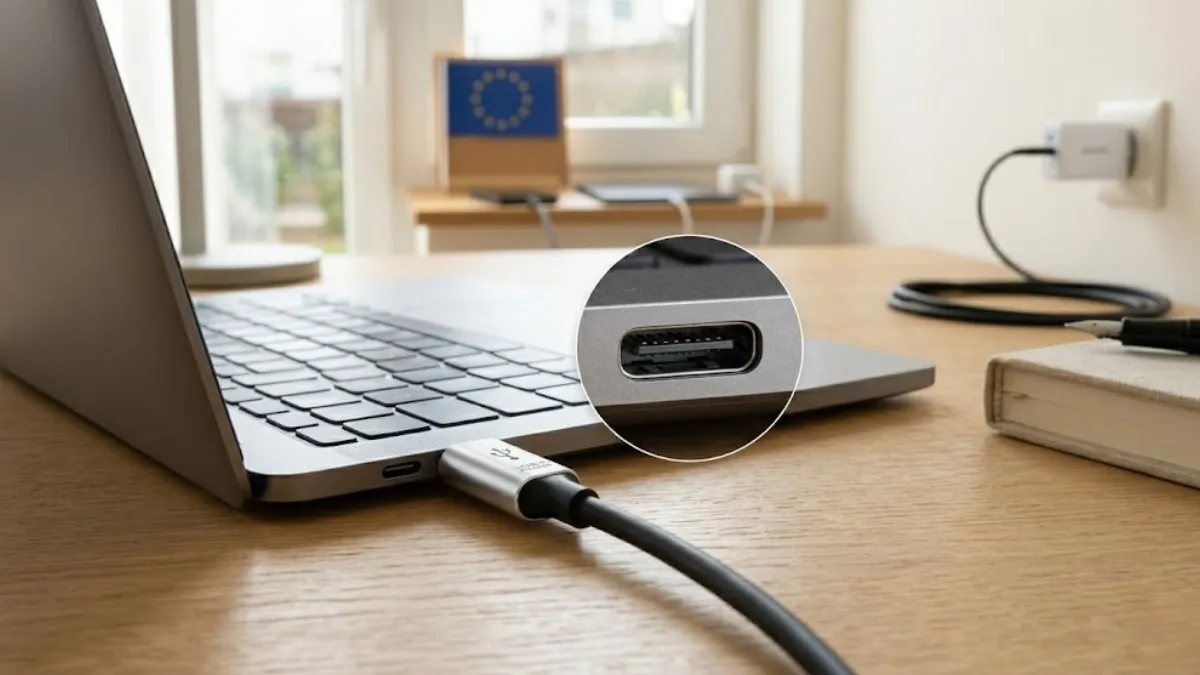
New laptops sold across the European Union must now support USB-C charging, as the bloc’s common charger rules expand to cover computers from April 28, 2026. Devices that do not meet the requirement can no longer be legally sold as new products within EU markets.
The update extends a regulation that already applied to smartphones, tablets, headphones, cameras, and other portable electronics since 2024. Laptops were given a longer transition period due to higher power requirements and more complex internal designs.
The requirement applies to laptops that operate at up to 100W. Any model within that range must include a USB-C charging port as a standard option. Systems that demand higher power, such as gaming laptops and mobile workstations, can still use traditional barrel connectors, but USB-C can be included alongside them rather than replacing them entirely.
USB-C itself is not limited to 100W. With USB Power Delivery 3.1, the standard supports up to 240W. However, most laptops have not yet adopted higher-power USB-C charging at scale, which is why the EU rule focuses on systems within the 100W range for now.
The directive also changes how laptops are sold. Manufacturers must offer devices without a bundled charger, allowing buyers to reuse existing USB-C adapters. The European Commission estimates that unused chargers generate around 11,000 tonnes of electronic waste each year, while the policy could save consumers roughly €250 million by reducing unnecessary purchases.
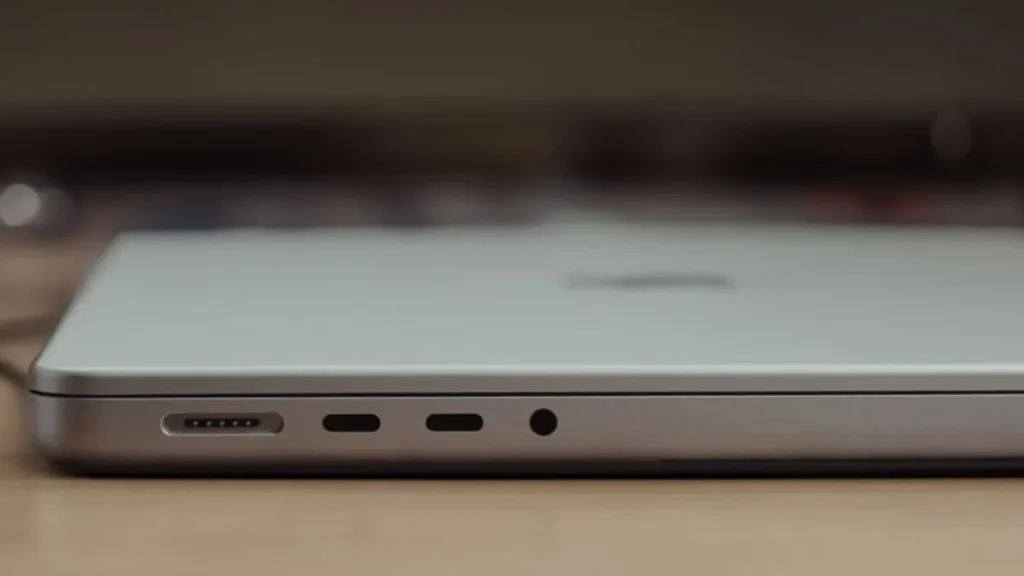
Despite the move toward a single connector, charging performance will still vary. USB-C only defines the port type, while actual power delivery depends on the charger and cable used. Many standard cables support lower wattage, which means a laptop may charge slowly or not at full performance unless paired with a compatible high-wattage adapter.
The regulation does not affect devices already on the market or second-hand sales. Existing laptops with proprietary charging ports can continue to be used and resold without restriction. The rule applies only to new products entering the EU market from the deadline onward.
In practice, the shift is unlikely to disrupt most manufacturers. Many brands had already transitioned to USB-C charging across thin-and-light and business laptops ahead of the regulation. The new requirement mainly formalizes an industry trend while removing remaining proprietary charging designs in this segment.
The policy is part of a broader EU push toward standardization, repairability, and reduced electronic waste. The next phase is expected to focus on battery replacement requirements and device longevity rules, scheduled to take effect in 2027.
Source: via RTE